


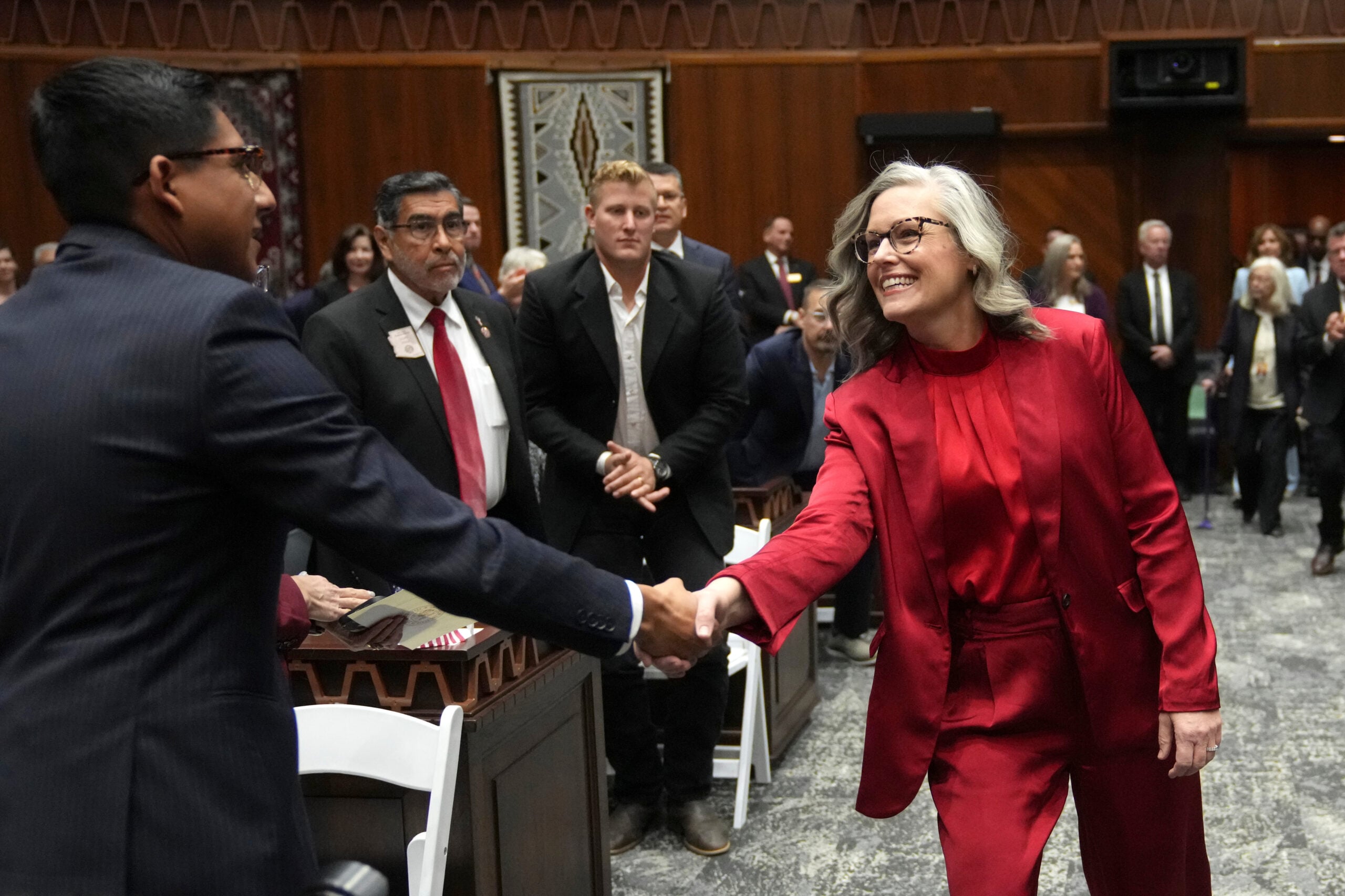
Democrats have made sweeping gains in state legislatures across the United States, flipping more than 500 seats and taking control of at least a dozen chambers in a result that will reshape policy and political power for years.
The party established new governing trifectas in Michigan, Arizona, Pennsylvania, Minnesota, Wisconsin and Nevada, while capturing legislative chambers in Texas, Georgia and North Carolina – states that have long been dominated by Republicans.
Democrats also strengthened their grip on traditionally liberal states including New York, California and Illinois. Their victories give them greater scope to pursue policies on housing costs, public education, taxation, artificial intelligence and the drawing of electoral boundaries.
Heather Williams, president of the Democratic Legislative Campaign Committee, described the result as a historic opportunity. “We had a generational opportunity to shift the power in our states and to affect change and we did just that,” she said. “We ran the table. It’s amazing.”
The scale of the gains is the largest for either party since the post-Watergate election of 1974. In New York, Democrats are on course for their biggest state Senate majority since 1846, while in Texas they have won the state House for the first time since 2002.
Arizona is set to have its first Democratic trifecta since the 1960s. Democrats also regained control of Georgia’s House, the first chamber in the Deep South that the party has taken back in the modern era.
The result marks the most significant shift in state capitals since Republicans won nearly 700 legislative seats and flipped 20 chambers in 2010. Those victories enabled Republicans to advance conservative policies and redraw legislative maps in their favour across much of the country.
In Wisconsin, Republicans used their control of both chambers and every statewide office to pursue a far-reaching conservative agenda. Democrats have now flipped both legislative chambers in the state.
Greta Neubauer, the Wisconsin Assembly minority leader who is expected to become speaker next year, said the party would use its new authority to demonstrate the impact of Democratic government. “We are going to use this power to deliver for the people of our state and demonstrate that government can be a force for good in their lives and things are different when Democrats are in charge,” she said.
Democrats face pressure to deliver in state capitals
The party’s advance has been building over several election cycles. Democrats gained 31 seats in special elections and in Virginia’s 2025 legislative elections after Donald Trump returned to the White House. They now control a narrow majority of at least 51 state legislative chambers, compared with 29 when Mr Trump first took office in 2016, according to the DLCC.
However, the newly empowered lawmakers will face voters dealing with rising financial pressures and frustration with government, regardless of party affiliation.
In Minnesota, Democrats increased their Senate majority by five seats and won control of the House. Republican strategist Gregg Peppin said the result reflected greater anger towards the president than towards fraud scandals that had occurred under Democratic governance in the state.
“Clearly we found out they were more fed up with Donald Trump than they were with fraud,” Mr Peppin said. “Everybody’s just worn out from the guy, I think Republicans too. It’s just time to turn the page.”
Arizona Democrats are preparing an extensive programme after decades out of power. Oscar De Los Santos, who is expected to become speaker of the House when lawmakers return to Phoenix next year, said the party had “sixty years of pent-up ideas” that it had been unable to advance.
Proposed measures include preventing corporate landlords from buying homes, restricting surveillance-based pricing and tackling the state’s water shortages. Mr De Los Santos also said Democrats would target Saudi-owned farms accused of using Arizona’s water to grow alfalfa for export.
Another priority is to rein in the state’s universal education voucher programme, which allows public money to be used for private school fees and other education-related costs. Mr De Los Santos alleged that funds had been spent on ski trips, kitchen renovations and lingerie, saying the scheme was “out of control” and that money should instead be directed towards public schools.
Democrats also expanded their majorities in states where they already controlled the government. In Illinois, the party gained at least eight General Assembly seats, including six held by sitting Republicans and two vacant constituencies.
The victories are expected to give Democrats 84 of the 118 seats in the Illinois House and 45 of the 59 seats in the Senate. Republican state representative Dan Ugaste, who lost his seat in Chicago’s western suburbs, said the result would reduce the pressure on Democrats to seek support from the political centre.
“It means Democrats don’t have to try to work toward the middle [on legislation], which is really where the vast majority of the electorate is,” Mr Ugaste said. He attributed the losses partly to stronger Democratic turnout and dissatisfaction with the economy and the Trump administration.
In California, Democrats are expected to add at least four seats to their already dominant Assembly majority. In New York, they are on course to gain at least 14 more seats, giving them control of 158 out of 213 across the legislature.
The results will also influence the next phase of the battle over electoral maps and could strengthen support in state legislatures for a presidential election system based on the popular vote.
Ms Williams said the victories would give Democratic state lawmakers an important role in defining the party’s direction ahead of 2028. “We need to begin to show everyone what Democrats are made of and what we’re able to accomplish and how we lead,” she said.
