


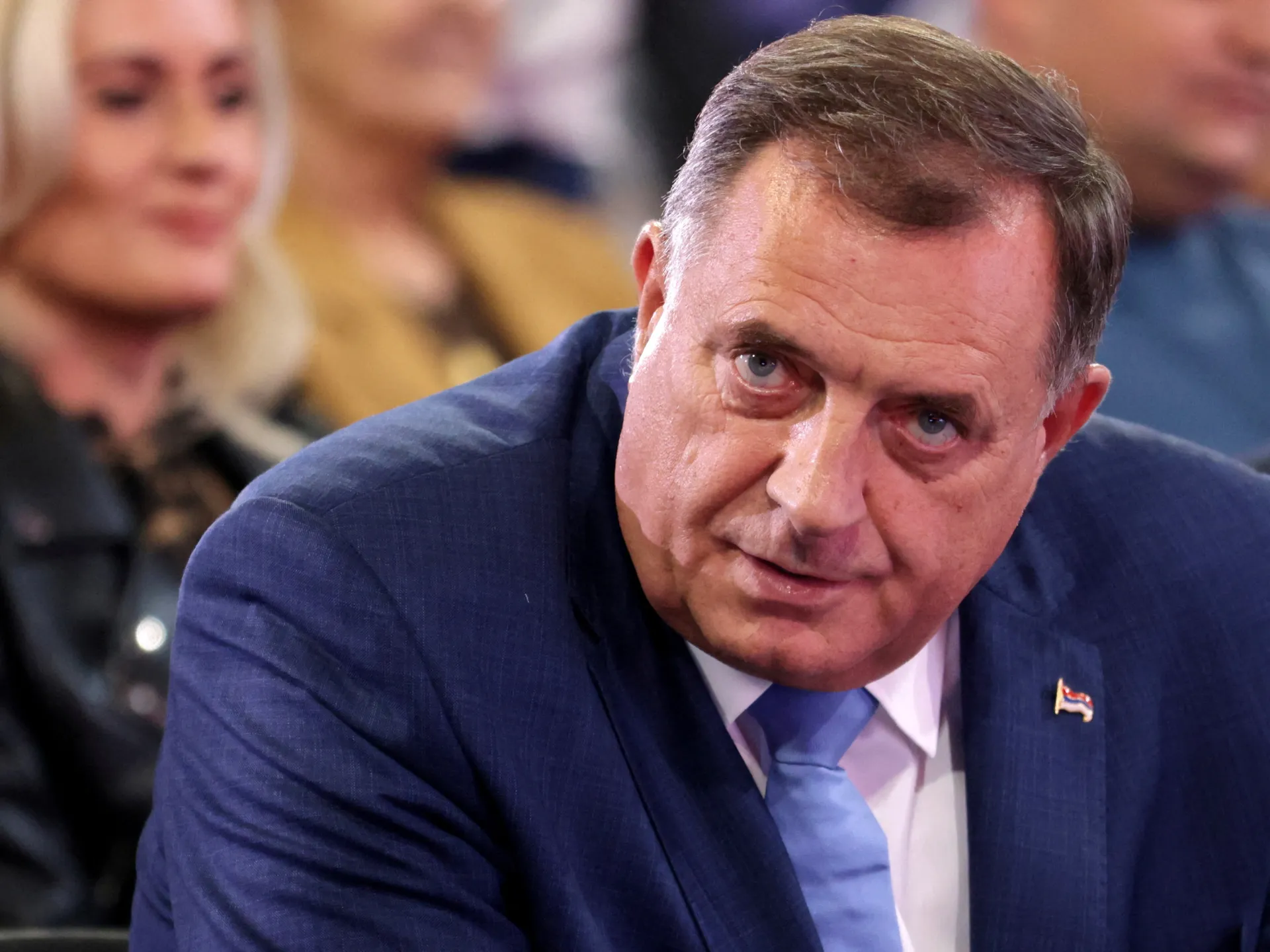
Bosnian Serb leader Milorad Dodik has declared Bosnia and Herzegovina “dead” at a final election rally, renewing his attacks on the country’s constitutional order and prompting warnings that his rhetoric forms part of a prolonged political escalation.
Addressing supporters of his right-wing Alliance of Independent Social Democrats (SNSD) in Banja Luka on Friday, Mr Dodik said: “Bosnia-Herzegovina is dead. It is an impossible country, it makes no sense.”
He described the country as “nothing more than an empty shell” for those seeking to keep it alive, adding that he believed they were trying to prove themselves right.
The remarks came before voters cast ballots on Sunday to elect the three members of Bosnia and Herzegovina’s multiethnic presidency, representatives to the national parliament and leaders of institutions in its two entities.
Dodik rhetoric described as populist
Bosnia remains divided over its political future more than three decades after the 1995 Dayton peace agreement ended the 1992-95 war. The accord established a power-sharing framework between Muslim Bosniaks, Orthodox Serbs and Catholic Croats, and divided the country into the Serb-majority Republika Srpska and the Federation, where most Bosniaks and Croats live.
Mr Dodik was not standing in the election. He was stripped of his post last year after being convicted of refusing to carry out decisions issued by Christian Schmidt, the international peace envoy overseeing implementation of the Dayton agreement.
Elvis Fejzic, a professor at the Faculty of Political Science in Sarajevo, dismissed efforts by politicians such as Mr Dodik to dismantle Bosnia and Herzegovina as “populist rhetoric”.
He said the country’s status as a United Nations member and internationally recognised state was secure, arguing that politicians and parties acting unconstitutionally could not determine its future.
“Bosnia and Herzegovina … will outlive all those who, through inflammatory statements, seek to obstruct its path towards integration and development,” Mr Fejzic said. “Their statements have no political relevance whatsoever.”
Political analyst Tanja Topic said that although Mr Dodik was not a candidate, he remained central to the campaign and was seeking to portray himself as a “senior official in international relations”.
Warnings over a long escalation
Adnan Cerimagic, a senior analyst at the European Stability Initiative, said Mr Dodik’s comments should be taken seriously as part of a “long escalation”, rather than simply as a description of Bosnia’s current reality.
He said Mr Dodik’s actions against the Dayton order and Bosnia’s European Union and Nato path had reached a dangerous level over the past four years. In March 2025, Bosnia came close to an armed standoff between Republika Srpska and state police, Mr Cerimagic said.
He also accused Mr Dodik of presenting Bosnia as a frontline in an alleged conflict between Christianity and Islam, and himself as a defender of Christian Europe. Mr Cerimagic said the approach was directed at the people in Europe against whom a genocide had been committed since the Second World War and recognised as such by two international courts.
Mr Cerimagic said the rhetoric could reflect uncertainty about the electoral prospects of Mr Dodik’s preferred candidate, as well as a belief that the European Union had less influence over Bosnia than previously.
Election results are expected to be released initially by the Central Election Commission late on election night and updated as further votes are counted. The final official results must be published by November 20 at the latest.
