


Demand for live music, sport and high-value art is rising as consumers and investors place a premium on experiences that cannot be reproduced by machines. The trend has given fresh relevance to the work of Walter Benjamin, the German-Jewish critic whose ideas about art’s “aura” were developed in exile in the 1930s.
Benjamin argued that an original work possessed something beyond its appearance: a unique presence tied to a particular time, place and history. Reproductions could show the image, he believed, but could not carry the same authenticity.
That argument is now being applied to an economy increasingly filled with instantly generated images, music and written material. For executives and investors, the scarce commodity is becoming the experience that still requires people to be physically present.
Why live experiences are gaining value
Michael Rapino, chief executive of Live Nation, made the case on November 5 as the concert company reported third-quarter revenue of $10.1 billion, up 19% on the previous year. Attendance also rose 19%, to 61 million fans.
Live Nation had sold 170 million tickets by the end of October, already exceeding the total for the whole of the previous year. The company expects nearly 180 million fans in 2026 and says it is on course for another record year, with double-digit growth expected to continue for years.
“In a world of endless screens and AI-generated everything, the one thing that can’t be replicated is being there,” Rapino said.
A Live Nation spokesperson added: “You can’t stream or replicate the energy of thousands of fans singing together as they watch their favorite artist. Being there in person is irreplaceable, and that’s driving global demand for live music.”
The idea has also entered popular culture. Dictionary.com defines “aura farming”, a trend that went viral on TikTok in 2025, as doing things with deliberate coolness, confidence or mystique. Its popularity began with a video of an Indonesian boy dancing on the bow of a racing boat.
Benjamin’s “aura” was a more serious concept. He described authenticity as everything an object carried from its beginning, including its duration and the history it had experienced. “The presence of the original is the prerequisite to the concept of authenticity,” he wrote.
He distinguished between “cult value”, attached to an original created for ritual and sometimes kept hidden, and “exhibition value”, attached to work that could be displayed to as many people as possible. As mechanical reproduction made art easier to distribute, he argued, exhibition value began to displace cult value.
In today’s market, however, the abundance of reproducible material is helping to make scarcity valuable again. The premium is moving towards events, objects and places that cannot simply be copied and viewed on a screen.
Art, sport and the price of authenticity
The global art market grew by 4% to an estimated $59.6 billion in 2025, although it remained below its 2022 peak. Growth was concentrated at the top end, with the value of fine-art lots worth more than $1 million rising 21% and sales above $10 million increasing 30%.
By contrast, sales of works priced below $50,000 fell 2%. Online art sales dropped to $9.2 billion, their lowest level since 2019, as collectors placed greater emphasis on owning and encountering significant originals.
Sport has similar characteristics. A franchise, with its fixed number of teams, venues and seats, carries the accumulated history of the games played there. Private-equity deals involving teams increased from 50 in 2018 to 192 in 2025.
The Los Angeles Lakers were valued at $360 million in 2000 and sold at a valuation of $10 billion in 2025. Streaming now accounts for about 20% of the sports media market, compared with 8% in 2021, but the limited supply of seats at major fixtures continues to support premium prices.
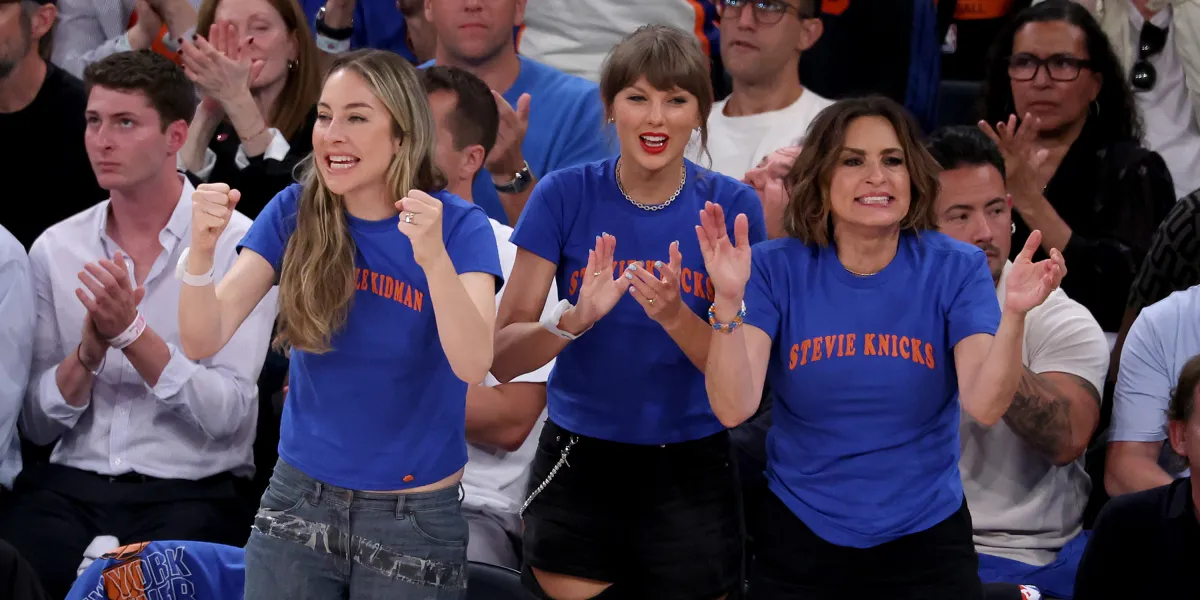
The New York Knicks’ historic title in 2026, their first in 53 years, was accompanied by record ticket prices. The cheapest seats for Games 3 and 4 at Madison Square Garden were listed at $3,876 and $3,609 respectively.
Music has generated a similar willingness to pay for physical presence. Taylor Swift’s Eras Tour grossed an estimated $2.2 billion across 149 shows between November 2022 and December 2024, selling just over 10 million tickets.
The concerts also boosted local tourism. In its July 2023 Beige Book, the Philadelphia Federal Reserve recorded that the city’s strongest month for hotel revenue since the pandemic began had been driven in large part by visitors attending Swift’s concerts.
Sports and music tourism is expected to double to about $1.5 trillion by 2032. Women’s sport, meanwhile, has seen game-day revenue rise from 11% of the business in 2022 to 30% in 2026, while sponsorship’s share fell from 64% to 45%.
From streaming to physical ownership
The resurgence of vinyl offers another example of the appeal of a tangible original. Although recorded music can be reproduced and distributed at very little cost, US vinyl sales increased for a 19th consecutive year in 2025, passing $1 billion for the first time since 1983.
Vinyl generated more than three times the revenue of CDs. The best-selling release was Taylor Swift’s The Life of a Showgirl, with about 1.6 million copies sold.
Broadway also grossed $1.91 billion in the 2025-26 season, up 1% despite the previous season having run for an additional week. Total admissions reached 14.6 million.
Even writing, which can now be imitated with increasing ease, is being given markers of human provenance. The Authors Guild launched a “Human Authored” mark in January 2025 for books written by people and opened the scheme to the public in March 2026 at a cost of $10 per book for non-members.
“Readers have the right to know if a text was written by AI or a human,” the Guild said.
Benjamin did not see the loss of aura as entirely negative. Writing from a Marxist perspective, he believed mechanical reproduction could emancipate art from its dependence on ritual and make it accessible to ordinary people.
His 1935 essay, The Work of Art in the Age of Mechanical Reproduction, attracted little attention during his lifetime before gaining influence in left-wing European journals and later through its 1968 English translation. Hannah Arendt selected it for her collection Illuminations and wrote its introduction.
Benjamin fled Germany in 1933 and spent much of the decade in exile, including in Paris, where he worked on an unfinished history of the city’s 19th-century shopping arcades. In September 1940, after crossing the Pyrenees into Spain with refugees, he was told by Franco’s police that the group would be returned to France. He was found dead in his hotel in Portbou the following morning.
His death was officially ruled a suicide, although local people have long questioned that conclusion. The rest of the group was allowed to continue into Spain the next day.
More than eight decades later, Benjamin’s theory is being used to explain why the value of being present may rise as more content becomes easy to reproduce. His essay remains freely available, while the experiences it helps describe are becoming increasingly expensive.
