


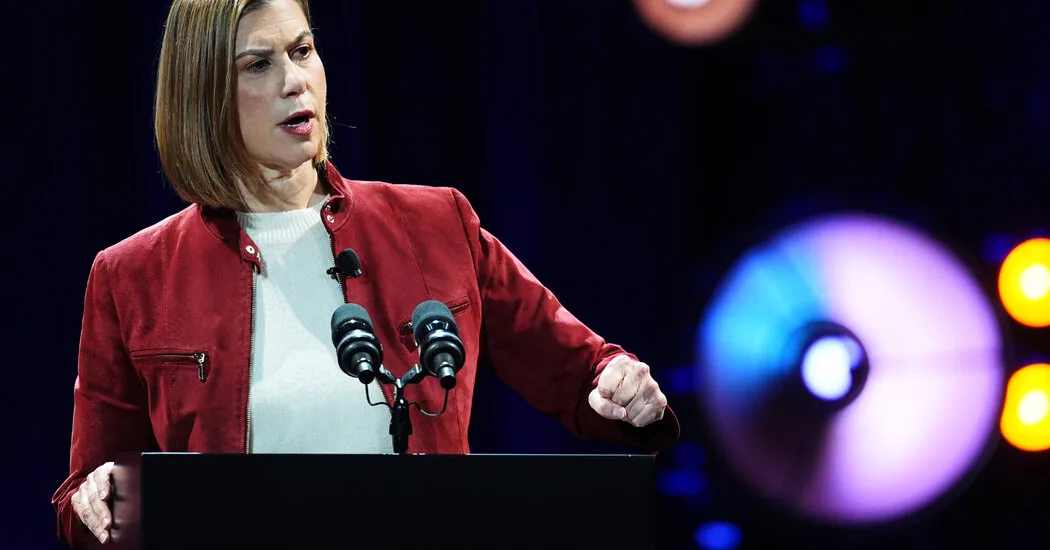
More than 3,000 Democratic strategists, activists, lawmakers and potential presidential candidates gathered in Denver as the party sought to build on sweeping midterm election gains and prepare for a fiercely contested 2028 presidential race.
Democrats flipped at least eight Senate seats and secured what could be the largest House majority for either party in three decades. At a welcome event, Hakeem Jeffries, the New York congressman expected to become speaker, told supporters: “America is back.”
The three-day gathering, hosted by the Majority Democrats organisation, offered an early glimpse of the party’s next generation of contenders. More than half a dozen possible presidential candidates appeared, although none was formally campaigning.
Josh Shapiro, the governor of Pennsylvania, shared the main stage with Elissa Slotkin, the Michigan senator, while Ruben Gallego of Arizona waited nearby to speak to reporters. Raphael Warnock of Georgia addressed the gathering before staying to hear Cory Booker of New Jersey, while Pete Buttigieg, the former transport secretary, was also in demand.
The crowded programme underlined how quickly the contest for the Democratic nomination is taking shape. Advisers linked to governors JB Pritzker of Illinois, Andy Beshear of Kentucky and Wes Moore of Maryland were also circulating in Denver, while Gavin Newsom of California was absent at a climate summit in Turkey.
Shapiro sets out his vision for the Democratic Party
Mr Shapiro used his appearance to outline an ambition for a broader electoral coalition. Democrats, he said, should aim to win 370 electoral votes rather than simply the 270 required for the presidency.
“We can’t be a party that is focused on sloganeering,” Mr Shapiro said. “We have to be a party that’s focused on real deliverables.”
He also warned against becoming distracted by ideological tests, saying Democrats should not focus on deciding “where someone fits on some imaginary political spectrum”.
His comments came as progressive voices continued to challenge the influence of wealthy donors. Ro Khanna, a California congressman considering a presidential bid, called for a wealth tax on billionaires and accused Israel of genocide, drawing cheers from the audience. The Majority Democrats conference is chiefly funded by hedge-fund billionaire Stephen Mandel and his wife, Sue.
Elissa Slotkin says she is seriously weighing a 2028 bid
Ms Slotkin gave the clearest indication yet that she could seek the Democratic nomination, saying she was “seriously” considering a run.
Most of the potential candidates discussed in Denver were men, including Mr Shapiro, Mr Gallego, Mr Warnock, Mr Booker, Mr Khanna and Mr Buttigieg. Former vice-president Kamala Harris and New York congresswoman Alexandria Ocasio-Cortez were among the other women who could enter the contest.
Ms Slotkin said gender alone would not be a reason to run, but added: “I would hate to see us go backwards by having no women enter the fray.” She later said she wanted to be part of the next generation of leaders, while adding that this did not necessarily mean becoming “the top dog”.
The 2028 primary timetable is also set to look markedly different. South Carolina, Nevada, New Hampshire, New Mexico, Michigan and Virginia will open the Democratic calendar, replacing the traditional sequence in which Iowa and New Hampshire led the voting before South Carolina.
Officials in Michigan, Virginia and New Mexico were already seeking to attract would-be candidates at the Denver event. Don Scott, Virginia’s House speaker, said he had urged Mr Buttigieg to begin meeting local leaders if he wanted to compete in the state, which will hold the final primary before Super Tuesday.
Democrats turn to attention, media and party control
Ms Slotkin said candidates would need to be compelling in a rapidly changing media environment. “The way citizens consume presidential elections is fundamentally changing,” she said. “I’m not sure we’ll ever have a boring president ever again.”
She pointed to Abdul El-Sayed’s success in Michigan and said the party had debated whether paid advertising mattered as much as generating organic attention through social media. “You can have all the great policy papers you want,” she said. “If you can’t convey authentically, that’s going to hold you back.”
There were also signs of unease with the Democratic establishment. Jeffries was repeatedly heckled during an appearance with Jessica Tarlov, a co-host of Fox News’s The Five, and dismissed the interruptions by noting that he was from Brooklyn.
Meanwhile, Chris Van Hollen arrived after announcing an underdog challenge to Chuck Schumer as the Senate’s top Democrat. He received loud cheers when he repeated his intention, though his prospects were described as unlikely. Mr Van Hollen said he had “a record of running against the establishment”, while acknowledging that he had chaired both the House and Senate Democratic campaign arms.
The possible presidential contenders and their prospective staff agreed that decisions could not be postponed for long. Mr Shapiro suggested he might announce his plans before attempting to deliver an ambitious programme during the first 100 days of Democratic state legislative majorities. Ms Slotkin said she would decide early next year.
Mr Warnock, who may have to choose between a presidential campaign and seeking re-election to the Senate in 2028, put the timetable bluntly: “I don’t think there’s much time for anybody who thinks they want to do this.”
