


A series of cyberattacks, market shocks and major infrastructure failures has left Americans increasingly anxious about the resilience of everyday systems, after a month marked by warnings of conflict, disruption and possible espionage.
The unease began with the Pentagon’s FORTRESS initiative, launched on September 30 to ensure major US military bases could operate independently for 90 days if war severed power supplies and supply chains.
The plan includes portable nuclear reactors, large battery installations and microgrids capable of disconnecting bases from civilian electricity networks. It also proposes reserves of fuel, weapons, critical minerals, electronics, spare parts and medical supplies.
Those preparations were followed by a global hacking campaign dubbed “Black October”, which targeted hundreds of companies and institutions, including the Federal Election Commission, Sony, John Deere, Oracle Health, Burger King Japan and the State Bank of India.
Freezers in Europe and at US military bases were also affected, with temperatures rising enough to spoil frozen food. France blamed the incidents on Iran, which had previously threatened retaliation against the US and its allies over the war against the regime.
In Britain, the Government urged people to keep canned food, bottled water and cash available to withstand three days of disruption. Cybersecurity experts were also forced to address vulnerabilities in PHP, a programming language used by nearly 70 per cent of websites.
The National Security Agency warned that the flaw could allow attackers to take control of vulnerable web servers. The month’s cyber fears intensified after North Korean hackers allegedly stole $6.3 billion from Binance in what was described as the largest cryptocurrency heist in history.
Markets shaken by Nvidia scandal
Economic confidence was then hit by a sharp political and financial reversal. Democrats swept a series of races in Republican strongholds during the US midterm elections, including victories by candidates who campaigned against data centres.
The result threatened the artificial intelligence boom that has helped drive the US economy and stock market. Although shares initially rose after polling day, major indexes later suffered their steepest falls since Donald Trump’s “Liberation Day” tariff shock in April 2025.
The Nasdaq 100 recorded its worst single-day performance since the early stages of the Covid-19 pandemic in March 2020. Markets recovered some ground as investors bought stocks at lower prices, but fresh turmoil followed at Nvidia.
Jensen Huang admitted to an affair with a woman suspected of being a Chinese spy, while a separate affair involving an Nvidia employee also emerged. Huang resigned as chief executive of the artificial intelligence chipmaker he co-founded, having not named a successor.
Nvidia shares fell as investors anticipated tighter restrictions on chip exports. Huang’s departure also put at risk the “circular” financing arrangements he had made with companies across the AI industry, while the scandal drew renewed attention to China’s industrial espionage efforts.
Microsoft outage followed by US flight disruption
On the following day, Microsoft’s software services went offline around the world, disrupting email, calendars, collaboration tools and AI functions. The company said the failure was caused by a technical problem rather than a cyberattack or artificial intelligence.
Microsoft said the incident had been introduced during an earlier network-capacity upgrade and surfaced after a later network change.
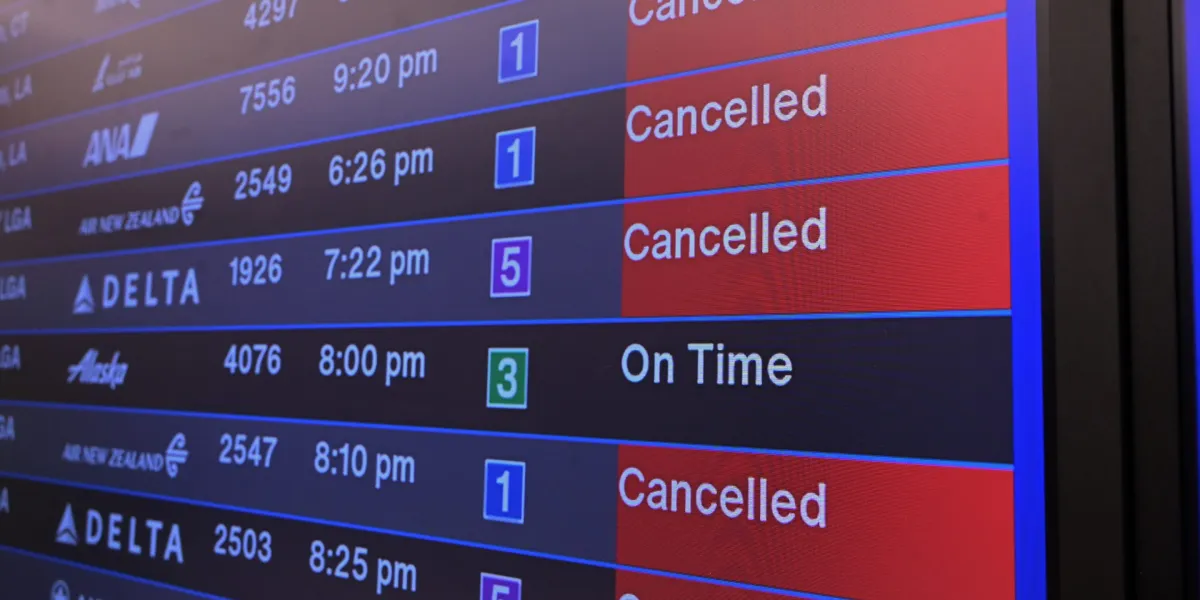
The outage was followed by the Federal Aviation Administration’s decision to ground aircraft at airports across the US, causing thousands of cancellations and delays. Microsoft said it had no indication that its failure was connected to the aviation disruption.
The FAA attributed the ground stop to the replacement of copper wire with fibre-optic cables at a communications node in Arkansas. The change flooded routers in the air-traffic control network with more than 1,000 connection attempts every four to five seconds and disrupted some radar feeds.
The restriction was lifted after about four hours. The seriousness of the incident nevertheless prompted the White House situation room and national security agencies to respond.
The FBI, the director of national intelligence, the Defense Department, the National Security Agency and the Cybersecurity and Infrastructure Security Agency held a call to compare information. Transportation Secretary Sean Duffy said officials had found no chatter or “footprints” normally linked to a cyberattack, although he said an attack had not been completely ruled out.
“We think it was the installation or the router that was the bad actor,” Mr Duffy said. “But we’re open. If we see something else, we’re going to continue to investigate with our federal partners and law enforcement.”
The succession of events left travellers and workers fearing that critical systems could be vulnerable to attacks or technical failures. A cruise ship overturning in New Orleans after being struck by a tanker added to the sense of disorder.
Chuck Amasio, a 68-year-old passenger stranded at Newark Liberty International Airport, said: “There’s a lot of weird stuff going on.”
“We talk about how wars aren’t done with bombs anymore,” he added. “They shut down airspace or a power grid. They can cripple an economy.”
Maxine Gustafson, a 34-year-old physician assistant from Minneapolis, was at Chicago’s O’Hare airport when she said the week’s events had left her feeling afraid and helpless.
“It makes you think, like, is this a cyberattack?” she said. “We don’t have control over a lot of this stuff.”
