


Democrats are showing signs of a potential blue wave in the 2026 election, with recent national polling placing the party more than eight points ahead on the generic congressional ballot.
Such a margin would represent a sweeping improvement on the 2024 result, when Donald Trump won the presidential vote by 1.5 points and Republicans secured the national House popular vote by almost three points.
A wave election has no formal definition. It generally describes a decisive victory in which a party wins the main battlegrounds while also overturning districts and seats that had been considered safely held by its opponent.
The latest polling suggests Democrats could be approaching that territory. A Times/Siena poll put the party 8.5 points ahead, while surveys by Quinnipiac University, Marquette University Law School and YouGov/Economist recorded double-digit Democratic leads.
Democrats’ position has strengthened as pollsters have shifted towards measuring likely voters rather than all registered voters. The Marquette and YouGov/Economist surveys found the party performing six points better among likely voters, while the Times/Siena poll showed a two-point improvement.
What a blue wave could mean for 2026
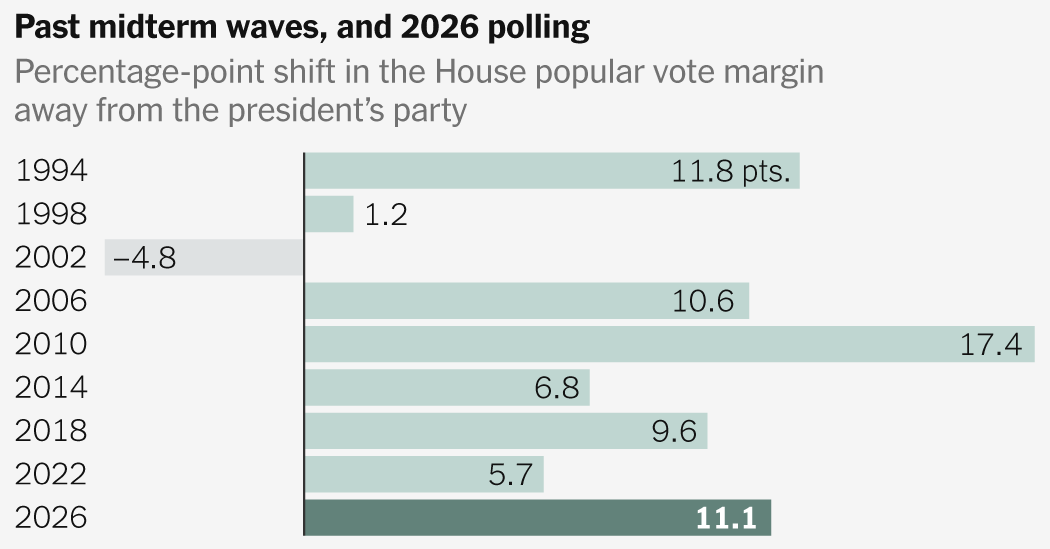
If Democrats were to win the national vote by about 8.5 points, the result would broadly match the 2018 Democratic wave and exceed the margins associated with other recent wave elections in 1994, 2006 and 2010.
It would also amount to an 11-point swing from the 2024 result. That would be comparable with the Democratic gains seen in 2006 and 2018, although smaller than the 17-point shift towards Republicans during the 2010 election.
On that basis, Republican-held states and congressional districts where Mr Trump won by 10 points or less would be expected to become competitive. Recent state and district polling has already shown Democrats ahead in a number of contests.
James Talarico led in every public Senate poll released in Texas during the past week, including a survey conducted by Siena in partnership with ReconMR. Democrats also led in high-quality Senate polling in Alaska and Kansas.
Republicans’ stronger performances were concentrated largely in traditionally Democratic-leaning northern states, including Minnesota, New Hampshire, Maine and Michigan. Democrats generally led those Senate surveys, but the results were less suggestive of a national wave, including one non-partisan poll showing a tied race in Minnesota.
Candidate quality and local campaigns can still affect individual contests. Democrats’ reported gains among Hispanic voters may also be helping the party disproportionately in heavily Hispanic areas, which could explain part of its strength in Texas.
The same gains may be less pronounced in states where Hispanic voters make up only a small share of the electorate. Democrats have appeared to underperform in some of those traditionally blue states despite their wider national advantage.
A strong Democratic performance would not automatically secure control of the Senate. Only one-third of Senate seats are contested in any election cycle, and the party would need to overturn at least two states where Mr Trump won by 11 points or more.
Recent polls have nevertheless placed Democrats ahead in at least four such states. Winning them would remain difficult, but that scale of potential breakthrough is characteristic of a wave election.
