


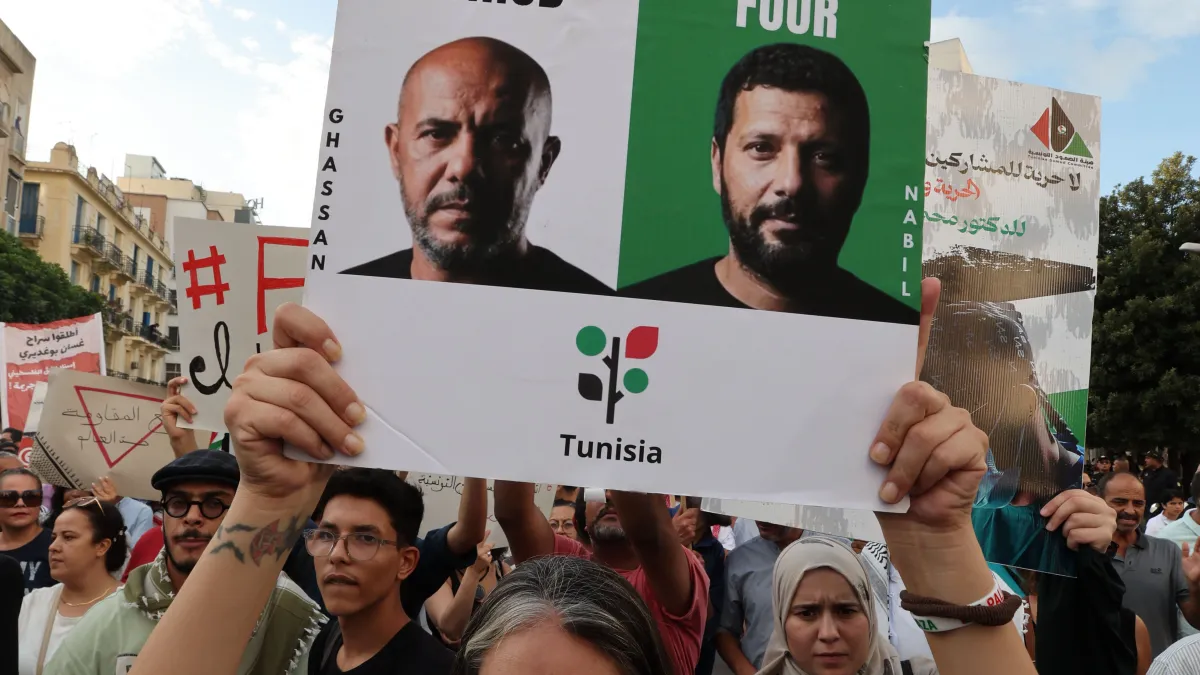
Tunisian courts have rejected an appeal against the continued detention of four activists linked to the Global Sumud Flotilla, as relatives warn that the men’s health is deteriorating and their families are struggling to cope.
Wael Naouar, 41, was taken to hospital after beginning a hunger strike on August 16 in protest at his detention. He suspended the strike after 38 days following appeals from lawyers and supporters, but said the decision did not mean he had abandoned his demands.
The Court of Appeal in Tunis rejected a challenge to a further four-month extension of pre-trial detention on Wednesday. Ghassan Henchiri, Ghassan Boughdiri and Nabil Channoufi remain on hunger strike.
Health concerns for detained flotilla activists
Naouar’s father, Hichem, said his son had been struggling to see clearly and keep water down without vomiting during a recent prison visit. He also described him as dizzy, with difficulty controlling his left leg.
Naouar was sitting with his hand against his cheek, his elbow trembling and his gaze fixed in the distance, his father said. Other prisoners had told Wael that he sometimes woke during the night calling out the name of his youngest daughter.
Henchiri’s father, Sebti, said his son remained conscious but was visibly exhausted after being on hunger strike since September 9. He said the activist had not been taken outside prison for further medical examination of a head injury sustained during his detention in Israel.
Sebti said his son also had one kidney, suffered from back problems and had developed a skin rash that was preventing him from sleeping. A request to see a dermatologist had been rejected because the prison doctor did not consider the condition serious, he said.
“I will remain steadfast, I will not give up my right and these malicious accusations are false,” Ghassan told his father, according to Sebti.
The four men have been held since March during an investigation by Tunisia’s Economic and Financial Judicial Pole, which handles alleged financial and economic crimes. The inquiry concerns the origin and use of money raised for the Global Sumud Flotilla, an international campaign seeking to deliver aid to Gaza and challenge Israel’s blockade of the territory.
Judicial sources cited by the state-owned TAP news agency said investigators were examining whether any funds had been diverted for other purposes. The activists and their defence team deny wrongdoing and maintain their innocence. None of the four has been convicted.
Ghassan Ghribi, a member of the defence committee, said the extension of detention was an “exception to the exception”, arguing that freedom should be the rule and detention the exception.
He said the investigating judge had spent six months on the case without carrying out investigative work beyond questioning the activists. The defence argues that the men should not remain in prison while the investigation continues.
The government has rejected accusations that the judiciary is being used to silence opponents, saying the judiciary is independent and that proceedings are conducted according to the law.
Families affected by the detentions
Naouar’s nine-year-old son, Yassar, tries not to cry during prison visits because he fears upsetting his father. His grandfather said the boy had begun waking up screaming at night, sleeping beside his mother and performing worse at school.
When Yassar told his mother that other children had asked whether his father was a thief, she asked what he thought. “Never,” the boy replied.
Naouar’s four-year-old daughter, Sumud, does not understand why her father is in prison. During one visit, she tried to embrace him through the glass and hit her head against the barrier.
Fourteen people detained after a September 19 protest calling for the activists’ release have also been placed in pre-trial detention, according to lawyer Rafed Rabbeh. One of them is a 17-year-old who was brought before a juvenile judge.
Rabbeh said the detainees faced charges including participating in a gathering allegedly intended to disturb public order and commit an offence, publicly attributing unlawful acts to a public official without proof, and making statements considered damaging to the reputation of a person or official body.
For the families, the detentions have brought anxious phone calls, prison visits and children asking when their fathers will return. Yassar has told his grandfather that he is ready to go on hunger strike too.
Asked where her father was, Sumud answered: “Palestine. Prison”.
