


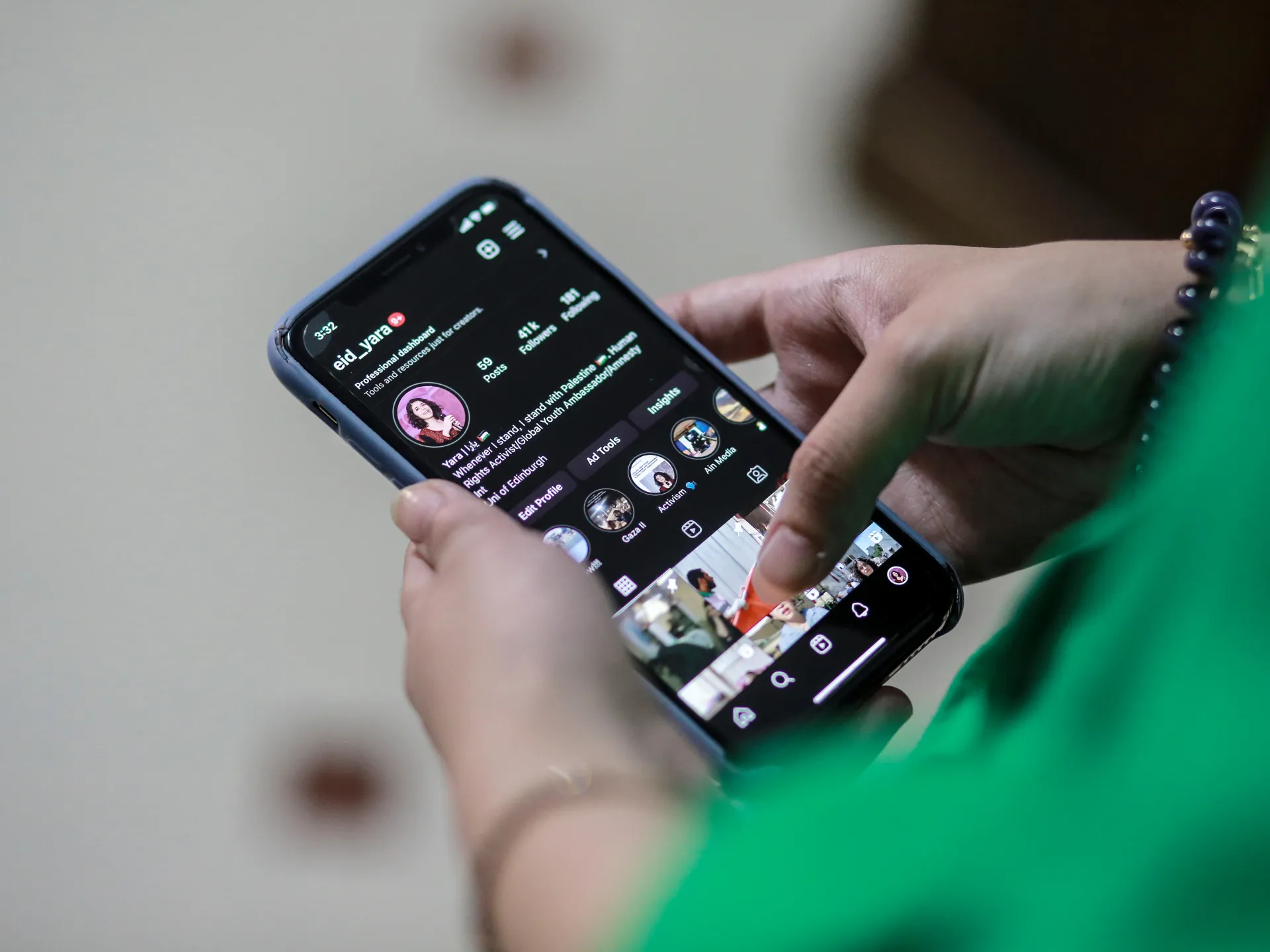
Social media suppression of Palestinian voices during Israel’s war in Gaza has raised concerns that testimony may remain online while being made increasingly difficult to find, share and remember. Journalists and digital rights campaigners say the process, described as “Echoicide”, can weaken the reach of evidence without deleting it outright.
The term refers to the way posts can be removed, accounts suspended or recommendations reduced, while users may also change their language or avoid publishing material because they fear penalties. The result, critics argue, is that a message survives online but reaches a smaller audience.
Palestinian journalists and citizen reporters became central to documenting events in Gaza after Israel intensified its siege in October 2023 and foreign journalists were barred from entering the enclave. Their work has included footage of civilians killed or injured, people living under fire and alleged war crimes.
Human Rights Watch has documented cases in which Instagram removed images and videos showing Palestinian civilians killed or injured in Israeli attacks, citing Meta’s rules on “violence and incitement”.
Ahmed Shihab-Eldin, a Palestinian journalist with more than 1.1 million Instagram followers, has used the platform to share firsthand accounts from Gaza, including videos of Israeli soldiers allegedly committing war crimes and footage of US senators appearing unmoved by the suffering.
He said posts and images had subsequently disappeared or seen their reach sharply restricted without explanation.
“Some of my posts, particularly the ones in which Israeli soldiers were incriminating themselves, have been used by South Africa in its genocide case against Israel at the International Court of Justice,” Shihab-Eldin said.
“People were flocking to my profile in the tens of thousands. And because of that, Meta made my page disappear several times and then started severely shadow-banning accounts like mine that were central to the documentation process.”
How social media reach can be reduced
Leila Warah, a journalist based in the occupied West Bank, said her Instagram account had been suspended and restored several times during the war. She argued that the problem went beyond the operation of algorithms and included the way audiences responded to what they saw.
“The bigger issue goes beyond algorithms and shadow-banning. A viewer can watch footage from Gaza, feel affected by it and then close the app and go back to their life,” Warah said.
“Palestinians living through what appears on those screens do not have that option. Even when the content reaches people, the more important question is: What happens after you press share?”
Jillian York, a London-based writer, activist and teacher with the Electronic Frontier Foundation, said digital censorship was often difficult to identify because material did not necessarily vanish.
“Algorithmic censorship doesn’t need to erase testimony. It can leave it online while gradually stripping it of reach, discoverability and an audience,” she said.
Smartphones, livestreams, satellite imagery and social media have enabled people around the world to witness conflicts in real time. But the uneven visibility of wars has prompted questions about why some suffering generates sustained attention while other crises remain hidden or lose their political force.
Concerns about the treatment of Palestinian content predate the current war. In 2021, Meta’s Oversight Board recommended an independent review of whether Facebook had applied its moderation policies fairly to Arabic and Hebrew content.
Meta commissioned Business for Social Responsibility to examine the issue, including the role of automated systems. The review found no evidence that employees had deliberately sought to benefit or harm one community, but acknowledged unintended consequences for Palestinian and Arab users, including concerns about freedom of expression.
The process of deciding what is seen online does not depend on a single person ordering that a particular voice be silenced. Engineers can alter how posts are ranked, policy teams can revise moderation instructions and product teams can determine what is recommended.
Each decision may appear separate from direct censorship, but campaigners say their combined effect can determine which accounts gain an audience and which stories fail to travel.
Meta rejected Human Rights Watch’s allegation of systemic censorship in a statement issued in 2023, while acknowledging that errors had occurred and saying changes had been made to address them.
“But the implication that we deliberately and systemically suppress a particular voice is false,” a Meta spokesperson said. “Claiming that 1,000 examples, out of the enormous amount of content posted about the conflict, are proof of ‘systemic censorship’ may make for a good headline, but that doesn’t make the claim any less misleading.”
The company said moderation was based on breaches of its policies rather than users’ political views, and that its rules were intended to give everyone a voice while keeping its platforms safe. It did not directly address questions about whether the accounts or posts of Warah and Shihab-Eldin had been downranked or otherwise restricted.
Who controls the meaning of suffering?
Marwa Fatafta, the Middle East and North Africa policy and advocacy director at digital rights organisation Access Now, said the silencing of Palestinian voices could not be explained as a collection of isolated moderation mistakes.
“Proving systemic harm doesn’t require finding a Meta executive who deliberately pressed a button to remove Palestinian content,” Fatafta said. “In fact, Meta’s own human rights review after the Sheikh Jarrah protests confirmed arbitrary censorship, attributing it to structural policy flaws rather than explicit intent. But negligence is a choice, and so is how policies are designed, timed, and enforced.”
Rebecca L Stein, a cultural anthropologist at Duke University who studies visual politics and digital media in Israel and Palestine, said the treatment of images could also alter perceptions of who was vulnerable.
“The violence of the Israeli state was replaced by the ostensible violence of the Palestinian image. In the process, Israel was refigured as the war’s foremost victim,” she said.
Saree Makdisi, co-author with Ussama Makdisi of the forthcoming book Anti-Palestinianism, said the issue was not simply that Palestinian suffering was invisible. He described a “complex of narratives, distortions, carefully cultivated blind spots and forms of denial” that repeatedly subordinated it.
Powerful actors, he said, could invoke fear, insecurity and historical trauma to present violence against a less powerful group as defensive. At the same time, repeated suffering among marginalised communities could become so familiar that it was treated as a background story rather than the central crisis.
That dynamic has made Palestinian journalists and civilians particularly important in recording events in Gaza, where restrictions on access have limited the ability of outside reporters to work there.
Alana Hadid, an activist and creative director based in Los Angeles, said she had seen a sharp fall in views for posts about Palestine. Her Instagram analytics showed that fashion and other evergreen material received substantially larger audiences than her Palestine-related posts.
“We are not fighting simply to be heard. We are fighting for the right to tell our own story,” Hadid said. “We are not asking for permission to exist. We are insisting that we will not be erased.”
