


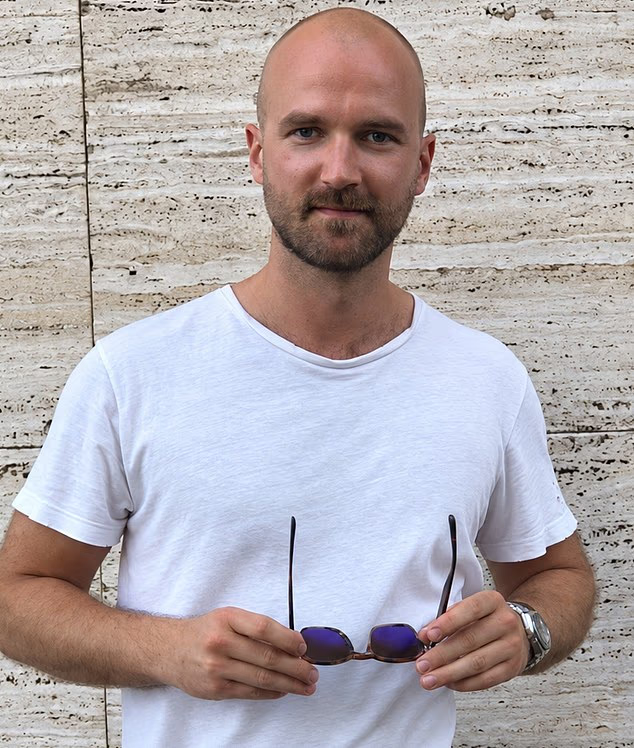
Niels Konradi was 23 when a family photograph on a Danish beach revealed how far his hair loss had progressed. The experience damaged his confidence and eventually led him to co-found Scandinavian Biolabs, a company developing plant-based hair products.
Konradi had worn his hair to his shoulders as a teenager while playing guitar in a band. But by the time he reached university in Copenhagen, he had a receding hairline and noticeable thinning at the crown.
He said he was the first among his friends to experience hair loss and struggled to find a hairstyle that concealed it. Jokes about his age and suggestions that he should visit a hair-transplant clinic added to his discomfort.
“From that point on, hair loss dominated my life,” he said.
Konradi’s then-girlfriend, now his wife, worked as a model, and he often accompanied her to fashion shows wearing a hat. He became increasingly aware of people looking at his hairline rather than his eyes during conversations.
Medication was not an option he wanted to pursue, while a transplant was beyond his means as a student. He said potential side-effects associated with treatments including minoxidil and finasteride also concerned him.
After becoming almost bald on top, he shaved his head completely. Although the decision initially felt liberating, he said it altered the way strangers perceived him.
Konradi, who is almost 6ft 6in and broad-built, said some friends and relatives barely recognised him. While working for a financial consultancy, he was given coaching on how to appear less intimidating during negotiations.
He also recalled being refused entry to a nightclub where his sister was celebrating her birthday because a bouncer assumed he might cause trouble.
“Not only did I feel self-conscious about my lack of hair, but I was having to check my personality all the time to counteract other people’s impressions,” he said.
Developing a hair loss treatment
In 2017, a friend introduced Konradi to scientists and researchers working on a plant-based approach to hair loss. He said he became involved in developing a serum containing laboratory-developed ingredients, including Capilia Longa, a form of turmeric intended to help reset disrupted hair-growth cycles.
He began using the serum himself every day. After five or six months, he said, he was able to have his hair cut for the first time in five years.
Konradi subsequently left financial consulting and co-founded Scandinavian Biolabs, which launched in 2020. Its Bio-Pilixin Activation Serum is applied to the scalp with a pipette and gently massaged in.
He said the product helped increase the density and strength of the hair where the follicles remained active. However, he stressed that it was not a guaranteed solution and that areas where the follicles were no longer functioning remained bald.
“Being in command of what my hair looks like was a complete game-changer for me,” he said.
Konradi’s mother later experienced rapid hair loss during the menopause and began wearing hats and wigs. He said she started using the company’s products and regained thicker hair, although it is now grey.
Scandinavian Biolabs is now sold in 100 countries, and its products were launched in more than 300 Boots stores in the UK this year. Konradi said the company continued to hear from people whose embarrassment about hair loss prevented them from leaving the house.
He said his own experience had shown him that hair loss could have a significant effect on confidence, even though his wife had always supported him and was pleased that he had hair again for their wedding photographs.
