


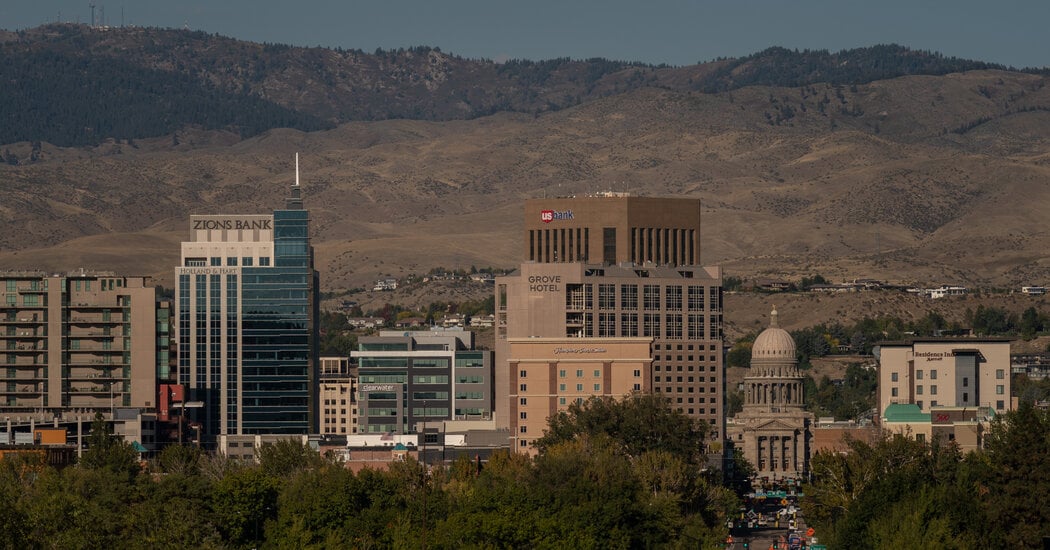
Supporters of an Idaho ballot measure to overturn one of the United States’ strictest abortion bans are campaigning primarily on the state’s shortage of doctors, rather than abortion itself.
Proposition 1, which voters will consider in November, would establish a right to abortion until fetal viability and afterwards in medical emergencies. It would also protect access to contraception and fertility treatment.
The campaign is presenting the measure as a response to wider healthcare problems in Idaho, where the number of doctors providing obstetric care has fallen sharply since abortion was criminalised four years ago.
A study published last year found that Idaho had lost 94 of the 268 physicians practising obstetrics when the ban took effect — a 35 per cent decline over the first two years, even after accounting for doctors who moved into the state. About half of Idaho’s 44 counties now lack a practising obstetrician-gynaecologist.
Healthcare professionals say the decline has led to longer waits, higher costs and reduced access to preventive care for women across the state, not only those who are pregnant.
“Most of what obstetricians do is not obstetrics,” said Dr Edward McEachern, who led the study. “It’s just taking care of women.”
Melanie Folwell, the proposition’s campaign manager, described the vote as a broader challenge to Idaho’s political direction. “This is the one way we have to say ‘enough’,” she said.
Idaho abortion ban at centre of ballot fight
Republican lawmakers and anti-abortion activists are focusing instead on the ban’s impact on the procedure itself. The number of in-person abortions in Idaho has fallen to almost none, from about 80 a month before the restrictions were introduced.
“Idaho is a pro-life state, and our laws reflect that,” said Blaine Conzatti, president of the Idaho Family Policy Center, which helped develop much of the state’s recent legislation.
Idaho’s 2020 law, designed to take effect after the Supreme Court overturned Roe v Wade, criminalises nearly all abortions. A separate measure bans abortion after embryonic cardiac activity can be detected and allows certain family members to sue providers. Exceptions for rape and incest are limited to the first trimester and require the crime to have been reported.
The legal risk falls on doctors and other providers rather than on women seeking care. Medical professionals have said the laws have created uncertainty even in cases involving miscarriage, with providers sometimes pausing treatment to consult hospital legal teams.
Amy Klingler, a physician assistant in rural Stanley, said doctors were second-guessing treatment plans for pregnant women in life-threatening situations. “If you can go somewhere else and just focus on caring for your patients, why wouldn’t you?” she said.
Proposition 1 supporters argue that the uncertainty has contributed to doctors leaving and reduced the healthcare options available in Idaho. Susie Keller, chief executive of the Idaho Medical Association, which represents 4,000 people in the field, said: “The lack of clarity has absolutely convinced some people to leave and reduced health care options in Idaho.”
The association has not taken a position on the proposed repeal.
Opponents challenge claims over doctors
Opponents argue that the proposition could permit elective abortions much later in pregnancy than Idaho allowed before Roe v Wade was overturned. They point to wording defining viability as a “significant likelihood” of sustained survival outside the uterus “without extraordinary medical measures”. Supporters dispute that interpretation, saying medical authorities generally place viability at about 24 weeks.
They also reject the claim that abortion restrictions are driving Idaho’s medical workforce decline. Conzatti said the state faced the same rural healthcare pressures as other parts of the country, including ageing populations and consolidation in the industry.
A national study cited by opponents found no statistically significant difference in obstetrician-gynaecologist workforce trends, in the two years after abortion rights were overturned, between states with total abortion bans and those protecting abortion access.
Active obstetrician-gynaecologist licences in Idaho increased by more than 20 per cent between 2022 and 2025. Doctors do not, however, need to live or work full-time in the state to maintain a licence, and not every practice provides a full range of women’s healthcare.
“The bottom line is that licenses do not equal access,” Ms Keller said.
Supporters believe the measure has a chance despite Idaho’s firmly conservative politics. A Boise State University survey in January found that 60 per cent of residents supported a right to make private reproductive healthcare decisions, including abortion until fetal viability and in medical emergencies. More than 110,000 people signed petitions to place Proposition 1 on the ballot.
Republican lawmakers could seek to restore some form of abortion ban in 2027 if voters approve the measure. Healthcare professionals warn that even a loosening of the law could leave Idaho’s medical workforce below its previous levels for years.
“It’s a generational thing,” said Dr McEachern.
