


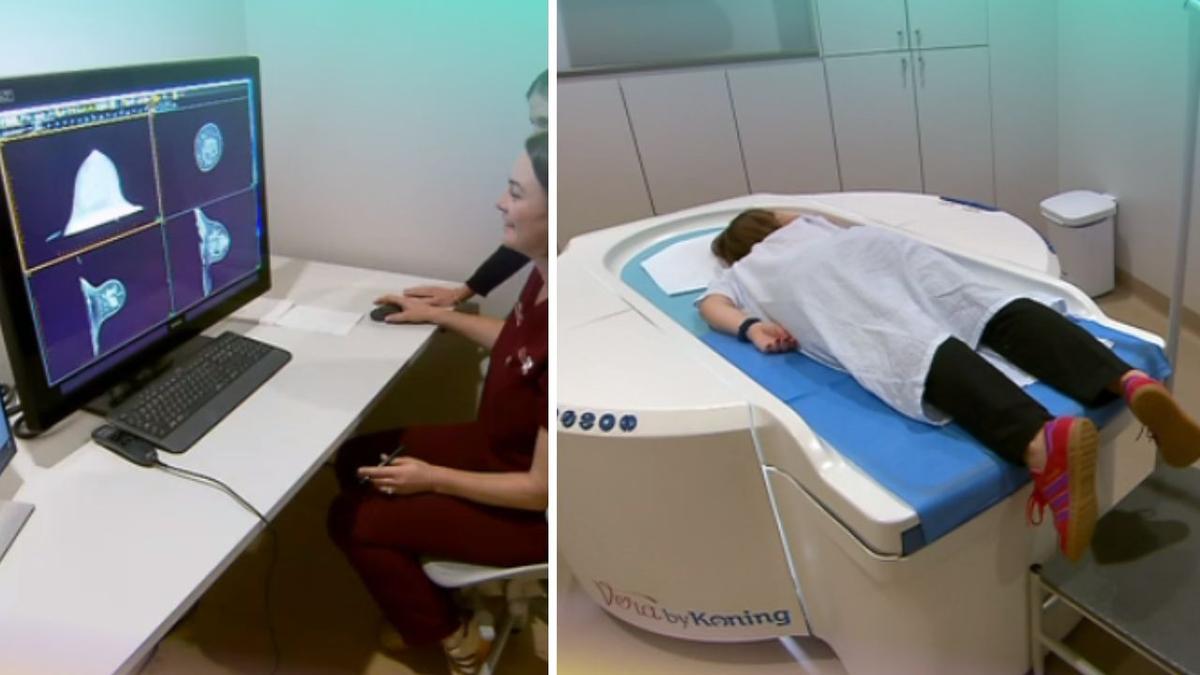
An Australian cone beam breast CT scanner that produces three-dimensional images without painful compression is being used to help detect cancers hidden by dense breast tissue and support more accurate treatment planning.
The Koning Vera system scans each breast in about 10 seconds while the patient lies face down. Its approval by Australia’s Therapeutic Goods Administration in September allows the technology to be supplied commercially, potentially enabling more clinics to adopt it.
Brisbane Radiology was the first Australian clinic to introduce the scanner. Clinic owner Angela Sclavos said women can access the imaging with a referral from their GP.
Belinda Yates, who has undergone mammograms and breast MRI after discovering a lump, said the new scan was markedly more comfortable than her previous experience.
“This scan has been a game changer for me. I have very dense breast tissue. There’s no pain. The discomfort was non-existent,” she said.
She described her earlier mammogram as “very crushing and quite painful”.
How the cone beam breast CT scanner could reveal hidden cancers
Breast surgeon Dr Beth Campbell said dense tissue could make it difficult to distinguish cancer on a mammogram. She compared the problem with trying to see stars through cloud cover.
“What the contrast does is it gets rid of that cloud cover so we can actually see behind to detect cancers when they’re smaller,” she said.
Dr Campbell recalled treating a patient whose mammogram appeared normal despite a large lump. The density was so intense that the cancer could not be seen, she said.
“So we put her through the cone beam scanner and when I eventually did her surgery, she had seven breast cancers in that breast,” she said.
Dr Ben Green, another breast surgeon, said the images could show that a tumour was more extensive than a standard mammogram indicated. That information could allow surgeons to alter the operation and reduce the chance of a second procedure.
He said MRI remained useful for some cancers but could take between 20 and 40 minutes and prove difficult for patients with claustrophobia.
Dr Campbell stressed that the scanner was an additional option rather than a replacement for established tests.
“I think it’s not going to replace mammography. It’s not going to replace MRI. It’s going to be another tool in our toolbox for picking up cancers early,” she said.
Dr Green said the technology could eventually be introduced more widely. He said some women had refused imaging because compression was painful, leaving them without a diagnosis, while the new scan was giving those patients access to earlier assessment.
Eligible patients can receive a Medicare rebate, although the out-of-pocket cost is similar to that of a private mammogram. Ms Sclavos said the cost was about 300 Australian dollars for patients who qualified under the Medicare Benefits Schedule.
Free screening mammograms remain available through BreastScreen Australia without a GP referral. Dr Campbell said she hoped a scan that avoided compression would encourage women who had been putting off checks to come forward.
“The earlier we pick up breast cancers, the easier they are to treat,” she said.
