


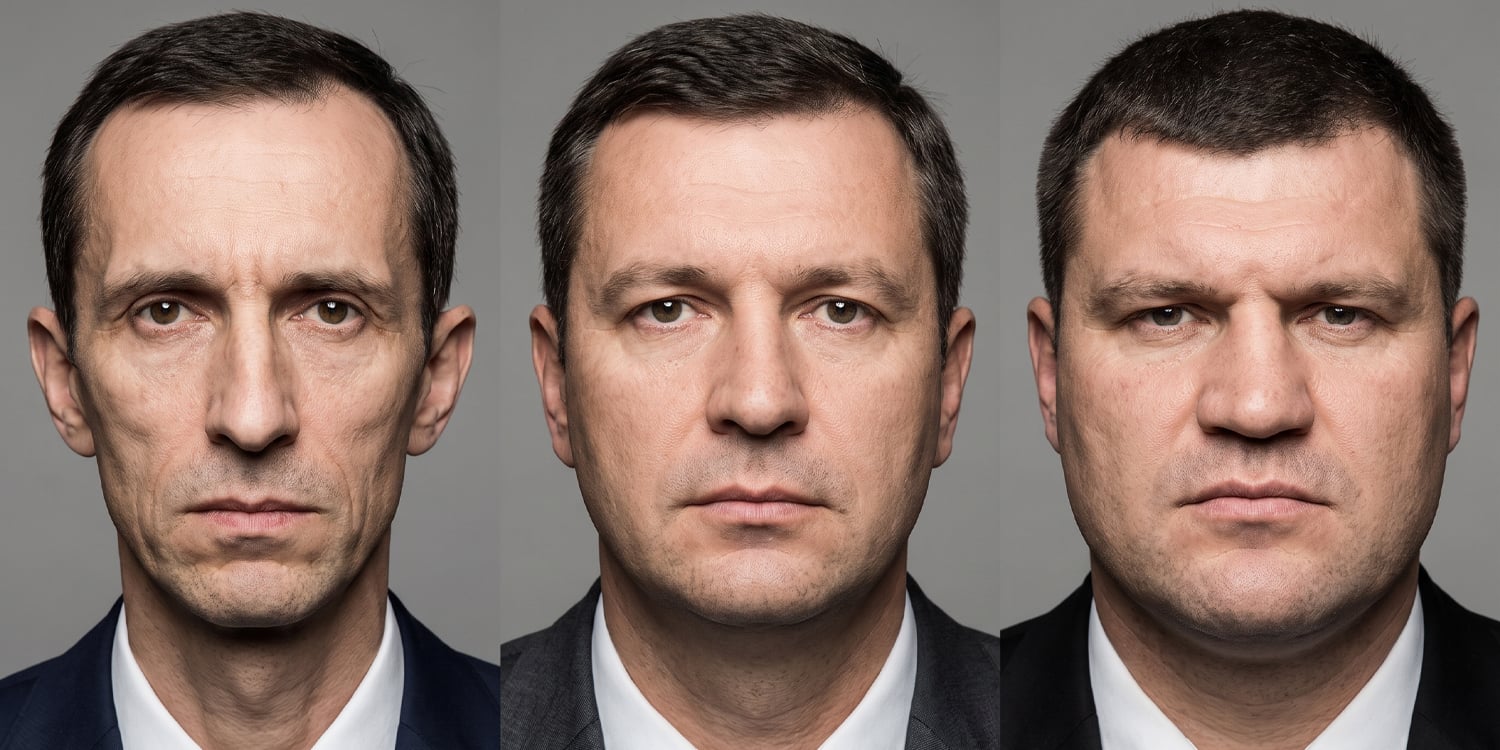
A new study suggests the shape of a world leader’s face could correlate with their likelihood of starting international conflict, with wider-faced rulers appearing more prone to war, particularly in the early days of their tenure. The research, published in Politics and the Life Sciences, analysed 1,761 leaders across 174 countries over a 63-year period from 1947 to 2010 and found that those with wider facial proportions were more likely to initiate militarised disputes abroad.
The metric at the heart of the study is the facial width-to-height ratio, defined as the distance between the outer cheekbones divided by the distance from the top of the upper lip to the middle of the brow. Evolutionary psychologists have long argued that this facial proportion signals underlying dominance and physical formidability. In ancestral environments, wider faces may have reliably signalled fighting ability, leading observers to subconsciously interpret such proportions as indicators of aggression. Earlier work has linked wider faces with aggression in everyday settings, and broader associations with political decision-making in some contexts. A 2022 study, for example, found that United States presidents with wider faces were more likely to use military force abroad.
Public responses to dominant-looking cues may also shape political preferences. A 2025 PsyPost study reported that people who perceive an ongoing threat of intergroup conflict tend to favour political leaders who look and act more dominant.
The new research broadens the field by examining leaders globally. Ross Miller, associate professor of political science at the University of Nebraska–Lincoln, said the work seeks to answer why some leaders are more conflict-prone than others and why responses to threats differ even among leaders facing similar security challenges. He argued that traditional political science often emphasises structural factors like power, but it is also useful to consider leaders’ personal qualities.
To test the idea, Miller assembled a large dataset of 1,761 leaders from 174 countries, spanning 1947 to 2010. He collected high-quality photographs where leaders faced the camera with a neutral expression and measured facial proportions with digital imaging software. These measurements were then compared with a historical database of militarised interstate disputes, which records threats or uses of force between states. The analysis controlled for several variables including military power, geographic proximity to adversaries, whether a state was a democracy, and the leader’s age and gender.
The results indicated that leaders with higher facial width-to-height ratios were more likely to initiate international conflicts than those with narrower faces. The effect was particularly pronounced in the early years of a leader’s tenure: in the first year, high-FWHR leaders were roughly three times more likely to initiate a conflict than their lower-FWHR counterparts.
“Traditional approaches emphasise important contextual factors – like power,” Miller explained. “For example, consider a traditional approach to this question: Why did Russia invade Ukraine? Because they are significantly more powerful than Ukraine, and figured they could force Ukraine to change its policy of joining NATO.” While these structural explanations are valid, he noted, his approach highlights that “it is also useful to take into account leaders’ qualities.”
The analysis drew on a dataset that Miller described as almost comprehensive for the post-World War II era, but he acknowledged limitations. He noted that, because economic and political conditions vary widely, the absolute probability of initiating conflict remains small even when relative risk appears elevated. Miller said: “In my reading, the key takeaway from this work is that there seems to be an association between the [facial width-to-height ratio] of elected leaders and, particularly in their early tenure, the likelihood of initiating an international conflict.”
Commenting on the scale of the effect, Swansea University’s Alex Jones, who was not involved in the study, told PsyPost that although high-FWHR leaders were over three times as likely to initiate conflict, the overall probability remains low. “The graphs highlight a change in probability of something like .02,” he said, adding that in very large samples, many findings reach statistical significance. “I’d assume that such a small effect probably doesn’t mean much in practical terms.”
Miller cautioned that the observed pattern likely reflects a combination of factors. He noted that new leaders often seek to establish their reputation through displays of assertiveness, which may invite adversaries to test resolve. He added that the tendency appears to fade as leaders’ aggressiveness becomes known internationally, with differences between high- and low-FWHR leaders diminishing by the third year in office.
The study also sits in tension with another line of inquiry, including a 2026 PsyPost piece that questioned the validity of the facial width-to-height ratio as an evolutionary marker of dominance. While the new work focuses on behavioural outcomes among elite leaders, the earlier work questioned broader anatomical differences by gender and body size, raising questions about the underlying biology.
The researchers stress that FWHR is just one characteristic and does not capture other facial cues that may influence perceptions of aggression. They also note that measurement from photographs can be imprecise due to factors such as camera distance and head orientation. There was no control for race or ethnicity in the dataset, a gap acknowledged by the researchers and noted by commentators.
Adi Wiezel, assistant professor of psychology at Elon University, cautioned against drawing causal conclusions from observational data. He suggested that a leader’s appearance can shape how others respond to them, which in turn can influence opportunities and behaviour. “Taken together, these findings raise interesting questions about the relationship between conflict, whom people select as leaders, and how those leaders subsequently behave,” he said.
Wiezel also highlighted that the study cannot definitively isolate the causal pathways that produced the association. She and Jones both called for further research, including a more nuanced cognitive-psychology approach that disaggregates facial features and explores their impact on decision-making. Jones urged looking beyond appearance to understand how leaders’ broader circumstances and environments interact with personal traits.
The researchers hope to extend their work to examine whether wider-faced leaders are less inclined toward international cooperation and peace-building. Miller noted that he is continuing work on related questions, including U.S. interventions in conflicts guided by facial metrics. The study, titled Looks that kill: Facial metrics and international conflict 1947–2010, was authored by Ross Miller.
