


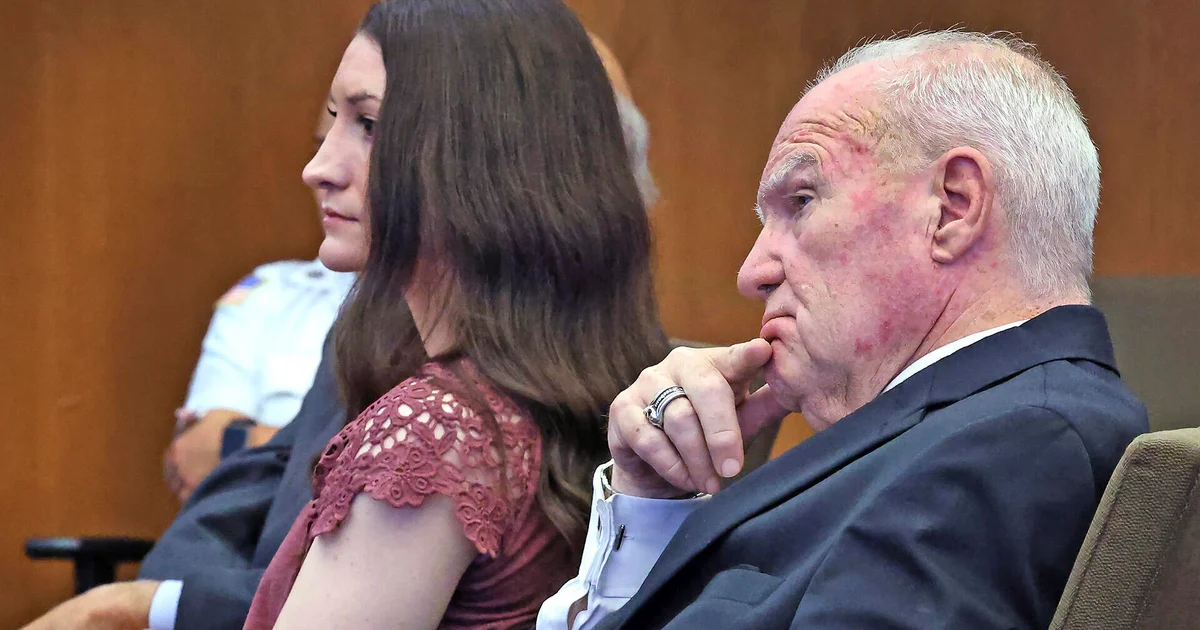
Lindsay Clancy’s lawyer has argued that prosecutors presented no evidence proving she killed her children, in a renewed attempt to secure a not-guilty finding after her murder trial ended in a mistrial.
Kevin Reddington made the submission at Clancy’s first hearing since the mistrial in early September. He asked the judge to rule that the evidence was legally insufficient for a rational jury to find her guilty beyond reasonable doubt.
“Where is the evidence that she did this? Where is the evidence that she did this?” Reddington said. “This entire case is based on speculation. Where is the admission? Where does she say that she did this?”
He challenged several elements of the prosecution case, including evidence concerning Clancy’s body temperature and testimony from her former husband, Patrick. “There’s no evidence that she admitted she did this,” he told the court.
The argument appeared to mark a significant change from Reddington’s earlier approach. In his opening statement in July, he said Clancy “knows what happened to those kids”.
At a pre-trial hearing in June, he said: “She takes responsibility. She, as the kids say, she owns it. She’s not running away from anything here. This whole case is an extreme tragedy.”
In an April motion, Reddington had also offered to stipulate in writing that Clancy admitted killing her children. He had asked for the trial to be split into two parts, dealing separately with guilt and her mental state, but that request was refused.
Reddington told the judge that his latest motion was being argued in two stages. First, he said prosecutors had failed to prove that Clancy carried out the killings. He then argued that they had also failed to prove she was criminally responsible.
“You’re put in a conundrum when you have to admit culpability in order to raise a lack of criminal responsibility,” he said.
The prosecution disputed the new position. Prosecutor Shanan Buckingham said: “Now for the first time the defendant is arguing that there’s no evidence that she did this. I would suggest to you that the entire record is voluminous as to information supporting the fact that she did this.”
Outside court, Reddington denied that the argument represented a new tactic. “Look, I argued that in the trial, I argued it on a motion for a required finding, it’s not new rocket science by any means,” he said. “It’s the fact that [prosecutors] cannot prove a probable cause.”
Legal analyst Jennifer Roman described the change in strategy as unusual and said it was “really bizarre” that Reddington had altered his approach on the substantive question of whether Clancy killed the children.
The motion is considered a long-shot attempt to avoid a second trial, although prosecutors have not explicitly said whether they intend to retry Clancy. Plymouth District Attorney Tim Cruz said officials were conducting a “very thorough review” and would continue working in “the interest of justice and the interest of the three children”.
The next hearing is scheduled for November 2.
