


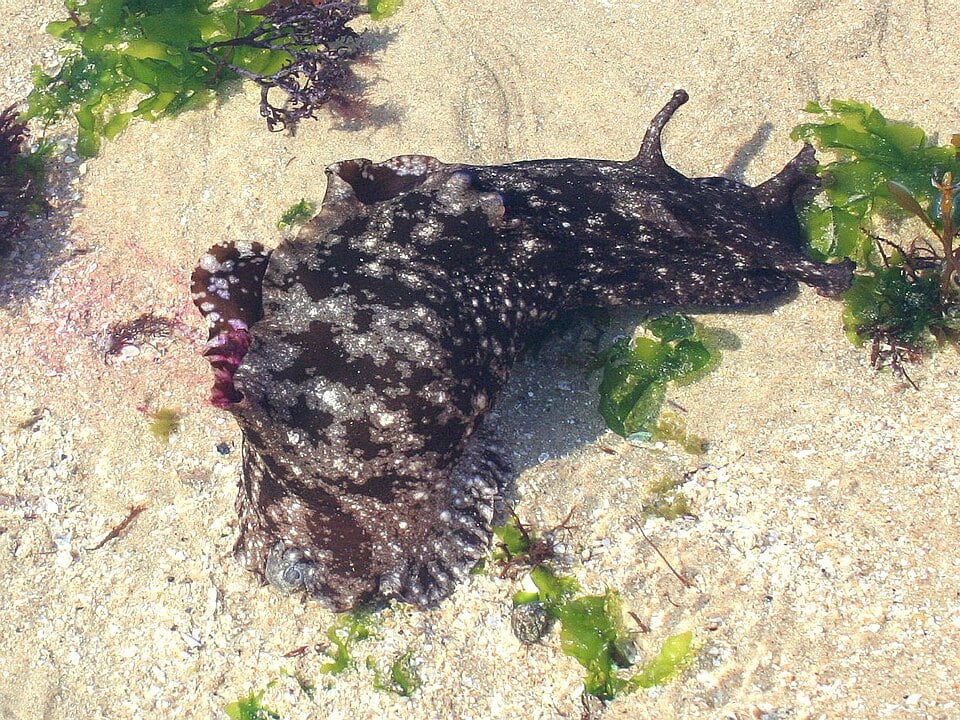
A slimy black sea creature that washed up on a popular Welsh beach has left onlookers puzzled over exactly what it might be — with experts suggesting it could be a rare species of sea hare.
The slug-like animal was spotted this week by a dog walker at Trearddur Bay on Anglesey. Emma Leese came across the creature around 20 metres from the water’s edge and, worried that dogs roaming the sand might take an interest in it, carried it back to the sea.
Once it was returned to the water, the animal appeared to come back to life. Speaking to NorthWalesLive, Ms Leese said it began to unfold and wriggle in a slug-like fashion, with its stalks rising back up.
The creature is thought to be a sea hare, a type of marine snail often referred to as a sea slug. These animals are usually found in rockpools on the low shore and can grow up to 20cm long. Curiously, they take their colour from their diet: those that feed on green seaweed turn a leafy green, while others that eat red seaweed take on a darker, maroon shade.
What has caused the excitement is the possibility that this one is an all-black specimen. True black sea hares — the largest species of sea slug, capable of reaching up to 40cm and far bulkier in build — are extremely rare in British waters. Directly related to the common garden snail, they are normally found in the Pacific Ocean off California, and it is thought the visitor may have travelled from there.
Frankie Hobro, owner and director of Anglesey Sea Zoo, urged caution about the identification. “Without examining the sea hare, we can’t be absolutely certain,” she said, adding that while it would be thrilling to confirm a true black sea hare on the Welsh coast, it was extremely unlikely. More probably, she suggested, it was a depilatory sea hare — itself a rare visitor to the UK, found occasionally in the south-west of Britain.
Sightings of the kind remain unusual. According to the Global Biodiversity Information Facility, there have been only a small number of confirmed records in the wider region, including in the Isle of Man and Scotland.
Experts have also issued a word of warning to anyone who comes across one: the creatures should not be handled without gloves, as their skin contains noxious chemicals.
