


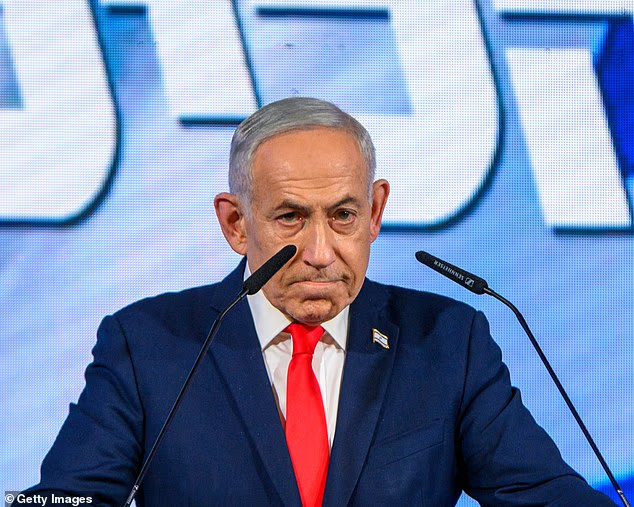
Benjamin Netanyahu’s Likud party has intensified unsubstantiated claims that Arab-led parties “stole” Israel’s election, after final results showed his bloc had fallen well short of a parliamentary majority.
The party also warned of “the Islamisation of Israel”, prompting accusations from opponents that the prime minister was attempting to demonise Arab citizens and undermine the result.
Election officials said Mr Netanyahu’s bloc had won 53 seats in the 120-member Knesset, compared with 48 for the main opposition and 19 for Arab-led parties. The count is complete but must still be certified and submitted to President Isaac Herzog next Wednesday.
Election allegations rejected as ‘baseless’
Likud began spreading allegations of electoral wrongdoing after exit polls suggested Mr Netanyahu had suffered a setback in Tuesday’s vote. The rhetoric escalated after Supreme Court Justice Noam Sohlberg, who heads the election committee, said “serious suspicions” of foreign interference had been brought to his attention.
In a letter to the Shin Bet security agency, Justice Sohlberg said he could not verify the claims but asked the agency to investigate because of their seriousness.
Likud responded with a statement declaring: “The elections in Israel have been stolen!” It alleged that the suspected interference was intended to facilitate “a foreign takeover of the Knesset, the Islamisation of Israel and toppling of the right wing government”.
Israeli media reported that members of Mr Netanyahu’s party had accused Qatar, which many Israelis regard as a patron of Hamas, the Gaza-based militant group. Qatar rejected the allegations as “ridiculous and dangerous”.
Dean Livne, the election commission’s acting director general, said the investigation was based on classified intelligence but warned that reports about it had been “entirely unfounded”.
“It does not affect the final results that will be submitted to the president, nor does it concern any particular sector of the population,” he said.
The election committee later said that, despite the investigation, “allegations of systematic violations of electoral integrity are baseless”. It has asked the Shin Bet to provide its findings within a week.
The security agency said the investigation was not intended to “cast aspersions” on an entire section of the population that had exercised its right to vote “in a democratic and lawful manner”.
Opposition considers alliance with Arab parties
Mr Netanyahu’s main rival, former military chief Gadi Eisenkot, accused Likud of trying to delegitimise the result. “They are doing this because they lost,” he said.
Mr Eisenkot also mocked the allegation of foreign involvement, saying: “I welcome the fact that Netanyahu is finally condemning Qatari involvement in the State of Israel.” Mr Netanyahu has previously faced accusations that former senior aides accepted money from Qatar.
By casting doubt on the vote, Mr Netanyahu appeared to be seeking to prevent his opponents from forming an alliance with Arab-led parties. He has suggested that it would be treasonous for Mr Eisenkot to join forces with them.
Yair Golan, leader of the Democrats party, accused the prime minister of conducting “an ugly delegitimization campaign directed against the will of the public – and against the Arab public in particular”. The Arab-led Joint List party in turn said: “Netanyahu is working to steal the election.”
Mansour Abbas, head of the Arab-led Ra’am party, welcomed the investigation into possible interference and said his party had no connection to the case, while accusing Mr Netanyahu of incitement.
President Herzog described the situation as a “sensitive moment” and called for a full investigation. He warned that “we must not tarnish an entire community that sought to exercise its right to vote and take an active part in democracy”.
Arab citizens of Palestinian descent account for about 20 per cent of Israel’s population. Campaign attacks portraying Arab-led parties as a danger to Israel, combined with opposition to Mr Netanyahu and his far-Right government, contributed to a historic turnout among Arab voters.
The election has left the country facing difficult coalition negotiations. If the rest of the opposition joins Arab-led parties, it could potentially form a government with a majority, although such an alliance would be politically risky.
Mr Eisenkot has indicated that he is open to working with Arab-led parties under certain conditions. Ahmad Tibi of the Joint List said the opposition had contacted him about replacing the Knesset speaker, and that his party would support the opposition’s candidate.
Arab-led parties could also strengthen the opposition without formally joining a coalition by supporting the election of a new speaker. That would give them influence over the parliamentary agenda and could allow legislation to advance before a new government is formed.
Mr Netanyahu remains in office while the contest for the 61 seats needed to control the Knesset continues. If no government can be formed after multiple attempts, Israel could face another election early next year.
