


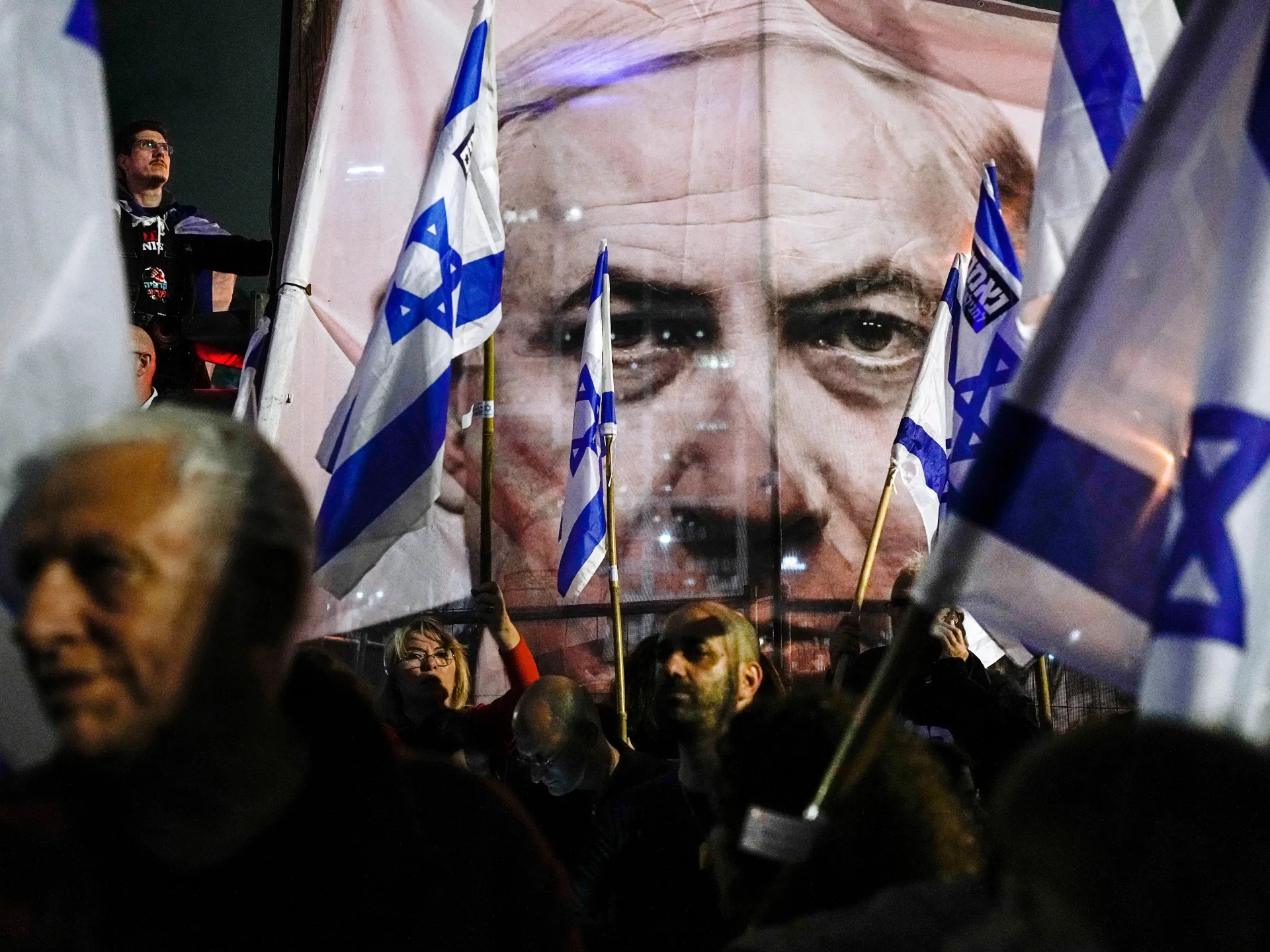
Benjamin Netanyahu’s fight to stay in power has intensified since Israel’s October 27 election, with the caretaker prime minister attacking political opponents and questioning the legitimacy of the result.
Mr Netanyahu is likely to leave office if the opposition, led by Gadi Eisenkot, succeeds in forming a viable government. But that coalition may need support from parties representing Palestinian citizens of Israel, giving the veteran leader an opportunity to attack their credibility.
He has baselessly accused Arab parties of cheating in the election, while the political atmosphere has deteriorated to the point that right-wing protesters have threatened civil war.
Netanyahu’s critics have also accused him of deliberately encouraging conflict with Iran in an attempt to retain office. Separately, Israel’s Shin Bet domestic intelligence agency reportedly sought approval to monitor the phones of five Arab lawmakers over suspected foreign interference and to arrest Palestinian citizens of Israel involved in politics on election day.
Those requests were rejected by the attorney general. Opposition leaders including Yair Lapid and Yousef Jabareen, head of the Joint List, described the measures as evidence of an “attempted coup”.
Law enforcement officials are also said to be examining whether the prime minister’s office fabricated allegations of vote-buying. It remains unclear whether Netanyahu will face immediate legal consequences over the alleged efforts to undermine confidence in the election.
Netanyahu’s political and legal threats
The stakes are high for the long-serving leader, who faces renewed calls for a state inquiry into the failures surrounding the Hamas-led October 7, 2023 attack on Israel.
Those demands have grown following reports that senior Egyptian and Emirati officials personally warned Netanyahu about the possibility of an attack. Establishing a state inquiry was also included prominently in the legislative programme for parliament’s new session.
Netanyahu’s war in Gaza and his confrontation with the judiciary have coincided with a corruption trial that began in May 2020 and has repeatedly been delayed by his duties as prime minister.
He faces charges of bribery, fraud and breach of trust in three cases. If convicted, he could receive a prison sentence of up to ten years.
“Netanyahu is behaving like a wounded animal,” said Israeli analyst Ahron Bregman of King’s College London. “For him, losing the elections is not just a political but also a personal matter, not least because of his corruption trial, which could result in him being sent to jail. Losing the premiership is losing his shield. Hence, for Netanyahu, nothing is off the table.”
Warnings of political violence
The prospect of violence has increased since the election. Right-wing demonstrators gathered outside Eisenkot’s home, warning him against forming a government with Arab-led parties and calling him a “traitor”.
Rabbi Gedalia Axelrod, a former head of Haifa’s rabbinical court, referred in a publicly shared letter to din rodef, or the “law of the pursuer”. The principle was invoked by Yigal Amir to justify the 1995 killing of former prime minister Yitzhak Rabin over the Oslo Accords with the Palestinians.
Ofer Cassif, an MP from the left-wing Hadash party, said the danger would grow if Eisenkot took longer to form a government.
“Netanyahu is willing to do anything, and I mean anything, to stay in power. He’s a psychopath. People on the right talk about civil war, and I’m not ready to discount that … Netanyahu built a cult around him, and it may easily raise arms against his rivals,” he said.
Yossi Mekelberg, a senior consulting fellow at Chatham House, said Netanyahu was focused on preserving his position rather than protecting those around him.
“Netanyahu battles for his survival and doesn’t care if those around him disappear into oblivion, but he might not succeed this time,” he said. “He doesn’t care about them, or even his political legacy. All he cares about is survival, about fighting for the next day and trying to cling on, no matter what the cost.”
Aides accused of giving false information to police before the election could face criminal scrutiny. Shin Bet chief David Zini, a Netanyahu ally, could also see the agency’s independence and his own position weakened over allegations that he took part in attempts to subvert the democratic process.
