


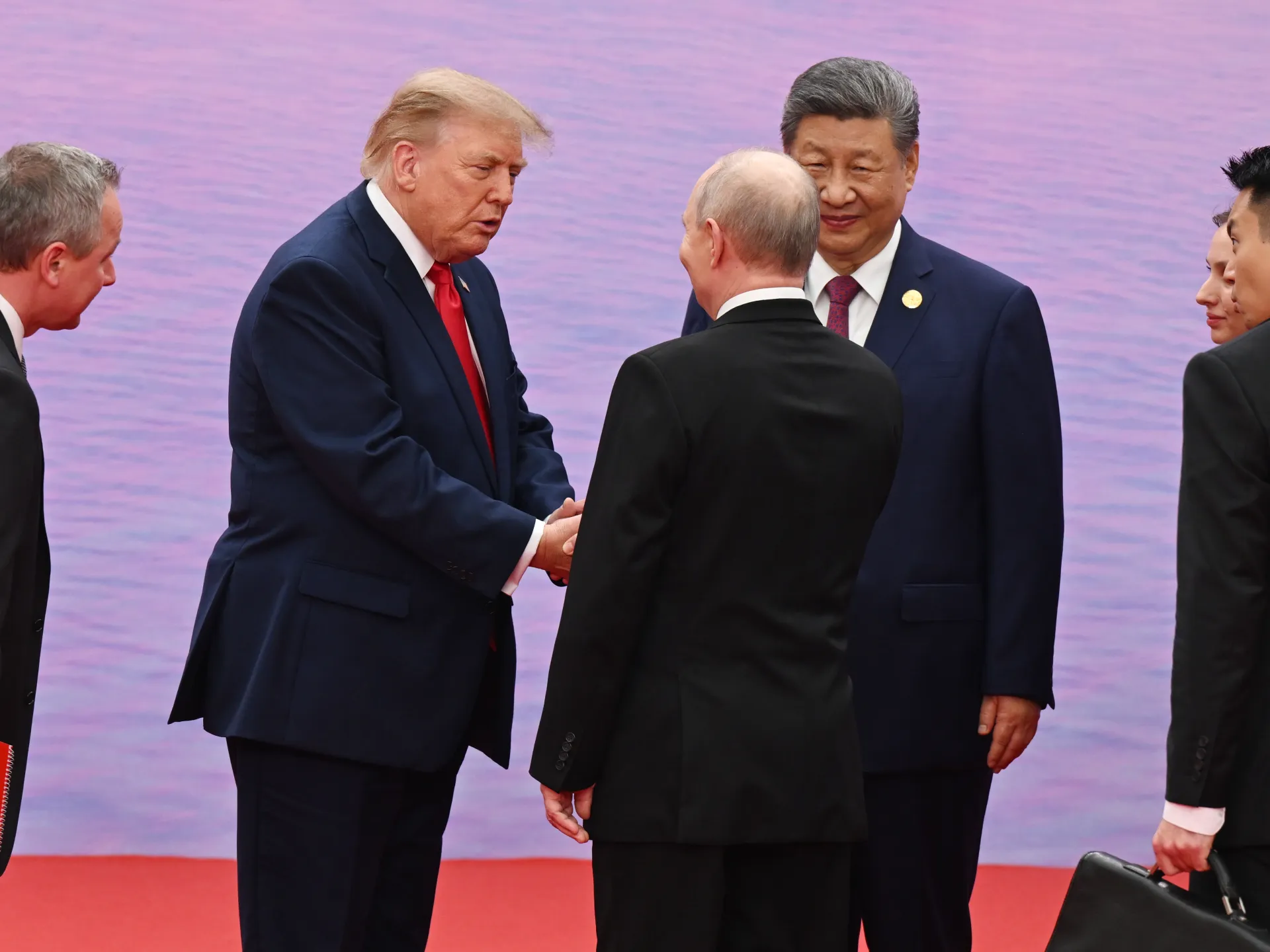
A possible meeting between Donald Trump, Vladimir Putin and Xi Jinping in Shenzhen during the November 18-19 Asia-Pacific Economic Cooperation summit has prompted calls for the three leaders to pursue a far-reaching nuclear disarmament agreement.
The proposed encounter has been compared with the 1945 Yalta conference, but a more relevant precedent may be the 1986 meeting in Reykjavik between Ronald Reagan and Mikhail Gorbachev, when the American and Soviet leaders came close to agreeing to eliminate their nuclear arsenals.
The central proposal is for the United States and Russia to reduce their stockpiles to roughly the level held by China, while Beijing abandons plans to expand its arsenal. That opening step could then lead to negotiations involving all nine nuclear-armed states.
The idea comes as diplomatic efforts continue against the backdrop of the wars in Iran and Ukraine, and amid concern over the destructive potential of nuclear weapons. Dmitri Trenin, formerly director of the Carnegie Moscow Centre and now president of the Russian International Affairs Council, has suggested that Russia could help broker a new nuclear agreement between the United States and Iran.
Trenin has written that an “unprecedented trilateral meeting” would make sense if it focused on denuclearisation. The wider proposal argues that the leaders should aim beyond a limited agreement and attempt to revive the ambition of Reykjavik: the eventual abolition of nuclear weapons.
A three-stage plan for nuclear disarmament
The first stage would last four years. During that period, Washington and Moscow would begin reducing their arsenals, while Beijing would refrain from increasing its own. The process would also require the wars in Iran and Ukraine to end quickly, alongside a renewed commitment by the United States, Russia and China to the United Nations Charter and peaceful development.
A second four-year phase would involve bilateral, trilateral and multilateral negotiations among all nine nuclear powers. The aim would be to address the individual security concerns that led each country to acquire nuclear weapons and establish conditions for their reduction or removal.
Under the proposal, those states would join the Treaty on the Prohibition of Nuclear Weapons, which allows a 10-year period for the elimination of nuclear arsenals. The final stage would focus on reductions, verification and the eventual destruction of the weapons.
The proposal argues that the process could be completed in four years if the arsenals had first been reduced to no more than 600 warheads each. It says this would allow the nuclear age to end before the centenary of the United Nations and the 100th anniversary of the atomic bombings of Hiroshima and Nagasaki.
Such an agreement would face substantial political obstacles. Russia regards its nuclear arsenal as a central source of national power, while China has said it will not enter arms control discussions until the gap between its stockpile and those of the United States and Russia has narrowed.
The proposal turns that position around, suggesting that Washington and Moscow should reduce their arsenals to the level China now possesses rather than wait for Beijing to build up to theirs.
Trump’s position is also uncertain. Following his party’s defeat in the midterm elections, the appointment of Stephen Miller as chief of staff has been presented as an indication that the president is unlikely to moderate his political approach. Yet Trump has repeatedly expressed concern about the cost and danger of nuclear weapons.
In February 2025, he said there was “no reason for us to be building brand-new nuclear weapons”, arguing that the existing stockpiles could destroy the world many times over. He also said that money spent on new weapons could be directed towards more productive purposes.
Trump had made similar comments years earlier. In 2016, he described nuclear capability as “the biggest problem the world has” and “the single biggest problem”, saying the power of modern weaponry was beyond anything previously imagined.
He has also recalled seeking advice in 1986 from Bernard Lown, co-founder of International Physicians for the Prevention of Nuclear War, about negotiating nuclear disarmament with Gorbachev. Trump said he would persuade Reagan to send him to Moscow and secure disarmament and an end to the Cold War within an hour. Lown later described himself as “dumbfounded” by the claim.
At the World Economic Forum in Davos in January 2025, Trump said Putin had liked the idea of sharply reducing nuclear weapons and that China would have taken part in the effort.
“So, we want to see if we can denuclearise, and I think that’s very possible,” he said. “And I can tell you that President Putin wanted to do it. He and I wanted to do it. We had a good conversation with China. They would have been involved, and that would have been an unbelievable thing for the planet.”
Putin and Xi have also backed the principle
Putin has previously expressed support for the eventual elimination of nuclear weapons. Speaking to the Valdai International Discussion Club in 2017, he said Russia wanted “universal nuclear disarmament” and would work towards it.
Shortly before Russia’s invasion of Ukraine, the leaders of the United States, Russia, China, France and the United Kingdom declared jointly that “a nuclear war cannot be won and must never be fought”. They also reaffirmed their obligations under the Nuclear Non-Proliferation Treaty, including the commitment to pursue negotiations on nuclear disarmament.
Russia’s subsequent invasion and Putin’s series of veiled nuclear threats have made that declaration more difficult to rely upon. But it remains a stated commitment by the five recognised nuclear powers and provides a basis, however limited, for renewed diplomacy.
Xi has likewise spoken in favour of a world without nuclear weapons. In a 2017 speech at the United Nations Office in Geneva, he described nuclear weapons as “the Sword of Damocles that hangs over humankind” and said they should be completely prohibited and ultimately destroyed.
His more recent position has been that China will not participate in arms control talks until its arsenal is closer in size to those of the United States and Russia. The suggested alternative is for the existing powers to reduce their stockpiles rather than for China to expand its own.
Reagan and Gorbachev ultimately failed to turn their Reykjavik discussions into a comprehensive disarmament agreement. Their negotiations came close when Reagan accepted Gorbachev’s proposal to eliminate all nuclear weapons, responding: “Yes, all.” US secretary of state George Shultz then said: “Let’s do it.”
The opportunity was lost after Reagan insisted on unrestricted testing of his Strategic Defense Initiative rather than limiting it to laboratory research for 10 years.
The proposed Shenzhen meeting, if it takes place, would therefore offer the three leaders a chance to attempt a breakthrough that has eluded the world since Reykjavik. The obstacles are formidable, but the argument is that a nuclear war would be unthinkable precisely because the weapons can be dismantled by political decision.
