


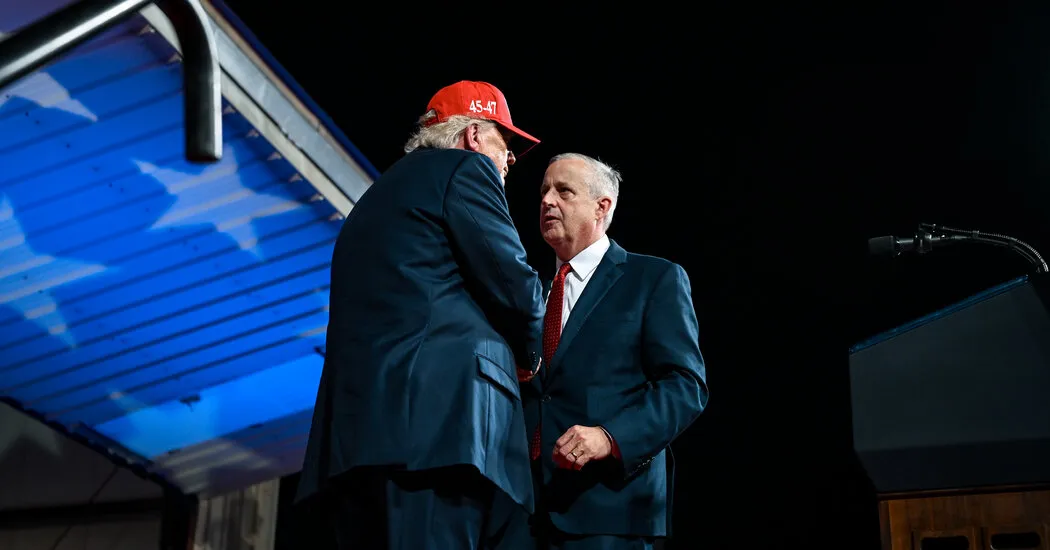
Michael Whatley is betting that an unqualified embrace of Donald Trump will carry him to victory in North Carolina’s closely watched Senate race, despite trailing Democratic nominee Roy Cooper and facing signs that Republican financial support is beginning to weaken.
Whatley has appeared alongside the president at his midterm convention, defended the Iran war and rejected blanket pauses on new data-centre construction. He has also welcomed visits from Mr Trump and Vice-President JD Vance — a distinction no other Republican Senate candidate can claim.
“I am still with that guy,” Whatley said during an appearance in Gastonia, near Charlotte, referring to Mr Trump.
With six weeks remaining before the election, the former chairman of the North Carolina Republican Party is running out of time to prove that tying himself to a president whose ratings are near historic lows will mobilise the Republican base more effectively than it alienates voters.
A Republican-aligned super PAC, Old North Action, removed $6.5 million in television advertising reservations on Monday, as Republicans debated whether to redirect resources away from the contest. Republicans have nevertheless outspent Democrats in the race and in future advertising bookings, while Whatley retains the backing of Mr Trump’s powerful super PAC.
The seat is now regarded as the most likely Senate contest in the country to change hands in November. Whatley, 57, has never held elected office and was not widely known to voters when he entered the race. He is seeking to replace Republican Senator Thom Tillis, who is retiring after repeatedly disagreeing with Mr Trump and facing the threat of a primary challenger.
North Carolina Senate race turns on cost of living
Whatley has built his campaign around crime and public safety, while repeatedly promoting traditional Republican positions including lower taxes and deregulation. Cooper, by contrast, has made household finances the centre of his campaign, using the slogan “Make Stuff Cost Less”.
That contrast has proved difficult for Whatley as petrol prices have averaged more than four dollars a gallon and polling has shown voters are increasingly concerned about the economy and have lost confidence in Mr Trump’s handling of it.
“Remember, the president promised that cost of living would be the Day 1 focus,” Cooper told supporters at a Charlotte brewery. “Now that that’s not happening, the things they’ve done have made it so much worse.”
Cooper, 69, has never lost an election and is broadly recognised in North Carolina as a centrist. He was first elected to office in 1986 and served as governor, while Whatley has had to introduce himself to voters at the same time as attacking his opponent.
Republican advertisements have blamed Cooper for a court-ordered pandemic-era settlement that led to 3,500 inmates being released early. They have also sought to connect him to the fatal stabbing of a Ukrainian immigrant on a commuter train in Charlotte last year, although the man accused of the killing was not released under that settlement.
Cooper has dismissed the attacks as “lies”. He has responded by linking Whatley to a convicted sex offender who held positions with the state Republican Party. Whatley says he did not hire the man and has described him as a volunteer who opposed his leadership of the party.
Cooper has also criticised Whatley’s work as a Washington lobbyist for oil and energy companies, at a time when voters are paying more for petrol and electricity. Whatley has sought to turn Cooper’s campaign message against him, describing the former governor as a tax-and-spend Democrat who “made things cost more”.
Whatley’s approach has frustrated Republicans who believe he should find more distance from Mr Trump. Mr Tillis, who has not endorsed either candidate, has also said Whatley should separate himself from the president.
Instead, Whatley has continued to present loyalty to Mr Trump as an electoral asset. At a gathering of builders and contractors in Charlotte, he argued that North Carolina’s economic growth depended on supporting the president’s tax and deregulation policies.
When an attendee raised concerns about town councils imposing moratoriums on new data centres, Whatley echoed Mr Trump’s argument that the United States needed to win the artificial intelligence race, while saying developers should secure local support.
He also attacked Cooper over the initial response to Hurricane Helene, which devastated parts of western North Carolina two years ago. Mr Trump appointed Whatley to help lead recovery efforts last year.
At a rally in Gastonia, Mr Trump said his administration had spent more than $2 billion on hurricane relief, while acknowledging that North Carolina was awaiting further funding. He then told Whatley: “I’m going to get that to you, Michael.”
Mr Trump added: “Now, if Michael loses, I’m not sending it, OK? No, I’m only kidding. You’re getting it. You’re going to get it, Michael.”
Whatley said after Mr Trump’s rally that the president’s intervention and millions of dollars in allied advertising were improving his position. “Numbers are moving in our direction,” he told reporters after meeting builders and contractors. “We feel very good about this.”
But the contest remains highly competitive. North Carolina has three large media markets, making the Senate race one of the most expensive in the country, and both candidates agree that statewide contests often tighten in Republicans’ favour as polling day approaches.
A plurality of North Carolina voters are unaffiliated with either party. Cooper has said undecided voters tend to make up their minds late and lean Republican, a trend Whatley needs to materialise if he is to maintain financial backing.
Democrats, meanwhile, are conscious of their own history of disappointment. Although they have held the governor’s office for most of the past 34 years, they have not won a Senate seat in North Carolina for 18 years. Mr Trump has urged Republicans to vote as if he were on the ballot, in an effort to bring out people who usually vote only in presidential elections.
Neither Cooper nor other North Carolina Democrats are predicting victory, despite the former governor’s lead in the polls.
“People see the polls, and it looks like a blowout is forming,” said Jordan Lopez, a Democratic state representative from East Charlotte campaigning for Cooper and other candidates. “But North Carolina has been 50-50.”
Cooper has said he would seek to roll back Mr Trump’s tariffs, push to end the Iran war and introduce anti-corruption laws. He rarely mentions the president by name, saying instead: “I will work with him when I can, and I will stand up to him when I need to.”
