


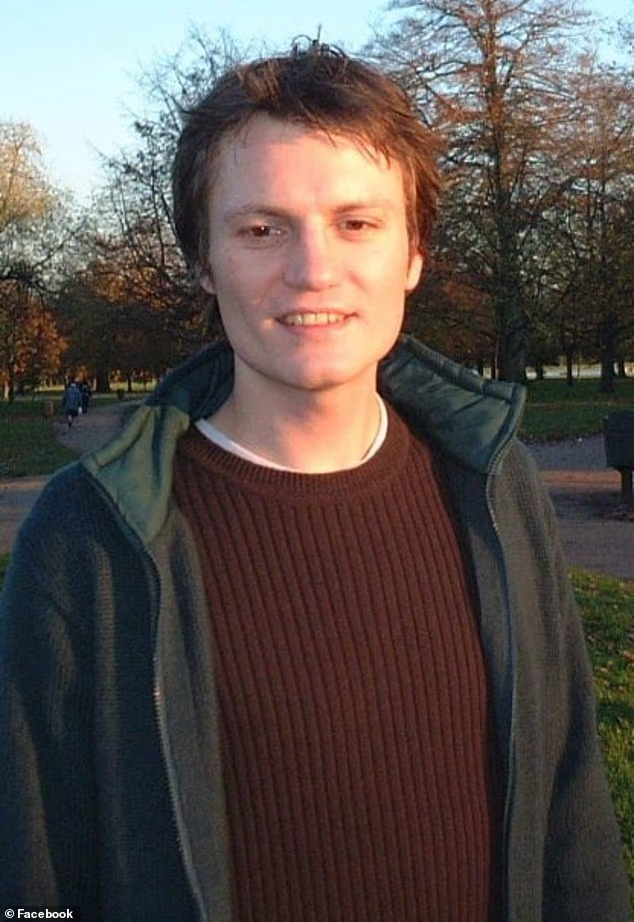
Oxford University solicited and accepted more than £12 million from the late motorsport tycoon Max Mosley — the son of the British fascist leader Sir Oswald Mosley — and arranged for the Mosley name to be inscribed on one of its most historic monuments, despite objections from academics, students and Jewish groups, according to an investigation by the Daily Mail.
Drawing on documents obtained through Freedom of Information requests, the Mail reported that several Oxford colleges and departments courted Mosley for donations in the years before his death in 2021, and that the university pressed ahead with the money even as it publicly distanced itself from other contested historical figures.
Among those who approached him was Alan Rusbridger, the former editor of The Guardian and now Principal of Lady Margaret Hall. In a July 2019 email disclosed under FOI, Rusbridger thanked Mosley for supper and invited a donation to the college, offering to name a programme after Mosley’s late son, Alexander. He wrote that since arriving at Oxford he had learned “habits of boldness in seeking funds.” The college ultimately received around £260,000.
The largest sums went elsewhere. St Peter’s College accepted a series of gifts from the Alexander Mosley Charitable Trust, including £100,000 a year over three years, a £1.1 million endowment for an engineering fellowship and £5 million towards a new accommodation block that architectural drawings show was originally to be named Alexander Mosley House. The university’s physics department, meanwhile, secured a pledge of £6 million to endow a professorship in biophysics, agreed after what one confidential record described as a “solicitation meeting” in Knightsbridge, attended by the department’s head, Professor Ian Shipsey.
The donations were contentious because of the family’s history. Sir Oswald Mosley led the British Union of Fascists in the 1930s, was an associate of Adolf Hitler and married his second wife at the Berlin home of the Nazi propagandist Joseph Goebbels, with Hitler among the guests. The Mail reported that Max Mosley had acted as election agent for his father’s far-right Union Movement and was named as the publisher of a racist 1961 by-election pamphlet that linked immigration to disease. Under oath at his 2008 privacy case against the News of the World, Mosley dismissed the suggestion that he had distributed such material; but after the Mail unearthed the pamphlet in 2018 he conceded in a Channel 4 News interview that it was “probably” racist. He never apologised for his father or for the family’s support of apartheid South Africa, and told GQ magazine in 2015 that the family fortune had passed to him.
The Mail’s latest investigation went further, claiming that the wealth behind the gifts could be traced to money Sir Oswald received from Hitler and Mussolini, to later business dealings and to investments in apartheid-era South Africa — assertions the family trust denies.
Despite the family’s record, Oxford moved to honour the donor. In December 2019 the then Chancellor, Lord Patten, invited the trust to join the Chancellor’s Court of Benefactors. The following year, the Mail reported, Patten offered to have the trust’s name engraved on the Clarendon Arch, a medieval monument near the Bodleian Library that lists just 242 benefactors, among them reigning monarchs. The inscription was added in 2021.
Opposition hardened after Mosley’s death in May 2021, aged 81, following a cancer diagnosis. Professor Lawrence Goldman, an emeritus history fellow at St Peter’s who has said relatives were murdered in the Holocaust, urged colleagues to refuse the money and accused the college of a “total moral failure” in comments to the Daily Telegraph and Sky News. A joint letter from a coalition of Jewish organisations — including the Holocaust Educational Trust, the Union of Jewish Students, the Campaign Against Antisemitism and the Jewish Leadership Council — condemned the decision to take funds from what they called “a notorious fascist family.” The Government’s then adviser on antisemitism, Lord Mann, and the then education secretary, Nadhim Zahawi, also objected, while Black Lives Matter called for the money to be returned. The Jerusalem Post reported that Imperial College London and University College London had received around £2.5 million and £500,000 respectively from the same trust.
Internal emails released to the Mail show Oxford bracing for the fallout, with one official urging colleagues to prepare “in case the brown stuff does hit the fan.” After Mosley’s death, the documents indicate, the trustees themselves moved to strip the Mosley name from the gifts, fearing damaging publicity.
Oxford and the colleges defended their conduct throughout. The then Vice-Chancellor, Professor Louise Richardson, declined to return the money and, in an internal email, argued the trust’s funds had “nothing to do with Oswald Mosley.” The university maintained that its due diligence had been “robust.” Lady Margaret Hall said the donation had helped students from diverse, low-income backgrounds and that no public acknowledgement had been sought or given. The Alexander Mosley Charitable Trust said it “abhors racism in all its forms” and that none of its money derived from fascism, while St Peter’s said no individual should be judged on the actions of previous generations. Rusbridger, who has continued to defend the donations, said the gifts had transformed the prospects of students in need and rejected any comparison with the university’s removal of contested statues.
The new accommodation block at St Peter’s is now open and carries no reference to its benefactor. The Mosley inscription on the Clarendon Arch, however, remains.
