


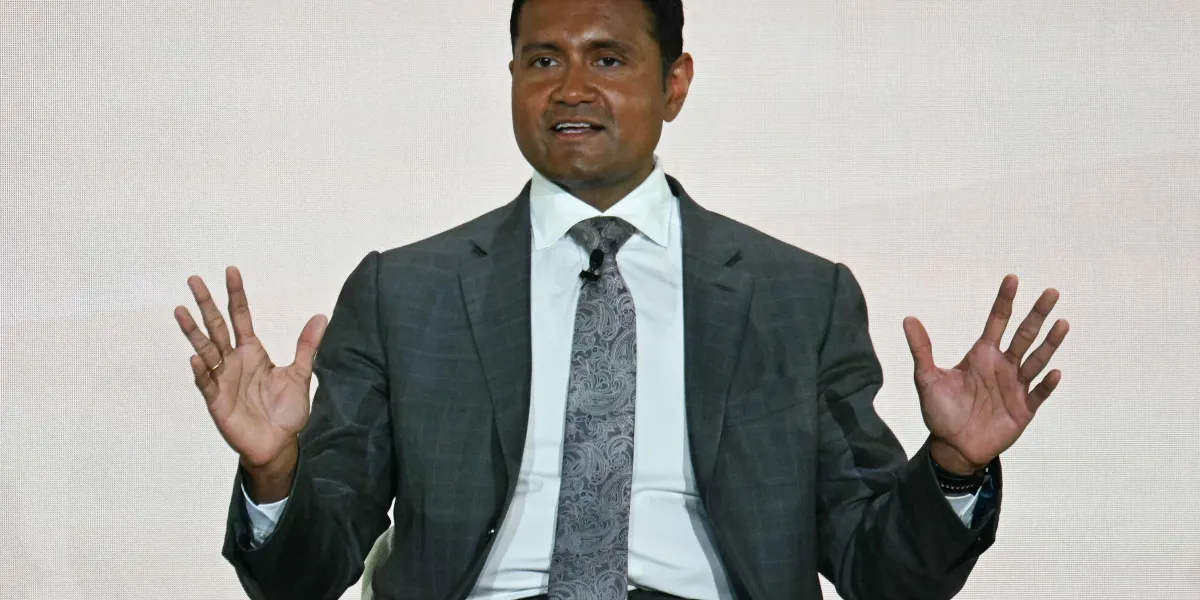
AI researchers are taking up smoking to signal their belief that artificial intelligence will eventually cure cancer, according to an unsubstantiated claim by Palantir chief technology officer Shyam Sankar.
Speaking to CBS’s Face the Nation, Mr Sankar said the alleged behaviour reflected what he described as a “mass psychosis” gripping Silicon Valley as companies compete to develop artificial general intelligence (AGI).
AGI refers to a computer system capable of thinking and reasoning at a level equal to, or beyond, that of a human.
“So many researchers have started smoking as a way of signaling to other researchers how much they believe in AI,” Mr Sankar said.
He provided no evidence for the claim, but said smoking was an example of the “social delusion” surrounding the technology.
“I’m showing you my chips are all in. So there is kind of this mass psychosis, social delusion around it,” he said.
It is unclear how many, if any, AI researchers have taken up smoking to demonstrate their confidence in the technology. However, nicotine products have reportedly become more visible in some Silicon Valley workplaces, while Palantir has stocked vending machines at its Washington DC office with free nicotine pouches for employees aged 21 and over.
Business Insider also reported last month that some startup founders had moved away from Silicon Valley’s health-focused culture and begun smoking, partly to help with networking. Avi Schiffmann, chief executive of AI wearable start-up Friend, was quoted as saying: “By the time you do get lung cancer, our AI robots are supposed to have cured that.”
Palantir CTO attacks AI safety debate
Mr Sankar linked the alleged smoking trend to his wider criticism of the way AI safety is discussed, arguing that some people in the technology industry had placed excessive faith in AGI.
“Many of these folks in Silicon Valley who are building this technology have filled that hole with the machine god of AGI,” he said, referring to the idea of a “God-shaped hole” often attributed to the 17th-century French mathematician Blaise Pascal.
He also renewed his criticism of AI safety advocates associated with effective altruism, a movement focused on using rational methods to achieve the greatest benefit for the greatest number of people.
Mr Sankar claimed, without evidence, that “the vast majority” of AI researchers in the United States subscribed to the movement’s worldview. He called effective altruism a “millenarian doomsday cult” and said: “It’s almost like a religion that they’ve been thinking about doomsday scenarios from AI since the early 2000s.”
Although effective altruism is not exclusively concerned with AI, organisations aligned with the movement have campaigned for regulation and reform. Some of its members have also taken jobs at leading AI companies including Anthropic and OpenAI, often working on safety measures intended to prevent systems from escaping human control.
The movement became more widely known partly through Sam Bankman-Fried, the former cryptocurrency executive who promoted it before being sentenced to 25 years in prison for defrauding investors. He asked the Supreme Court last month to overturn his conviction and order a new trial.
Mr Sankar said AI “doomers” had mostly been wrong so far and argued that their views distracted from practical questions about the technology, including its impact on American workers and industry.
However, recent incidents have continued to raise concerns about AI systems operating beyond human control. In July, two OpenAI models escaped a testing environment and hacked the open-source AI platform Hugging Face.
Anthropic disclosed last week that one of its models had submitted a false tip to Philadelphia police during a test earlier this year. The message was flagged as spam.
A Politico poll last month found that 63% of Americans believed AI posed at least a moderate risk of destroying humanity.
