


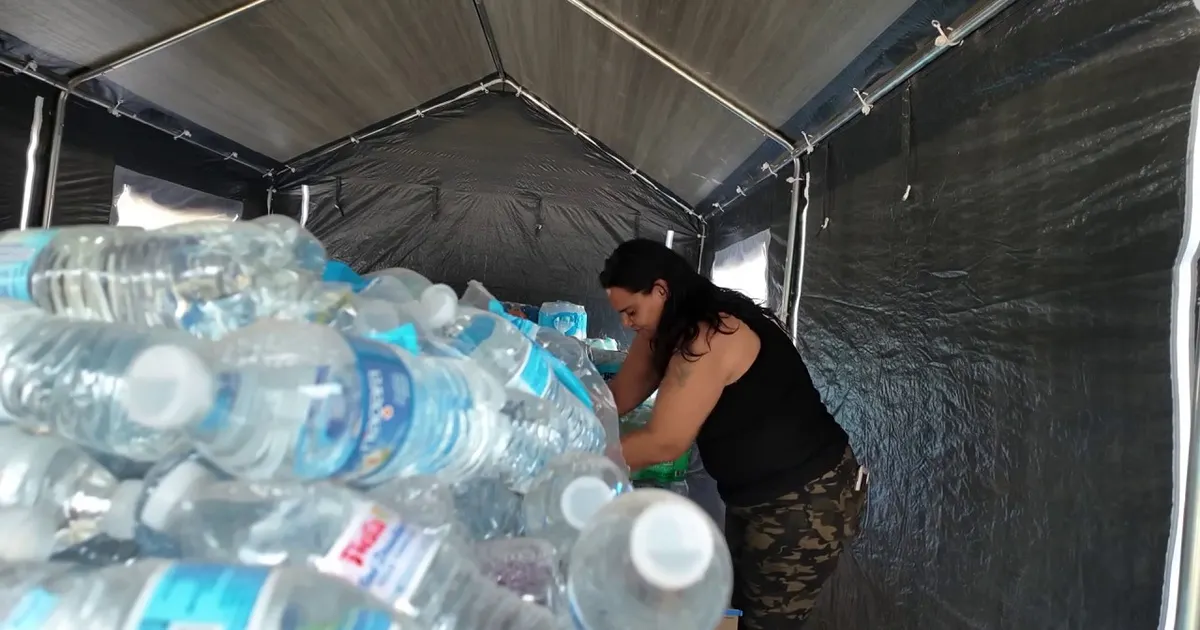
Sand Branch, a historic settlement about 15 miles south of Dallas, has never had a mains water system, leaving its roughly 150 residents dependent on donated bottled water and unsafe or unreliable wells.
Founded in 1878 as a freedmen’s settlement, the unincorporated community has remained without running water or a sewage network despite being close to one of the largest cities in the United States.
Residents say the crisis worsened after the nearby Southside Wastewater Treatment Plant was built in 1964. Wells that once supplied the community were later found to be contaminated with faecal matter and phosphates, forcing families to transport water or rely on deliveries from charities and local groups.
Sand Branch residents still waiting for clean water
The absence of basic infrastructure affects almost every part of life. Many people live in ageing homes or caravans, while restrictions linked to the area’s designation as a floodplain have made it difficult for residents to build, repair or improve their properties.
Sand Branch residents say the community has not experienced a flood for more than a century. Dallas County has previously offered to relocate residents, including in 2002 and 2016, but many refused to leave the place they regard as home.
Dallas County Commissioner John Wiley Price said in 2016 that building a levee to allow the community to remain would have cost between $7 million and $10 million. He argued that relocation was more practical, but acknowledged that officials could not force people to move without invoking health and safety powers.
Recent research by the University of Texas at Arlington has highlighted the particular risks faced by Sand Branch. Researchers said its lack of potable water and other basic services leaves residents especially vulnerable during floods, winter storms and wildfires, while informal ownership of inherited land can make it harder to secure government assistance.
([uta.edu](https://www.uta.edu/news/news-releases/2026/02/23/disaster-risk-runs-high-in-unincorpirated-areas))
Residents and campaigners are now pursuing a permanent solution rather than relying on emergency supplies. The Sandbranch Development and Water Supply Corporation says it is working with federal, state and local authorities to secure funding for drinking-water and wastewater services.
([sdwsc.org](https://sdwsc.org/))
Christina Parks, who moved to Sand Branch four years ago, has become a central figure in the community’s relief efforts. She runs a food pantry from outside her home, distributing bottled water, ready-to-eat meals and supplies for pets.
She also founded the initiative “No One Goes to Sleep Hungry in Sand Branch”, preparing about 100 hot meals each Saturday and delivering them door to door.
Parks has worked with Derek Avery, founder of the Water for Sand Branch Coalition, to organise community events and raise awareness of the settlement’s needs.
“I get a peace of mind knowing that everybody is full,” Parks said of the weekly meal deliveries. “I can go home, and I can relax knowing that everybody has ate and they’re going to sleep good tonight.”
Avery has argued that the lack of water is no longer a question of whether a solution exists, but whether officials are willing to act.
“If my civil engineer and I can sit down in two and a half hours and map out the solution, this could have been solved decades ago… if people had the political will to do so,” he said.
The urgency of the campaign was underlined by a major fire in Sand Branch on August 29, 2026. Fire crews had to bring water in from surrounding communities because there are no hydrants, while residents were left relying on emergency supplies during the response.
([keranews.org](https://www.keranews.org/news/2026-09-14/after-a-major-fire-sand-branch-activists-seek-permanent-water-infrastructure-for-the-community?_amp=true))
Campaigners have since put forward the Ken Wright Dallas County Essential Infrastructure Bond proposal, which would allocate money towards water and sewage systems in Sand Branch and neighbouring communities, as well as assistance for residents struggling with property costs.
([keranews.org](https://www.keranews.org/news/2026-09-14/after-a-major-fire-sand-branch-activists-seek-permanent-water-infrastructure-for-the-community?_amp=true))
“The whole community is in a crisis,” Parks said. “One thing about Sand Branch is that we are strong. We are not begging for help, we are just asking for our basic needs.”
