


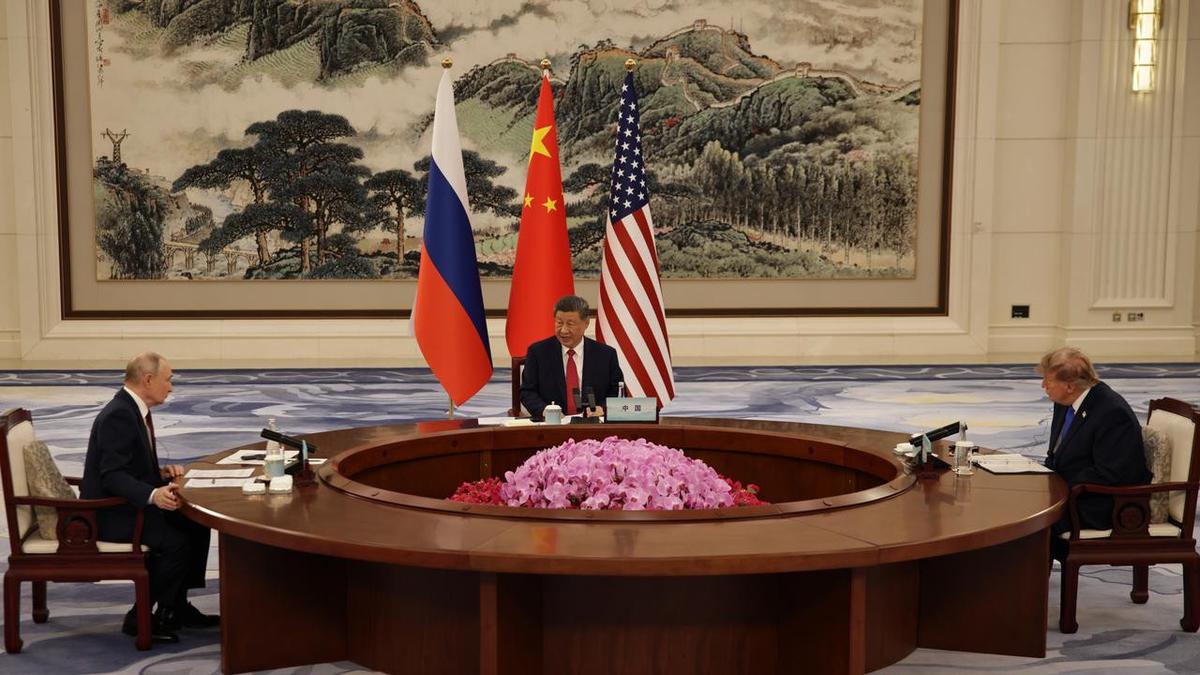
Anthony Albanese’s meeting with Xi Jinping in Shenzhen is expected to be overshadowed by the Chinese president’s earlier talks with Donald Trump and Vladimir Putin, despite being a major diplomatic engagement for the Australian prime minister.
The Australian and Chinese leaders are due to hold their fifth formal meeting at the Kylin State Guesthouse on Friday, a day after Xi hosts the first trilateral gathering involving the leaders of China, the United States and Russia.
That meeting, held on the sidelines of the APEC summit, is expected to dominate proceedings. Mr Trump said the three countries were “uniquely positioned to discuss how to reduce the number of nuclear weapons on Earth and also to lessen the risk of those weapons being used”.
Mr Albanese used a speech to the summit to call for an end to the conflicts in Iran and Ukraine, directly urging Mr Putin to “end it now”.
However, attempts by Australia and other middle powers, including Canada and New Zealand, to isolate Russia were weakened by Mr Trump’s warm reception for the Russian president.
Mr Trump also criticised globalism and questioned the credibility of the International Criminal Court, which has issued an arrest warrant for Mr Putin over alleged war crimes. Once treated as a pariah after Russia’s full-scale invasion of Ukraine in 2022, the 74-year-old leader has returned to a prominent role on the international stage.
Australia-China meeting to focus on beef exports
While Mr Albanese’s ability to influence a settlement to the Ukraine war may be limited, his talks with Xi and Chinese Premier Li Qiang are expected to focus on practical gains for Australian businesses.
Trade access, particularly for Australian beef, is likely to be raised during the discussions. China introduced a quota on beef imports from Australia and other countries for three years from 2026, citing the need to protect domestic farmers.
Chinese importers reached this year’s 205,000-tonne quota in June, leading to a 55% tariff on further imports. Speaking at a supermarket in Shenzhen on Wednesday, Mr Albanese said the speed at which the quota had been filled showed the strength of demand among Chinese consumers for Australian beef.
Rabobank analyst Angus Gidley-Baird has predicted that the 2027 quota could be exhausted by May. The Australian Meat Industry Council estimates the restrictions could cut the value of Australian beef exports to China by about $1 billion a year.
The sector will not be represented at a chief executives’ roundtable in Beijing on Friday evening, but the Business Council of Australia, which is co-hosting the event, is expected to press for improved access for beef exporters.
“From an Australian perspective, we have a compelling proposition to offer,” BCA president Geoff Culbert will tell Australian and Chinese business leaders.
