


Everywhere you look the influence of one figure overshadows Prince Harry’s shock homecoming to Britain. It is there in both the element of surprise and in its breathtaking chutzpah.
And it is there in Harry’s certainty that, whatever the consequences, it was the right thing to do.
That figure, of course, is Princess Diana whose memory has become a lodestar for Harry. Indeed, as the decades have passed – next year Harry (and let’s not forget Prince William) will be marking the 30th anniversary of her tragic death.
But for Harry, rather than diminishing with time, his mother’s influence is growing. The audacity of the announcement and the timing was guaranteed to grab the attention of the country and to shake his own family out of their high summer drowsiness at Balmoral.
How reminiscent it was of Diana’s revelation that she had secretly recorded a television interview with BBC’s Panorama programme, a broadcast that even now, 31 years later, continues to reverberate with the Royal Family.
Harry gave his father three days’ notice of his and Meghan’s intentions to relocate from California.
Diana announced news of her interview eight days after it had been shot and a week before its screening. It blindsided everyone.
For both mother and son, each announcement was a fait accompli, not subjects for discussion but matters of fact.
Harry’s unexpected announcement to relocate back to Britain, giving King Charles just three days’ notice, mirrors Diana’s secret 1995 Panorama interview – which similarly caught the Royal Family off guard

Like Diana, Harry is banking on the British public’s capacity for forgiveness. Pictured: Martin Bashir interviews Princess Diana in Kensington Palace for the television program Panorama
Here, too, Harry, like Diana, has made another calculation – but in the Duke of Sussex’s case it is infinitely riskier.
It is the issue of forgiveness and that for all his past mistakes he can rely on the British public’s sense of fair play – or at least mercy.
Diana escaped unscathed from the Panorama fiasco, despite massive establishment anger over her airing of dirty laundry in general and her criticism of her then husband Prince Charles’s ability to become an effective monarch.
It barely dented her image, and her popularity – especially among women – soared with a public who identified with her dramatic account of how her marriage had been destroyed by the presence of Mrs Camilla Parker Bowles, now the Queen.
Like Harry, the princess also collaborated with a tell-all book, about the unhappiness of her life with Charles and difficulties with being a member of the Royal Family.
Again, whatever the truth of the matter, the public sided with a young woman they judged had been cruelly treated by cold and hostile in-laws.
There are, however, some essential differences that Harry would be wise to consider. Diana never broke with the royals and, whatever her frustrations about public duty, continued to be a much-valued and effective working member of the family.
Harry quit and was scathing about the country and institution he walked away from. His and Meghan’s departure was littered with accusations of racism and resentment with attacks that blighted the last months of the lives of both of the prince’s grandparents, the Queen and Prince Philip.
Was Harry’s head turned during his brief visit to Britain in July when he impressed during engagements with a public that was briefly swayed by his natural charm, a reminder of the carefree pre-Meghan days?
Until this point, both his and Meghan’s popularity had been on the floor, with approval ratings only marginally better than the disgraced former Prince Andrew.
Remember too, that however deep her dissatisfaction with the royals, Diana did not make ad hominem attacks on wider family members as Harry has.

King Charles reportedly desires family unity, recognising from his own past media controversies that public perception can recover over time. Pictured: Prince Charles, Prince William, Catherine, Meghan and Prince Harry attend a Christmas Day service at Church of St Mary Magdalene on the Sandringham estate in December 2018

Rumors indicate Harry is planning a documentary about Diana for the 30th anniversary of her death, a project unlikely to involve William. Pictured: Prince Harry and Meghan attend The Endeavour Fund Awards at Mansion House on March 05, 2020 in London
The rift between Harry and William is deeper and strategically more damaging for the monarchy than any of Diana’s quarrels, which largely were patched up.
One other key factor is the lack of any sign of regret from Harry. He may see himself as the returning prodigal son but without any measure of repentance, that return looks distinctly shaky.
For her part, Diana did have regrets and admitted mistakes. She acknowledged she went too far in some of her remarks to reporter Martin Bashir, an interview, remember, that we now know she was tricked into.
It is not just the confessional of the book and broadcasting where Harry is following his mother’s footsteps, but also in her unpredictability.
The princess had an uncanny ability to divine the public mood on matters of national importance. Her decision to attend a Remembrance Sunday service in Enniskillen, Northern Ireland, six years after the IRA’s Poppy Day bomb killed 11 people, was just such a moment.
She and Charles had visited the town in the aftermath of the 1987 attack, and she kept up a long correspondence with the families of the victims of terror and of other tragedies. And she chose unfashionable causes to champion.
But while this guaranteed her huge support, it did not make her popular within the Royal Family, whom she was repeatedly accused of upstaging. This eventually was to chip away at her confidence.
I understand that Harry has told friends he feels his late mother’s presence, that she is guiding him and that she comes to him.
This undoubtedly is affecting. Diana’s death has cast a long shadow over Harry’s life and the poignancy of him following the coffin at her funeral, aged 12, is seared into the national memory.
But Harry is not the sole custodian of the princess’s legacy. It is shared with William. He too, overwhelmed by sadness, was part of that funeral party. Both brothers have acknowledged their mother in aspects of their lives.
Their daughters Charlotte and Lilibet share Diana as a middle name; their wives wear her jewellery; and their Spencer family cousins are woven into their lives as godmothers to their children.
Weddings and christenings have included references to the mother they lost. And both princes continue to cite her influence. But Harry is far more public about it and has sought ownership of that legacy in a way William never has.
Should Harry now attempt to stake further claims on his mother’s inheritance it is unlikely to be welcomed by William.
Rumours abound that part of the reason for Harry coming home concern his plans – thought to be well advanced – to make a documentary about Diana for screening next year. Friends and family have been approached but it is not clear whether they include William or indeed whether he would even consider it.
Ten years ago, the brothers joined forces to contribute to two documentaries on their mother for the 20th anniversary of her death. The idea of co-operating together on such a project today seems scarcely credible.
So, can there ever be a reconciliation? William was outraged by the claims of racism which, according to Harry and Meghan, had sprung from family discussions about the likely skin colour of their unborn son Archie.

The rift between Prince Harry and Prince William remains severe, with no direct contact reported in four years

Unlike traditional royal upbringing, Harry has kept his family dynamic and children largely guarded, shielded from official public duties, red-carpet obligations, and British media exposure
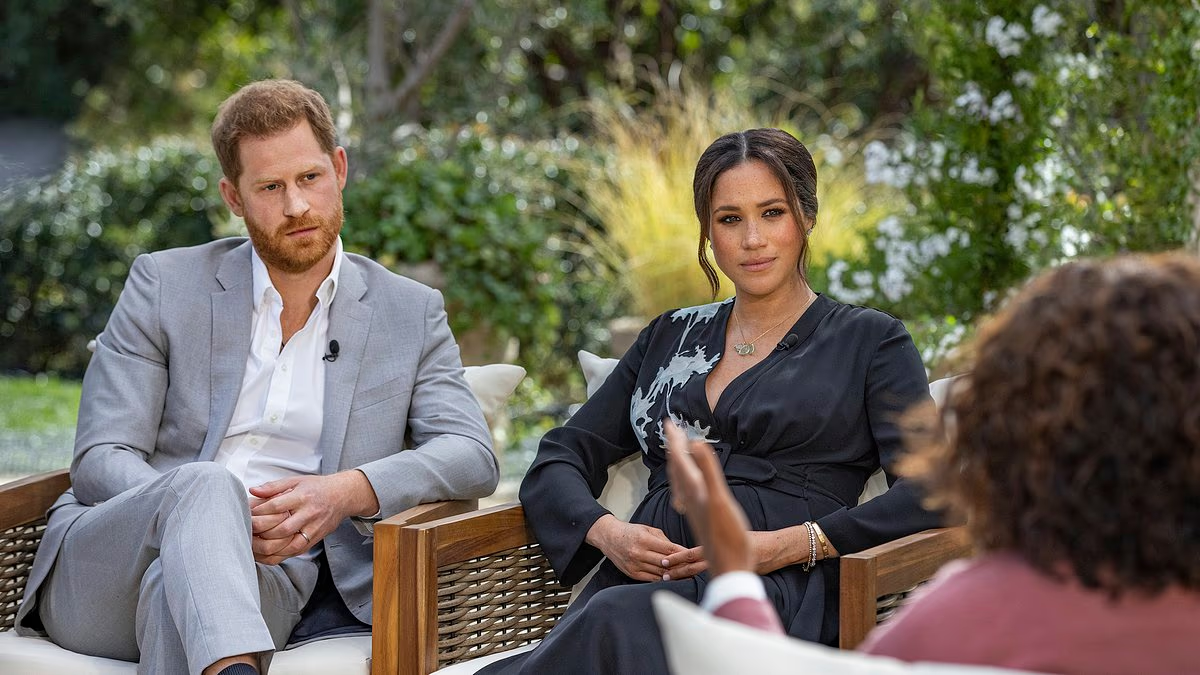
Claims which were broadcast to the world in the Sussexes’ Oprah interview. The brothers are not thought to have spoken for four years.
When they were forced to come together – with Catherine and Meghan – to meet wellwishers at Windsor after Queen Elizabeth’s death, the Princess of Wales confided to a family member that it was the ‘hardest thing’ she’d ever had to do.
No wonder William looked grim-faced as he emerged at the wheel of a car at Balmoral yesterday. If anyone has been blindsided, it is him and Kate.
With talk of a rival court emerging around his brother, William has every reason to fear that all the work he has done to stabilise the monarchy in the wake of both Megxit and the Andrew Mountbatten-Windsor scandal may be disrupted.
Can he rely on assurances that there will be no gradual return to public duties by the Sussexes? And what about red carpet events? With Meghan apparently set on resuming her acting career, there will surely be glamorous public-facing engagements that could diminish coverage of his and Kate’s working lives.
Then there is the crucial issue of trust. William needs to be certain that private family matters are not leaked to US networks and Sussex-friendly magazines.
Despite the public notion of a Royal Family doing everything together, they lead largely separate, self-contained lives, only coming together on set-piece occasions.
And one is already looming. What will happen at Christmas? Having been deprived of the company of his Sussex grandchildren for years, the King will surely want them at Sandringham. Don’t be surprised if William exercises his right to spend this Christmas with his Middleton in-laws.
At the same time, Harry may be inclined to take another page out of his mother’s playbook.
After her separation from Charles, Diana spent the bare minimum of time with the Royal Family at such gatherings, arriving late on Christmas Eve and leaving after church on Christmas Day. Time – just – for her to see the joy on her sons’ faces when they opened their presents.
For Charles, Harry’s homecoming may be mixed: thrilled to have his entire family back in Britain but wary too. He has found the family breach sad and exhausting. As he told a friend: ‘My mother had 70 years to look after her family, I don’t have that luxury.’
No one knows more about the vicariousness of popularity than the King. As Prince of Wales, he was mercilessly criticised for his treatment of Diana and lampooned for his cranky views. But as King he has become a much-loved figure.
‘He will have told Harry that we in Britain will forgive and forget,’ says one close figure. ‘Don’t forget he too wrote a book criticising his parents, made a television programme, and admitted adultery. All that now is in the past.’
Whether the public will extend that same courtesy to his son remains to be seen.
It’s true that the monarchy has survived other family crises. But the reintegration of Harry and Meghan may be its toughest test yet.
