


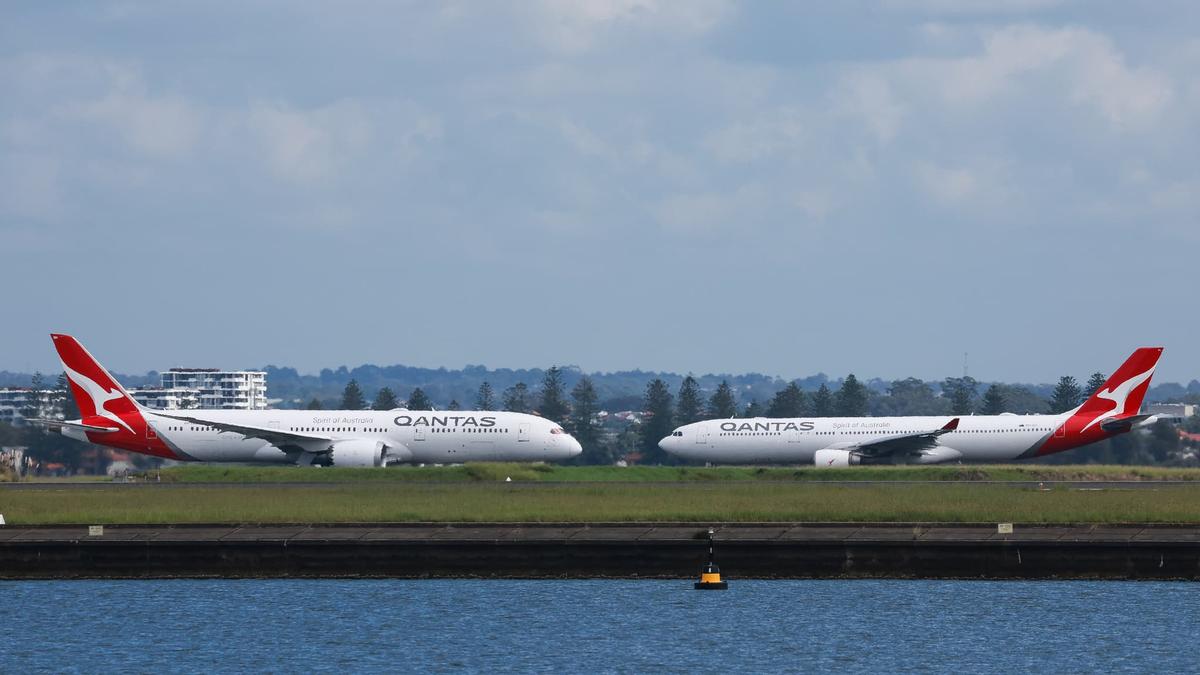
A runway near-miss at Sydney Airport in which a Qantas Boeing 737 was cleared to cross ahead of a QantasLink Dash 8 still completing its landing roll has been classified as the most serious level of runway incursion.
The Australian Transport Safety Bureau (ATSB) released four preliminary reports on Wednesday as it investigates six incidents between July 27 and August 18. The reports do not make final findings or recommendations.
Angus Mitchell, the ATSB commissioner, said the incident was only the third in Australia to receive the highest classification on the international scale since records began in 2003.
Air traffic controller numbers at Sydney Airport have emerged as a recurring line of inquiry, although the bureau has not concluded that staffing levels contributed to any of the occurrences.
“I will stress that we have not determined whether staffing resources directly contributed to any occurrence, or whether they were simply underlying conditions that were effectively being managed by Airservices (Australia),” Mr Mitchell said.
Fatigue risks examined in Sydney Airport investigation
The preliminary reports record that roster modelling by Airservices Australia predicted elevated fatigue risks for controllers during many of the incidents.
Mr Mitchell stressed that the modelling did not establish that any controller was fatigued or that fatigue affected their performance. The investigation is examining whether the measures used to manage the identified risk were effective.
On August 9, a Jetstar aircraft had to brake suddenly to avoid a Qatar Airways Boeing being towed. A Jetstar cabin crew member fell and suffered a fractured wrist.
Later that day, a Qantas 737 was cleared to cross the runway in front of a Virgin 737 that had just been cleared for take-off. On August 18, a Qantas A321 also had to brake to allow a Qantas 737 to pass in front.
Mr Mitchell said safeguards had operated in each of the six incidents, with controllers, pilots or ground staff intervening to prevent more serious outcomes.
“Nonetheless, we need to understand why those interventions were required,” he said.
Airservices Australia said the preliminary reports had not determined that staffing, overtime or fatigue contributed to the incidents. The organisation said it had acknowledged workforce pressures at Sydney Airport and was addressing them through its Sydney Service Resilience Plan.
It said individual reviews of the occurrences had found no correlation with fatigue and that the recent incidents did not indicate an immediate safety risk to travellers based on the information currently available.
The ATSB’s wider analysis found Sydney had the highest rate of aircraft conflicts among major airports after the Covid period, at about 20 per cent above the national average. The bureau said the figure needed to be viewed in the context of Sydney being Australia’s most complex airport.
The analysis also identified Sydney-specific increases in potentially high-consequence events, including runway incursions, near-collisions on taxiways and losses of separation attributed to air traffic control actions.
