


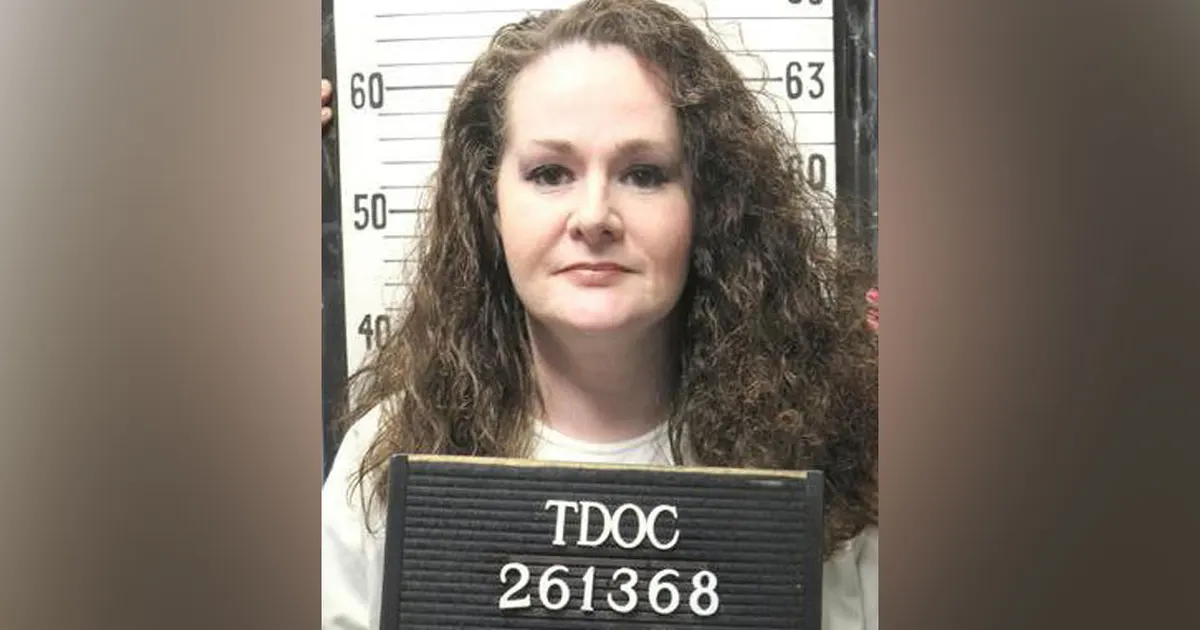
Christa Pike is in critical condition after surviving an attempted lethal injection in Tennessee, where officials administered two doses of pentobarbital before taking her to hospital.
The 50-year-old had been due to die at Riverbend Maximum Security Institution in Nashville on Wednesday for the 1995 murder of 19-year-old Colleen Slemmer. The procedure was halted after Pike remained alive, prompting Governor Bill Lee to suspend Tennessee’s remaining scheduled execution this year.
Pike’s lawyer, Randy Spivey, said on Thursday that she was receiving “lifesaving care” but that her legal team had not been given a detailed update on her prognosis.
“Christa is alive right now. We don’t have a sense of her prognosis or much update on her health at the moment,” Mr Spivey told reporters. “But we know she is alive right now and receiving lifesaving medical care.”
Her lawyers said Pike was still breathing and loudly snoring after the two doses had been administered. They described the failed procedure as torture and called for her death sentence to be commuted to life imprisonment.
What happened during the lethal injection attempt
Media witnesses said the execution chamber was opened at about 7.27pm, showing Pike strapped to a gurney. She delivered what were intended to be her final words, saying: “I’m going to leave this world the way I spent most of my life and that is in love.”
She later asked prison officials whether her arm was supposed to feel the way it did. A second dose of pentobarbital was given by about 8.26pm, but witnesses continued to hear her snoring before the microphone was switched off.
Pike’s lawyer Steve Ferrell said she had a lifelong blood disorder which had made it difficult to access her veins. Mr Spivey said he counted at least seven needles being used in her left arm alone.
The Tennessee Department of Correction said Pike had been taken to an off-site medical facility. It maintained that staff had followed “every step” of the state’s approved execution protocol and said the procedure did not permit any additional measures beyond those carried out.
The state’s protocol requires a second set of syringes to be administered if a prisoner is not dead after the first dose. It does not specify what should happen if the prisoner remains alive after the second set.
Mr Lee ordered a comprehensive independent review of the incident, calling it “deeply disturbing”. He said carrying out a lawful sentence was among the state’s most serious responsibilities and that executions must be conducted in a way that is legal, constitutional and effective.
The failure came after a federal appeals court had briefly halted Pike’s execution shortly before it was due to begin. The US Supreme Court later overturned that stay, allowing Tennessee to proceed.
Pike would have been the first woman executed in Tennessee in more than 200 years. She was sentenced to death for the killing of Slemmer, a fellow student at a job-training facility in Knoxville.
Prosecutors said Pike lured Slemmer into a wooded area before attacking her with a box cutter and a piece of asphalt. Pike’s boyfriend, who was 17 at the time, was also convicted but received a life sentence with the possibility of parole.
The failed execution was the second time in 2026 that Tennessee had been unable to complete a lethal-injection procedure. In May, officials abandoned the execution of Tony Carruthers after spending more than an hour trying to establish an intravenous line.
