


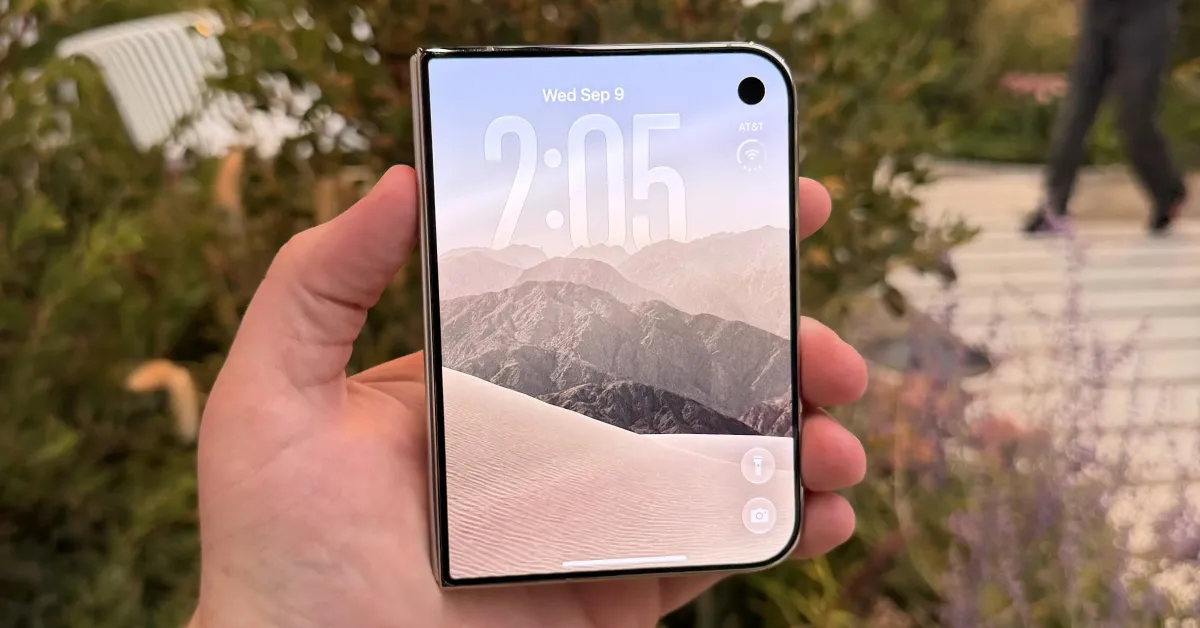
Apple’s foldable iPhone Duo has made its debut, but the company’s most significant attempt to challenge Samsung and other established rivals may be its software rather than its hardware.
Unveiled at Apple’s “Surprise and Shine” event, the Duo is a book-style foldable with a slightly wider, shorter design than Samsung’s Galaxy Z Fold 8. It uses flexible plastic and thin titanium layers beneath its OLED display, with Apple claiming the central crease is almost impossible to see.
The company has also brought back an under-display camera and added Apple Pencil support, two features that have recently disappeared from Samsung’s competing Fold range. The Duo will be released in October alongside iOS 27.1.
Apple’s foldable iPhone Duo puts iOS centre stage
Early demonstrations suggest Apple has paid close attention to how its operating system moves between the external and internal screens. Animations are designed to make the transition feel continuous, while changes to the interface are intended to make the larger device easier to use with one hand.
The cover display will also feature a redesigned sidebar incorporating status icons and the dock. Apple hopes the changes will make the Duo feel like more than a conventional iPhone that opens into a larger screen.
Older applications may initially appear awkward on the expanded display, but developers will be able to target the foldable directly through updates released for iOS 27.1. Apple is relying on the attraction of the larger canvas to encourage developers to redesign their apps and create new opportunities for paid features and services.
That approach could become one of the Duo’s biggest advantages. Apple has historically been effective at persuading developers to support new screen sizes and hardware categories, potentially giving its foldable a more consistent app experience than some Android rivals.
The company’s hardware, however, does not appear to represent a decisive break from the latest foldables. The Duo has an IP68 rating for dust and water resistance, although that protection can deteriorate over time, and uses a fingerprint sensor built into its side rather than Face ID.
It has two cameras, without the upgraded imaging features found on the iPhone 18 Pro models, and weighs 254 grams. That makes it heavier than most current book-style foldables. The device is also expected to cost about 2,000 dollars, placing it firmly at the premium end of the market.
Apple’s entry could nevertheless have an impact beyond its own customers. Developers who have been reluctant to optimise Android applications for foldable screens may face greater pressure to do so once the iPhone Duo brings a large, high-profile audience to the format.
The wider launch included the iPhone 18 Pro and Pro Max, Apple Watch Series 12 and Ultra 4, and AirPods 5. But the Duo’s arrival marks the company’s clearest attempt yet to redefine the smartphone experience through software that adapts to a changing screen.
