


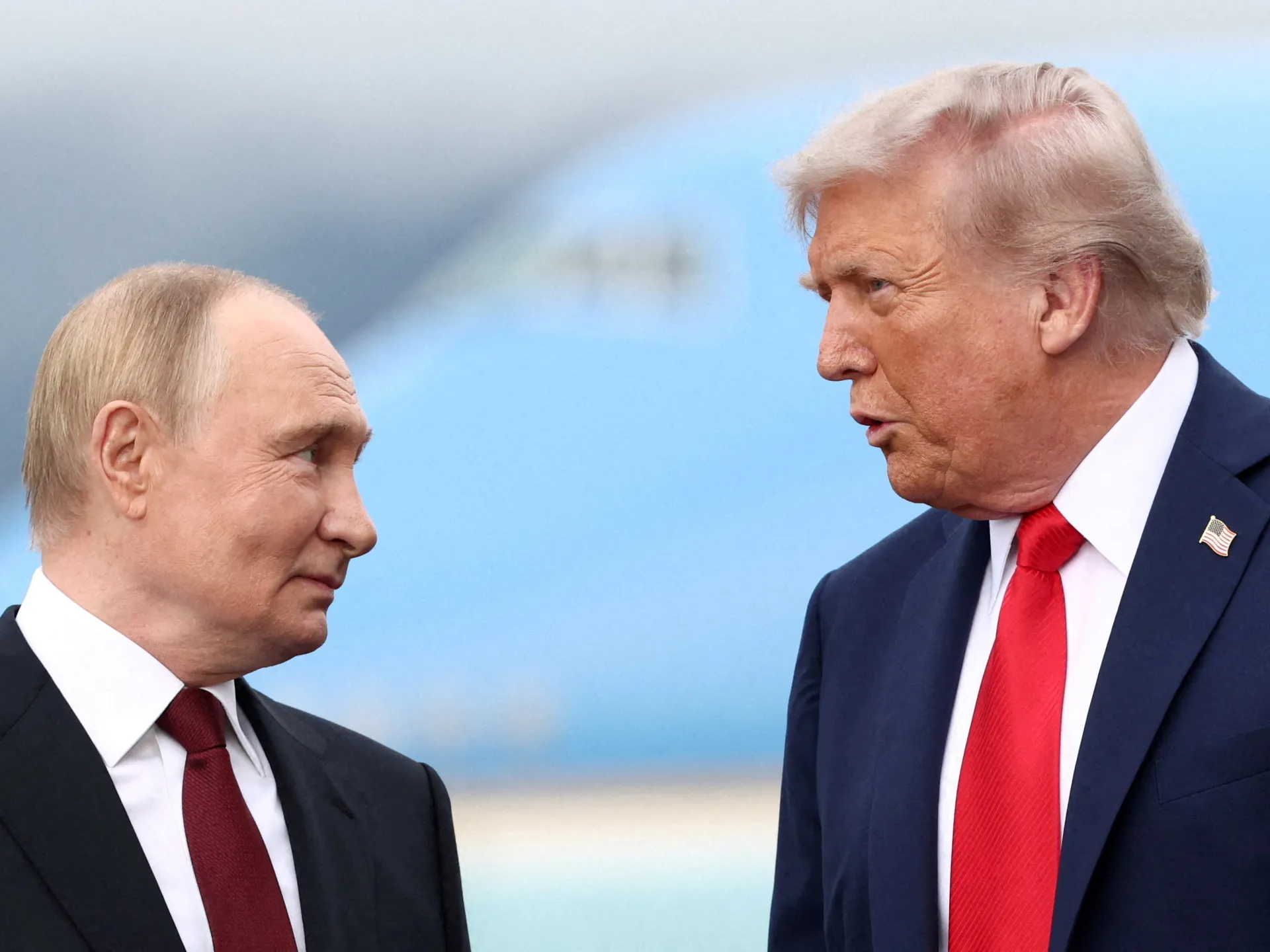
China is set to take part in the first-ever meeting between the leaders of the world’s three largest nuclear powers, as Donald Trump presses for a new US-Russia-China nuclear arms treaty.
The US president will hold talks with Chinese President Xi Jinping and Russian President Vladimir Putin on the sidelines of the Asia-Pacific Economic Cooperation summit in Shenzhen this week, the White House has confirmed.
Washington and Moscow are expected to focus on replacing New START, the treaty that limited their strategic nuclear arsenals before its five-year extension expired in February. Mr Trump has rejected Russia’s proposal to extend the agreement, calling instead for a “new, improved and modernised” deal that includes China.
Why China is resisting a nuclear arms treaty
Beijing has repeatedly indicated that it is not ready to enter negotiations to cap its nuclear forces. Its central argument is that its arsenal remains far smaller than those of the United States and Russia.
China is estimated to possess about 620 nuclear warheads, compared with more than 5,000 each for Moscow and Washington, according to figures from the Stockholm International Peace Research Institute. New START allowed the US and Russia to deploy up to 1,550 strategic warheads each.
“China’s nuclear forces are not on the same level as those of the United States and Russia, and China will not participate in disarmament negotiations at this stage,” Chinese foreign ministry spokesman Lin Jian said when New START expired.
China’s stockpile is nevertheless expanding faster than that of any other nuclear power, with about 100 new warheads added each year since 2023, according to SIPRI data.
Zhao Minghao, a professor at Fudan University’s Institute of International Studies, said Beijing’s position reflected the imbalance between the three countries and its own approach to nuclear weapons.
“China maintains a declared no-first-use policy and a ‘minimum deterrence’ posture – nuclear weapons as political instruments for assured retaliation, not warfighting,” he said.
Mr Zhao said a trilateral treaty could restrict China’s ability to build a survivable retaliatory force while imposing verification requirements on a comparatively small arsenal. He also pointed to what he called a credibility problem caused by previous US withdrawals from arms control agreements.
Sun Chenghao, a fellow at the Center for International Security and Strategy at Tsinghua University, said Beijing was also concerned about US missile defences, precision-strike capabilities and emerging technologies that could weaken its ability to retaliate.
“An agreement limiting China’s forces while leaving those concerns untouched would have limited appeal,” he said.
The challenge of replacing New START
New START, signed in 2010 by Barack Obama and Dmitry Medvedev, restricted US and Russian strategic warheads, long-range missiles and bombers. It also required the two sides to permit inspections of strategic weapons sites.
The treaty was extended in 2021, but inspections were halted during the Covid-19 pandemic and following Russia’s full-scale invasion of Ukraine. The two countries have since had to rely on their own intelligence to assess whether the other is complying.
The agreement had provided safeguards between the two countries, which together possess about 86 per cent of the world’s nuclear warheads. Washington now wants any successor treaty to cover weapons not included in New START, including newer Russian systems and the growth of China’s arsenal.
William Yang, the International Crisis Group’s senior analyst for north-east Asia, said Beijing saw no clear benefit in joining negotiations and would regard a treaty as an attempt to constrain its nuclear modernisation.
“As a result, Beijing prefers to maintain strategic autonomy in expanding its nuclear arsenal and modernising relevant defence capabilities,” he said.
A possible agreement would need to recognise the different sizes of the three countries’ arsenals and their contrasting nuclear doctrines. Analysts have suggested phased reductions, data exchanges, advance notification of major exercises and talks on crisis communications.
Sun said negotiations would also need to address missile defence, advanced conventional weapons and emerging technologies, including human control over artificial-intelligence-enabled nuclear systems.
But analysts said a formal accord was unlikely in the near term. The war in Ukraine, tensions over Taiwan and US military deployments in the Asia-Pacific continue to weigh on relations between Washington and Beijing.
“The likeliest near-term outcome is not a treaty but informal restraints while formal arms control waits for a geopolitical thaw that this decade is unlikely to deliver,” Mr Zhao said.
