


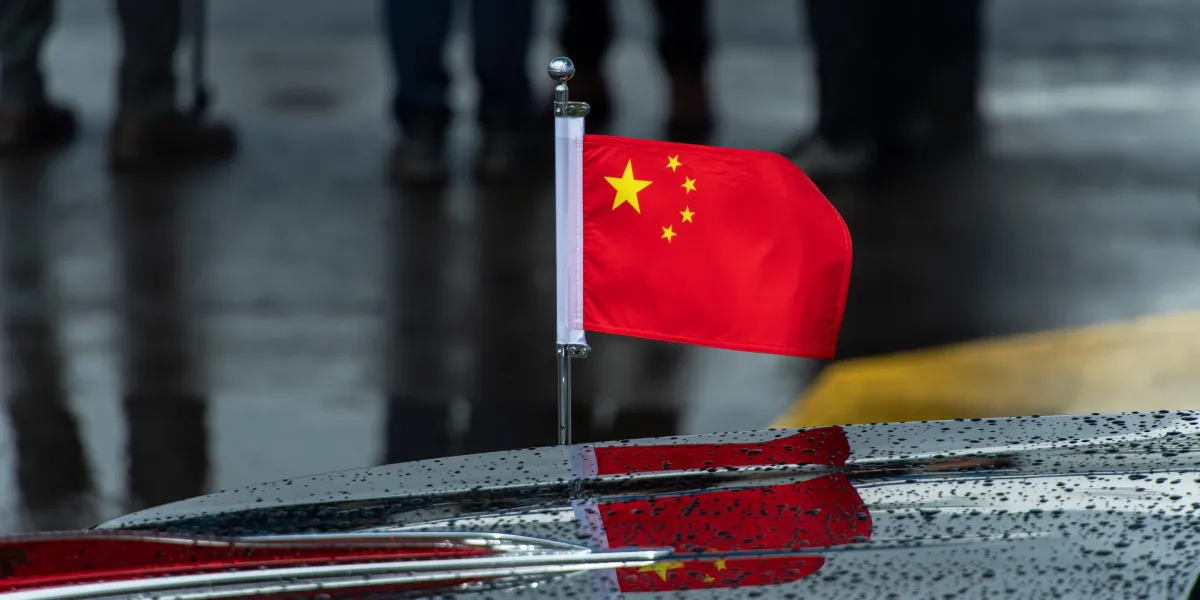
China’s car industry has gone from being protected from European competition to producing more vehicles than the European Union, the UK and the US combined, with electric vehicles driving its rise and prompting tariffs in overseas markets.
Chinese manufacturers produced more than seven million cars in the first quarter of 2026, compared with 3.7 million across the EU and UK and 2.6 million in the US. The scale of that expansion has left established European carmakers facing a challenge from an industry they once helped build.
“There’s been a complete reversal,” said Eric Thun, professor of Chinese business studies at Oxford.
The European Union and US have imposed tariffs on Chinese-made electric vehicles, arguing that state support has helped create excess production and a wave of cheap exports. Weak demand at home has increased Chinese manufacturers’ reliance on overseas sales.
Germany, whose car industry is particularly exposed, may even require joint ventures with Chinese companies — reversing the model China used decades ago to develop its own manufacturing capabilities.
From protected market to global producer
Before China joined the World Trade Organisation in 2001, its car market was protected by import quotas and tariffs of up to 100 per cent. Foreign manufacturers could operate there, but generally had to produce vehicles locally with a Chinese partner that held at least half of the joint venture.
When Michael Dunne first visited China in 1986, the country had barely any domestic car industry. The roads were dominated by two models: the Soviet GAZ-24 Volga and the Volkswagen Santana.
That year, Beijing made vehicle manufacturing a priority in its seventh Five Year Plan and began inviting international carmakers to establish production in the country. By the late 1990s, joint ventures accounted for more than 80 per cent of domestic vehicle production.
The policy created a large manufacturing base but did not initially produce Chinese companies capable of matching Volkswagen and General Motors in petrol-engine technology, said Mr Dunne, who spent 36 years advising carmakers in China.
However, foreign companies were required to source a proportion of their components locally. Engineers from Volkswagen and other manufacturers helped Chinese suppliers meet international production standards, creating what Mr Thun described as “very deep industrial capabilities”.
China’s entry into the WTO brought greater competition and also coincided with relaxed restrictions on new domestic manufacturers. BYD, then a battery maker, obtained an automotive licence in 2003, while Chery and Geely also benefited from the rapidly expanding market.
Beijing encouraged manufacturers to reduce their reliance on Western technology and offered tax support for research and development. The country’s existing strengths in batteries and electronics then gave its companies an opportunity to compete in electric vehicles rather than directly challenge European and Japanese expertise in internal-combustion engines.
How electric vehicles changed China’s car industry
Government support for electric vehicles began in earnest in 2009, when China introduced programmes to deploy electric buses and taxis in cities. Early models had serious limitations, including batteries that could run out during a taxi driver’s shift, but the schemes gave manufacturers a large testing ground.
“These procurement policies essentially forced a lot of learning and gave them sort of space for experimentation,” said Jonas Nahm, a former member of the White House Council of Economic Advisers and a professor at Johns Hopkins School of Advanced International Studies.
China’s Made in China 2025 initiative, announced by Premier Li Keqiang in 2015, set out the ambition to become a leader in electric vehicles. Subsidies and preferential financing helped manufacturers expand rapidly, but also contributed to excess capacity as a prolonged property slump weakened domestic demand.
The arrival of Tesla accelerated the change in consumer attitudes. China began relaxing restrictions on foreign ownership of electric-vehicle manufacturers in 2018, allowing Tesla to build a factory in Shanghai without a Chinese joint-venture partner. The plant began delivering locally made cars by the end of 2019.
Mr Dunne said Chinese officials viewed Tesla as a modern, technologically advanced electric car that could alter public perceptions. The company’s Shanghai plant shipped 50,000 cars and Tesla held 21 per cent of China’s electric-vehicle market in the first half of 2020.
Tesla also sourced 95 per cent of its parts locally, according to Mr Nahm, raising standards and intensifying competition among domestic manufacturers. That competition later contributed to a price war known as neijuan, or “involution”, in which companies overproduced and sold vehicles at a loss in China.
Chinese manufacturers produced 16 million electric vehicles last year, 20 per cent more than domestic demand, according to the International Energy Agency’s 2026 Global EV Outlook. Exports doubled to 2.5 million as BYD, XPeng and Xiaomi expanded in Latin America and Europe, with BYD outselling Tesla for the first time this year.
The growth has placed the international manufacturers that once dominated China under pressure. Volkswagen’s deliveries in China fell by 36.6 per cent in the second quarter of this year, after the country had previously supplied half or more of the group’s profits.
“The global automakers were caught flat-footed thinking they were going to be the darlings of Chinese consumers forever,” Mr Dunne said.
