


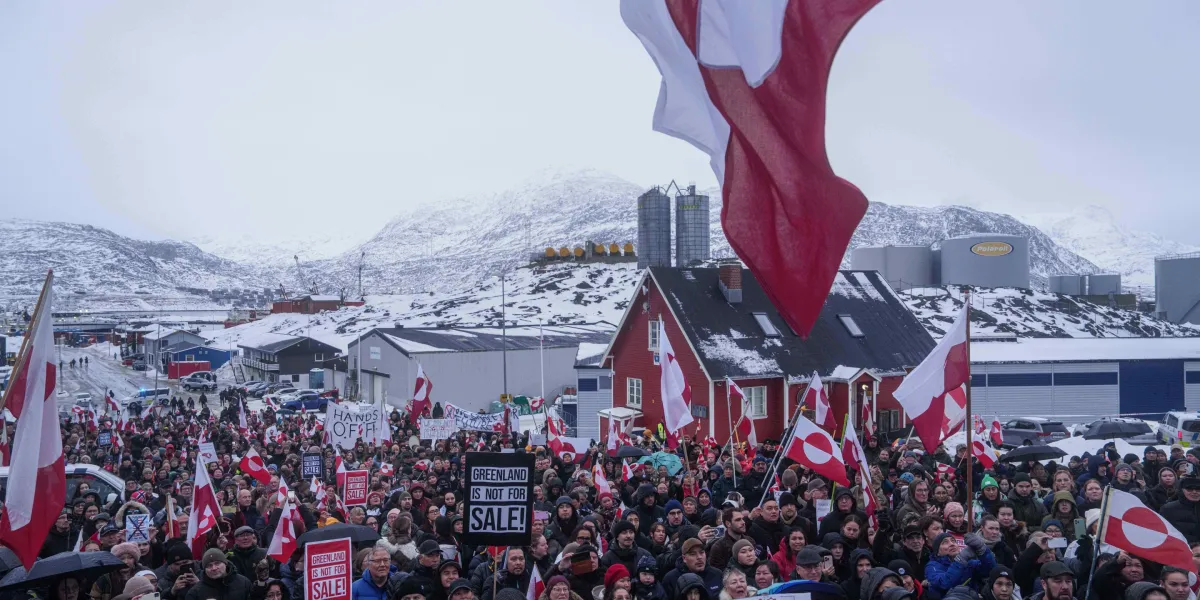
Donald Trump has announced a deal with Denmark to expand the US military presence in Greenland, while leaving the Arctic territory under Danish control after months of threats to take it by force.
The agreement is intended to give the United States what Mr Trump described as “permanent control over security, and all other needs, in Greenland”, while addressing American concerns about the strategically important island.
Mr Trump said his administration would “immediately” begin developing a larger military presence in Greenland, a mineral-rich territory whose location has made it important to the defence of North America.
The office of Denmark’s prime minister, Mette Frederiksen, said the deal would be signed by the governments of the US, Denmark and Greenland next week during the United Nations General Assembly. It will still require approval from the Danish and Greenlandic parliaments before it can take effect.
Ms Frederiksen said the agreement recognised “the sovereignty and territorial integrity” of Greenland and Denmark, while upholding the right of both peoples “to self-determination”.
Greenland’s prime minister, Jens-Frederik Nielsen, said the emerging agreement benefited all three governments and recognised “Greenland’s interests and our place in the international cooperation”.
Agreement rules out non-Nato bases in Greenland
A US State Department official said the agreement would ban any non-Nato base in Greenland, restrict investments by adversaries and prevent China and Russia from establishing a base there.
Secretary of State Marco Rubio called the arrangement a “historic deal” and a “huge win” for the United States. He said Greenland would “forever be part of the strategic defence area of North America” and that the agreement “permanently and completely addresses our national security concerns in Greenland”.
The United States already operates Pituffik Space Base in north-western Greenland, supporting missile warning, missile defence and space surveillance for the US and Nato. The base was established after a 1951 defence agreement between Washington and Copenhagen.
Greenland lies off Canada’s north-eastern coast, with more than two-thirds of its territory inside the Arctic Circle. Its position has made it strategically significant since the Second World War, when the US occupied the island to prevent it falling under Nazi German control and to protect North Atlantic shipping routes.
Since returning to the White House last year, Mr Trump had repeatedly urged Denmark to sell Greenland to the US and declined to rule out using military force. Denmark and Greenland insisted that the territory was not for sale and condemned reports that the US was gathering intelligence there.
The American campaign was also opposed by Russia and much of Europe. Imran Bayoumi, an associate director at the Atlantic Council’s Scowcroft Center for Strategy and Security, said the threats had damaged the image of the US among European allies and would require substantial work to repair relations.
