


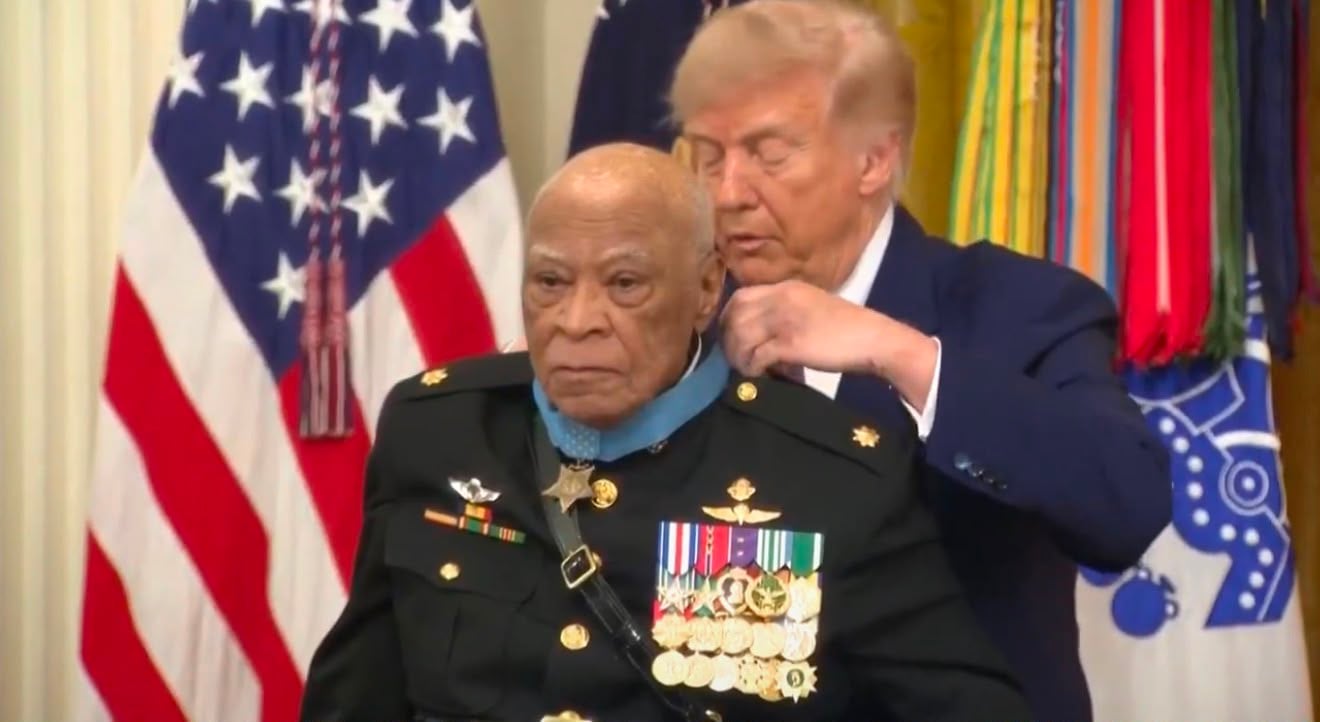
A retired United States Marine has been awarded his country’s highest decoration for valour almost 59 years after he led his reconnaissance team out of a Vietnamese ambush while gravely wounded.
Major James Capers Jr., now 88, received the Medal of Honor from President Donald Trump at a White House ceremony on Thursday. He was one of three servicemen honoured at the event, alongside Colonel John W. Ripley of the Marine Corps, recognised posthumously, and retired Army Major Nicholas Dockery.
According to the White House and the US Army, the award recognises Capers’s actions over four days in late March and early April 1967, when, as a second lieutenant, he led a nine-man team from the 3rd Force Reconnaissance Company on a patrol to locate a North Vietnamese regimental base camp. The mission, deep in enemy territory, ended in a violent ambush.
The patrol came under heavy fire and ran into mines and hidden explosives. Capers was severely hurt, suffering shrapnel wounds to his abdomen and elsewhere, along with a broken leg; by some accounts he was carrying more than a dozen separate wounds. Despite his injuries, he kept command of the team. At one point, as reported by Task & Purpose, he called in a mortar strike on his own position in order to hold the advancing enemy at bay.
He then led his men to the extraction point, and is said to have made sure every member of the team was aboard the rescue helicopter before he allowed himself to be lifted out last.
Capers, who spoke to Task & Purpose ahead of the ceremony, played down the language of heroism that has surrounded his story. He said his focus at the time had simply been on getting his troops out alive.
His military career was notable long before this week. Born in Bishopville, South Carolina, in 1937 to a family of sharecroppers, he enlisted in the Marine Corps at 18 and went on to become the first African American to command a Marine reconnaissance company and the first to receive a battlefield commission. Over his service he was decorated with the Silver Star, multiple Bronze Stars and three Purple Hearts.
For his actions in the 1967 ambush, Capers was originally given the Bronze Star with a “V” device for valour, an award later upgraded to the Silver Star in 2010. The campaign to elevate that recognition to the Medal of Honor ran for years, driven by fellow veterans and a group of lawmakers.
A practical obstacle stood in the way. Under standing rules, the Medal of Honor must normally be presented within five years of the action it recognises, and any later award requires Congress to waive that limit. Legislation to do exactly that passed both chambers, and President Trump signed the waiver into law in late March, clearing the path for Thursday’s ceremony.
The South Carolina congressman Ralph Norman, who reintroduced the authorising bill, had argued that Capers risked everything to save fellow Marines while severely wounded, and that recognition of his courage had been far too long in coming.
The award places Capers among a small group of living Medal of Honor recipients and closes a gap of nearly six decades between a young officer’s actions on a Vietnamese hillside and his country’s formal acknowledgement of them.
