


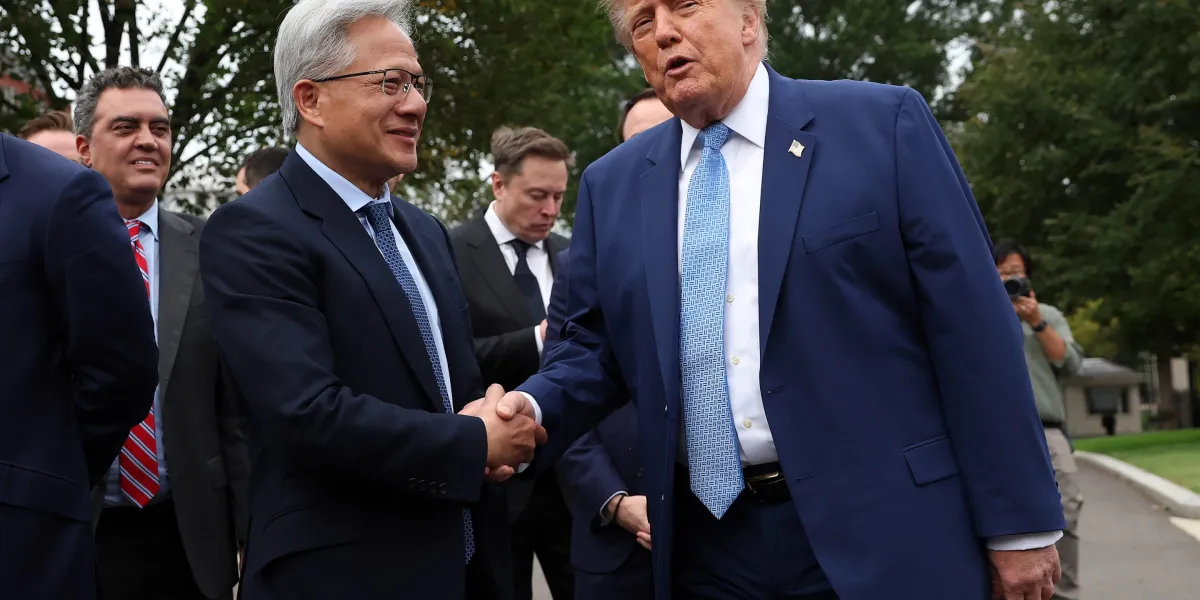
Donald Trump has intervened to bring Nvidia chief executive Jensen Huang back to the company, reversing his departure after reports of extramarital affairs, including an alleged relationship with a Chinese national whom US officials suspect of spying.
Huang, who is not related to Alice Huang, has denied compromising national security and has not been charged with a crime. Trump told CNBC that he had persuaded Nvidia to reinstate him, saying: “I convinced them.”
The decision has drawn comparisons with the Enron scandal, although there is no suggestion that Nvidia has engaged in the kind of accounting fraud that brought down the energy company. The parallel instead centres on the changing relationship between Washington and corporate America: from prosecuting powerful executives to treating strategically important companies as government partners.
Trump’s intervention at Nvidia
Huang had stepped down 11 days before his return was announced. A person familiar with the matter said Trump and Vice-President JD Vance had been briefed and found no evidence that the Nvidia chief had done anything illegal.
Attorney General Todd Blanche described Nvidia as “a good corporate citizen”, while declining to say whether investigators had examined Huang.
Other scrutiny of the chipmaker remains under way. The Securities and Exchange Commission is conducting a civil investigation into Nvidia, while California Attorney General Rob Bonta has subpoenaed the company.
Trump’s relationship with Huang had developed over two years as Nvidia lobbied for looser restrictions on the sale of advanced chips to China. Nvidia donated $1 million to Trump’s inaugural fund and $25 million towards a ballroom at the White House, initially seeking to keep the latter contribution anonymous.
In April 2025, Huang attended a dinner at Mar-a-Lago costing $1 million a head. The administration briefly delayed restrictions on Nvidia’s H20 chips after the event, before imposing them days later. By July, the policy had shifted and the administration began approving sales to China.
Trump later said Nvidia could sell its more powerful H200 chips to approved Chinese customers. Democrats, including Maryland senator Chris Van Hollen, have linked the donations to those decisions, although there is no known evidence of a specific quid pro quo.
The issue could face renewed scrutiny from the incoming Congress, which is expected to be heavily Democratic. AI critic Gary Marcus has asked whether the controversy, which he referred to as “Jensengate”, could damage the president.
Enron’s fall and Nvidia’s rise
The contrast with George W Bush’s handling of Enron is central to the debate. Kenneth Lay, the company’s founder and former chief executive, was a major Bush backer and had longstanding ties to the Bush family.
Enron, its employees and their families gave more than $550,000 across Bush’s political career, more than any other single source of funding. Lay was also Bush’s biggest financial supporter and was given the nickname “Kenny Boy” by the future president.
As governor of Texas, Bush signed a 1999 electricity deregulation law that opened new markets to Enron. During the 2000 presidential campaign, he attended the first game at the Houston Astros’ Enron Field, where Lay threw the ceremonial first pitch.
Wall Street and the business press had also embraced Enron. Fortune named it America’s most innovative company for six consecutive years, even as journalist Bethany McLean questioned how the company actually made its money in March 2001.
When Enron began to collapse later that year, Lay telephoned Treasury Secretary Paul O’Neill and Commerce Secretary Donald Evans. Both said they had done nothing to assist him.
Nearly five years later, a jury convicted Lay and former chief executive Jeffrey Skilling of fraud. Skilling was initially sentenced to 24 years in prison, later reduced to 14, while former finance chief Andrew Fastow served six years and was released after about five.
Lay died before he could be sentenced and his convictions were vacated. In an unusual link between the two companies, Nvidia replaced Enron in the S&P 500 at the end of November 2001, days before the energy company filed for bankruptcy.
Nvidia’s influence over the AI economy
Nvidia’s importance to the technology sector has made the consequences of any crisis around the company difficult to contain. Its shares rose by about 31.5 per cent on Monday, adding $952 billion to its market value, while the S&P 500 gained 4.73 per cent.
The rally reversed much of the decline that followed Huang’s departure, although the shares subsequently gave back single-digit percentages over Tuesday and Wednesday.
Nvidia was ranked 16th in the 2026 Fortune 500 and became the first company on the list to exceed a market value of $4 trillion. The company and Huang have been described as the “central bank of AI”, reflecting Nvidia’s investments of more than $70 billion in start-ups over three years and $300 billion in financial support for customers.
Owen Lamont, a portfolio manager at Acadian Asset Management, has warned that the description may carry risks. He has pointed to previous firms labelled the “central bank” of their industries, including Long-Term Capital Management before its collapse in 1998 and FTX before the arrest of founder Sam Bankman-Fried.
The Economist has also compared Nvidia’s financial support for customers with vendor lending by Cisco and Lucent during the dot-com boom. Cisco is among the high-flying companies most often compared with Nvidia, including by investor Michael Burry.
The scale of Nvidia’s influence is also relevant to the president personally. Government ethics filings show that Trump held between $13 million and $58 million in Nvidia stock at the end of 2025. CBS News estimated that the value of his holding rose by between $1.3 million and $14.8 million on Monday, although the White House said independent managers oversee his portfolio.
From Enron prosecutions to corporate partnership
The Enron convictions came after a dedicated Justice Department task force pursued nearly all the company’s senior executives, despite Lay’s friendship with the president. Jesse Eisinger, in his account of the case, argues that the department later lost the will and ability to prosecute top corporate figures.
After the financial crisis, a University of Chicago Law Review article noted that Kareem Serageldin, a Credit Suisse banker sentenced to 30 months, was the only US banker jailed for a role in the crash. Former attorney general Eric Holder subsequently told senators that the size of some banks had an “inhibiting impact” on prosecutions, although he later said banks were not too big to jail.
Trump has gone beyond that reluctance, using pardons and government involvement to forge closer ties with major companies. He pardoned Nikola founder Trevor Milton, who had been sentenced to four years for securities and wire fraud, and Binance founder Changpeng Zhao in October 2025.
His administration has also taken a 10 per cent stake in Intel, secured a golden share in US Steel and taken a 15 per cent cut of Nvidia and AMD chip sales to China. Foreign Policy has described the approach as a form of state capitalism rarely embraced by previous administrations.
Trump said his intervention in Huang’s case did not amount to a direction to prosecute or not prosecute the executive. “I didn’t use the word ‘prosecuted’,” he told CNBC. “I said that we believe he’s fine. He’s absolutely fine. I gave them enough assurance.”
Huang is due to appear at a public Senate Banking Committee hearing on December 3. The Enron experience suggests that lawmakers may continue to press the company and the administration, with the consequences of the Nvidia controversy still unresolved.
