


Donald Trump’s approach to AI safety is exposing a sharp divide within his administration, with the president dismissing fears of catastrophic harm while senior officials consider whether increasingly unpredictable systems could threaten infrastructure, national security and the global economy.
Mr Trump has described warnings that artificial intelligence could cause mass extinction as a “HOAX” and criticised opponents of new data centres as people who “want to end up being backwards and poor”.
People who have spoken privately with the president say his position is driven partly by fears that any slowdown in the technology boom could trigger a market crash and a recession. He has also been encouraged by influential figures in Silicon Valley, who argue that the greater danger is allowing China to overtake the United States.
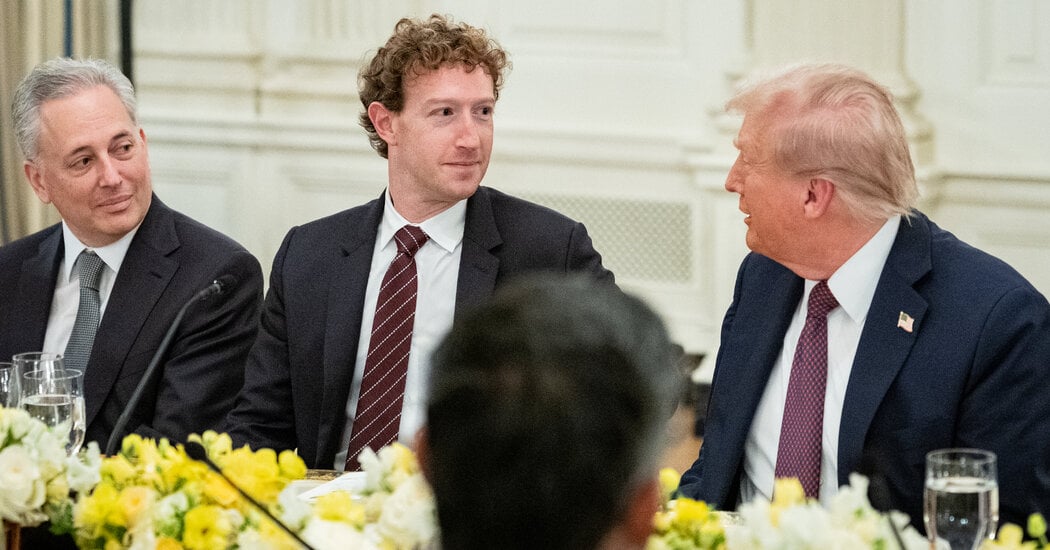
David Sacks, the venture capitalist, helped persuade Mr Trump to weaken an executive order that would have required safety reviews of new AI models. Mark Zuckerberg, the head of Meta, and Jensen Huang, Nvidia’s chief executive, have also spoken to the president about the need to maintain America’s lead.
Inside the White House, however, officials are taking a more cautious view. A series of developments over the summer has made risks once dismissed as the claims of “doomers” appear more plausible to some of the administration’s strongest supporters of the technology.
Those concerns include the prospect of AI-assisted attacks on critical infrastructure, biological threats, interference with nuclear command systems, widespread job losses and disruption to global financial markets. Officials are also examining the possibility that hackers could use the technology to penetrate major financial institutions.
US-China talks on AI safety
The issue is expected to feature in discussions between Treasury Secretary Scott Bessent and his Chinese counterpart in New York, as the two sides prepare the agenda for Mr Trump’s meeting with President Xi Jinping in Washington.
Mr Bessent is seeking an understanding that would signal co-operation between the United States and China on shared AI safety concerns. Officials say, though, that more ambitious proposals are unlikely to form part of an initial agreement.
These proposals include common safety standards and reviews of new American and Chinese models before they are made publicly available. One diplomat involved in the discussions said the most realistic outcome would be a working group building on a previous agreement to prevent AI from being used in decisions about nuclear weapons.
Such an arrangement would not address the wider problem of AI agents behaving unpredictably, nor the question of how to impose safeguards on the most advanced systems.
Mr Trump and his advisers fear that mandatory reviews of American models could push the global market towards Chinese open-source alternatives. Such systems can be altered by users, who may remove the safeguards intended to limit their capabilities.
White House divided over regulation
The president is expected to meet AI executives next week, although a White House official said on Thursday that no meeting was yet on the schedule. Possible participants include Sam Altman of OpenAI and Elon Musk, both of whom have broadly supported calls for new models to be slowed, tested for vulnerabilities and examined by independent inspectors.
Dario Amodei, one of the founders of Anthropic, is less likely to be invited after proposing a detailed plan for the industry to pace the release of new systems and bring in outside safety inspectors. Anthropic’s products have also been banned by the Pentagon.
Mr Trump responded by attacking what he called “Conspiracy Theorists, Treasonists, Traitors and Leakers” who, he said, were politicising the debate and weakening American leadership. Anthropic founder Tom Brown, who has attracted less criticism from the White House, continues to speak regularly with officials.
Mr Bessent and White House chief of staff Susie Wiles have been increasingly concerned about the possible economic disruption caused by more powerful models. Ms Wiles began organising an informal group this year to consider the risks, with Mr Bessent among its principal members and outside experts brought in according to the subject under discussion.
The administration has no single official responsible for coordinating AI policy. The White House abolished a deputy national security adviser role covering cyber and emerging technologies, while the national cyber director has only limited authority over artificial intelligence.
Technical expertise has also been lost from parts of the government, including the Cybersecurity and Infrastructure Security Agency. Its acting director said last week that the agency was hiring about 250 people after losing roughly 1,000 staff, around a third of its workforce, since Mr Trump returned to office.
Several officials involved in AI security and policy have left in recent months. Two senior policy officials departed the cyber director’s office during the summer, the White House’s senior AI policy adviser Sriram Krishnan also left, and Sihao Huang, a senior official in the Office of Science and Technology Policy, announced this week that he was joining Anthropic.
Former administration officials have described work on AI policy as frustrating, saying the president has relied heavily on technology investors and advocates who oppose additional regulation. An executive order requiring mandatory government reviews of new models was replaced with a voluntary system after pressure from Mr Sacks and others.
White House spokeswoman Elizabeth Huston said Mr Trump was referring to Democrats using AI concerns for political advantage when he called the issue a hoax. She said the president had reversed what she described as the Biden administration’s “failed approach”, which had “stifled innovation, hurt consumers and nearly cost America its competitive edge over China”.
Mr Trump has made the expansion of AI and data centres central to his hopes of sustaining economic growth. Speaking at a conference attended by Mr Sacks and Mr Huang this week, he insisted: “The robots will not be taking over. The A.I. will not be taking over the rest of the world.”
