


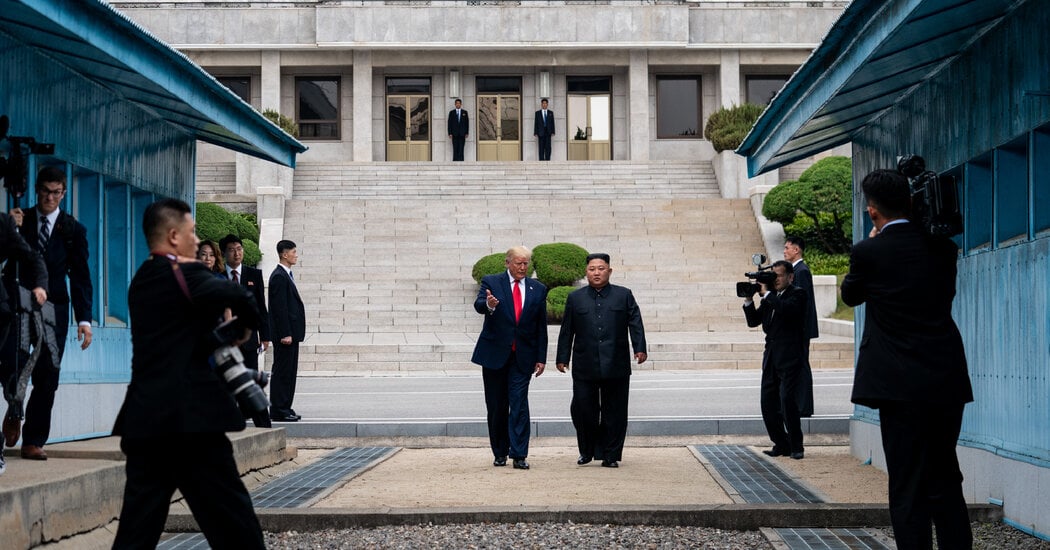
Plans for a possible Trump-Kim summit are taking shape, but North Korea has yet to respond to the American president’s renewed attempts to revive their personal diplomacy.
Donald Trump has repeatedly signalled that he wants to meet Kim Jong-un again, including by posting a photograph of the two leaders together in Singapore and saying they had a “very good relationship”. He also said he would meet the North Korean leader this year.
Mr Trump is expected to raise North Korea with Chinese president Xi Jinping during Mr Xi’s state visit to Washington next week. China is North Korea’s oldest and most important ally, and could potentially help arrange a meeting.
A Trump-Kim meeting could be linked to a possible visit by Mr Trump to an annual Asian economic summit in southern China in November, which Mr Xi is due to host.
Mr Xi is understood to be reluctant to see Washington and Pyongyang draw closer. However, helping broker a summit could give Beijing greater influence over the diplomacy and provide leverage in other disputes with the United States, according to a former Trump administration official.
For Mr Trump, renewed engagement with Kim would revive a relationship he has valued since his first term. It could also shift attention away from the unpopular and costly war involving the United States and Israel against Iran, according to current and former officials and analysts.
Although the two leaders failed to reach a nuclear agreement at their second summit, in Hanoi in 2019, Mr Trump has continued to speak warmly of Kim. He once said the pair had “fell in love” and showed visitors to the White House letters exchanged between them.
North Korea shows little sign of responding
Unlike during Mr Trump’s first administration, when the two men exchanged effusive letters, Kim has not answered the latest overtures. His sister and close aide, Kim Yo-jong, said last month that she knew of no communications between them.
She also dismissed the significance of any reduction in American and South Korean military exercises, saying it would not alter their “provocative and offensive nature”.
North Korea has continued testing ballistic missiles and expanding its nuclear weapons programme. Its ties with China and Russia have also strengthened, while its economy is described by analysts as stronger than it has been in many years.
Kim signed a mutual defence agreement with Russia two years after Vladimir Putin ordered the full-scale invasion of Ukraine. North Korean forces have been fighting alongside Russian troops against the Ukrainian military, and Mr Kim and Mr Putin have met in each other’s countries.
A senior aide to Mr Putin has said the Russian leader might join a group meeting with Mr Trump and Mr Xi in China in November, raising the possibility of a four-way summit if Mr Kim also attends.
North Korea’s Foreign Ministry has shown no sign of softening towards Washington despite Mr Trump’s decision to curtail military exercises with South Korea. An official statement said the United States had reaffirmed its “invariable hostile policy” towards North Korea and made clear that talks about denuclearisation would not succeed.
Robert Carlin, a former US intelligence analyst on North Korea, said Kim’s strategic outlook had undergone a fundamental change since the collapse of the Hanoi summit. He said the North Korean leader now saw himself as part of a global anti-imperialist movement and believed confrontation with the United States was inevitable.
Some analysts nevertheless argue that direct diplomacy remains worth pursuing after decades of sanctions failed to halt North Korea’s nuclear advances. Jung Pak, a former State Department official and CIA analyst, said “any morsel of a response at all is good” if it led to talks.
She criticised the way Mr Trump announced the reduction in US-South Korean exercises, saying the decision surprised Washington’s ally and made the relationship appear unequal.
