


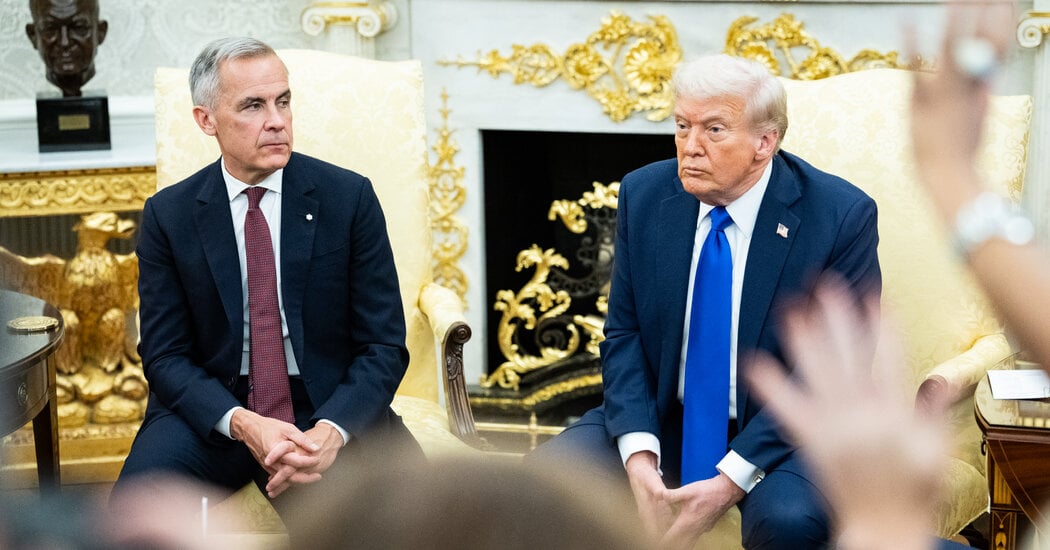
Canada has been invited to become an “associate member” of the European Union, in a move seen as a direct consequence of Donald Trump’s efforts to pressure and antagonise the country.
The proposal marks a striking shift in Canada’s relationships under Prime Minister Mark Carney, after Mr Trump spent months threatening tariffs, deriding Canada’s leadership and suggesting it should become the 51st US state.
Although the offer may prove more symbolic than substantive, it signals how the president’s approach to longstanding allies is reshaping international partnerships. Canada and the EU are due to hold a summit at the end of October, when they are expected to discuss more concrete arrangements.
James Batchik, deputy director at the Atlantic Council’s Europe Centre, said the initiative should be understood as “a direct consequence of Trump’s actions and rhetoric”.
“The rhetoric around making Canada the 51st state, and the threats against Greenland, which are still highly, highly, controversial and remembered in Brussels, are really reminders for both sides that the United States is not necessarily that trusted ally that it once was,” he said.
Mr Trump reacted angrily to the European overture during a conversation with reporters on Wednesday night. He warned that the US could impose severe tariffs on Europe or halt trade in a range of goods if he believed the move had been made with hostile intent.
“Canada’s been a terrible trade partner,” Mr Trump said. “No, I don’t see that. If they do that, if I think it’s at all a hostile act, I will put very serious tariffs or stop trading with Europe on many things.”
The president added: “If it’s a good intention, that’s fine — if it’s a bad intention we’ll put very heavy tariffs on Europe, which is a possibility.”
His trade war with Canada has hit major sectors including cars, steel, aluminium and timber. The dispute has also had political consequences, helping Mr Carney present himself as a defender of Canadian interests and contributing to a surge in support for the country’s Liberal Party, which went on to win an election.
Mr Carney has used the dispute to argue for a less US-centred international order. Speaking in Davos, Switzerland, he said: “The middle powers must act together because if we’re not at the table, we’re on the menu.”
Canada and the EU explore closer ties
The precise meaning of associate membership remains unclear. Liana Fix, a senior fellow for Europe at the Council on Foreign Relations, said it was not yet apparent what the arrangement would add to existing trade and defence agreements.
European Commission president Ursula von der Leyen has said Canada and Europe could work more closely on the Arctic, defence industries and critical minerals. Ms Fix said the EU wanted to demonstrate that middle powers had influence and would not be bullied by the Trump administration.
The Canadian initiative forms part of Mr Trump’s wider focus on the Western Hemisphere. He has applied heavy economic pressure to Cuba, proposed a “friendly takeover” of the country and threatened to seize the Panama Canal and take Greenland from Denmark.
He has described his approach as a “Trump Corollary” to the Monroe Doctrine, declaring that “the American people — not foreign nations nor globalist institutions — will always control their own destiny in our hemisphere”. Mr Trump also refers to the idea as the “Donroe Doctrine”.
Mr Batchik said the treatment of allies, alongside what he described as a softer approach towards countries including Russia and China, was encouraging governments across Europe to look for alternatives to Washington.
“It could end up being a generational turn away from the United States,” he said, “or at least will take a significant amount of energy and time to repair these relations.”
