


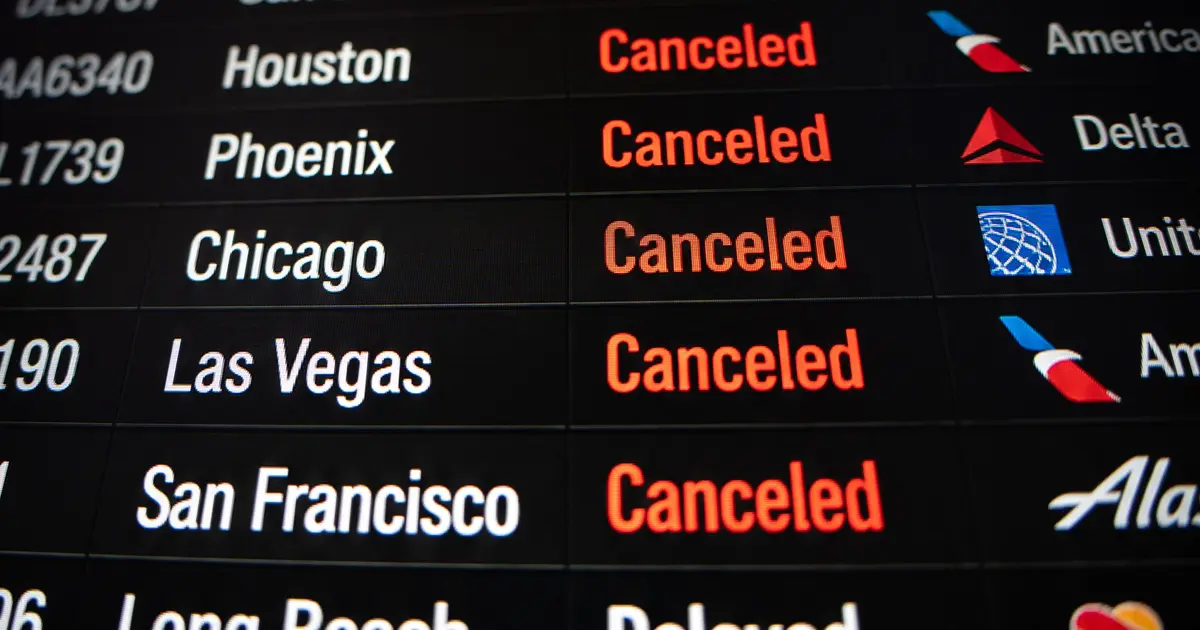
Airlines cancelled more than 6,000 flights across the United States on Saturday as they struggled to recover from a rare FAA nationwide ground stop triggered by failures in air traffic control communications and radar systems.
The Federal Aviation Administration lifted the order late on Friday after more than 3,500 aircraft were safely brought to the ground. Officials said the disruption was caused by instability in the telecommunications network used by air traffic controllers, rather than a cyber attack.
FAA administrator Bryan Bedford said the air travel schedule should return to normal by the end of Sunday, although passengers were warned to expect further delays and cancellations during the recovery.
What caused the FAA ground stop?
Transportation Secretary Sean Duffy said preliminary findings pointed to work by contractor L3Harris at a remote FAA facility, where ageing copper telecommunications lines were being replaced with fibre-optic connections.
A router involved in the upgrade began sending more than 1,000 connection attempts every four to five seconds to other routers across the air traffic control network, according to Mr Duffy. The resulting overload caused intermittent problems with communication between controllers and pilots, as well as disruption to some radar feeds.
Investigators were still determining whether the failure was caused by faulty equipment, an installation error or other contractor-related work. Mr Duffy said officials had found no evidence that the incident was linked to a cyber attack.
“Once we were able to isolate the work that was being done at this remote location, all of our systems came back online,” he said.
L3Harris said it was supporting the FAA’s investigation and took seriously the impact on travellers, airlines and air traffic operations. The company said more than 70% of the planned conversion from legacy copper lines to fibre had been completed.
The Professional Aviation Safety Specialists union, which represents FAA technicians, said the agency normally consults its own technical staff before carrying out upgrades or repairs to assess the risks. It said that had not happened in this case.
Thousands of flights disrupted
The nationwide ground stop was the first of its kind since January 2023 and the longest in the US for 25 years, according to the Associated Press. More than 9,000 flights were cancelled and about 7,000 delayed on Friday, with the disruption continuing into the weekend.
Airlines cancelled thousands more services on Saturday as aircraft and crews were left out of position. The FAA said more than 8,000 flight operations resumed after the ground stop was lifted on Friday night.
Mr Bedford said the “worst is behind us”, while warning that airlines would need time to clear the backlog. Officials said the system was expected to be operating normally in time for the Thanksgiving travel rush.
Mr Duffy praised air traffic controllers, pilots, airport staff and passengers for their response, saying the aircraft already in the air had landed safely using established emergency procedures.
He also renewed calls for Congress to provide more money to modernise the country’s ageing air traffic control system. The Department of Transportation said 69% of the FAA’s copper communications infrastructure had now been replaced with high-speed fibre using an initial $12.5bn in funding.
