


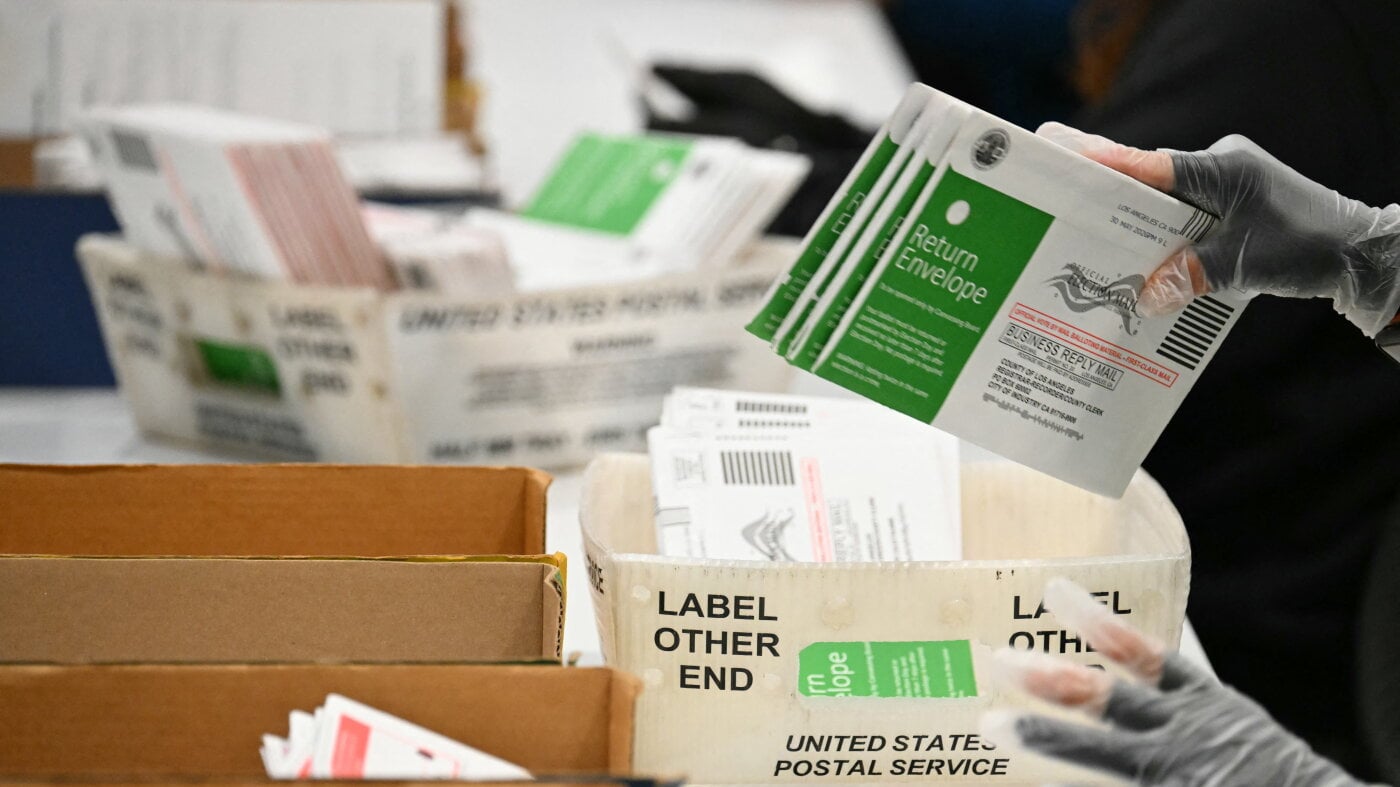
The US Supreme Court has rejected Donald Trump’s attempt to impose new mail-in voting requirements ahead of the 2026 midterm elections, leaving the US Postal Service expected to continue delivering ballots under existing arrangements.
The justices agreed to keep in place an injunction issued by a federal judge in Boston, finding that the Trump administration was unlikely to succeed in its legal challenge. Voting by mail has already begun in Alabama, North Carolina and Wisconsin, with other states due to follow.
The restrictions stemmed from an executive order directing the Postal Service to require states to provide lists of voters’ names and addresses, as well as specific barcodes on ballot envelopes, before the agency would deliver them.
The Boston judge had ruled earlier this month that the requirements were likely unlawful because the Postal Service did not have authority to control the way states administer mail-in voting. A second federal judge issued a further preliminary injunction late on Sunday.
Justice Brett Kavanaugh, a conservative member of the court, joined the decision while issuing a short concurring opinion. He said “there is at least a fair prospect that the final rule falls within the Postal Service’s statutory authority”, but added that applying it in the 2026 elections would be “arbitrary and capricious” under the Administrative Procedure Act because officials had insufficient time to implement it properly.
Several Republican state election officials, including officials from Utah, joined a Supreme Court brief warning that introducing the requirements at this stage “will almost certainly lead to mistakes, delays, and confusion for both voters and election officials”. Hawaii, Oregon and Washington are among the states where elections are held primarily or entirely by mail.
Justices Samuel Alito and Clarence Thomas dissented, saying they would have granted the administration’s request to suspend the Boston judge’s ruling.
Trump said he wanted the Postal Service to change its rules to prevent illegal voting by non-US citizens. However, studies and audits cited in the case indicate that such voting is extremely uncommon, and the administration’s lawyers presented the courts with no evidence of fraud involving mail voting.
Trump has repeatedly criticised mail-in voting, which was used by about one-third of voters in the last two federal elections. In 2024, 37% of Democrats reported voting by mail, compared with 24% of Republicans, according to a national survey by the MIT Election Data and Science Lab.
Last year, Trump said he would lead a movement to abolish mail-in ballots, claiming that “ELECTIONS CAN NEVER BE HONEST WITH MAIL IN BALLOTS/VOTING.” He voted by mail himself in Florida this year.
