


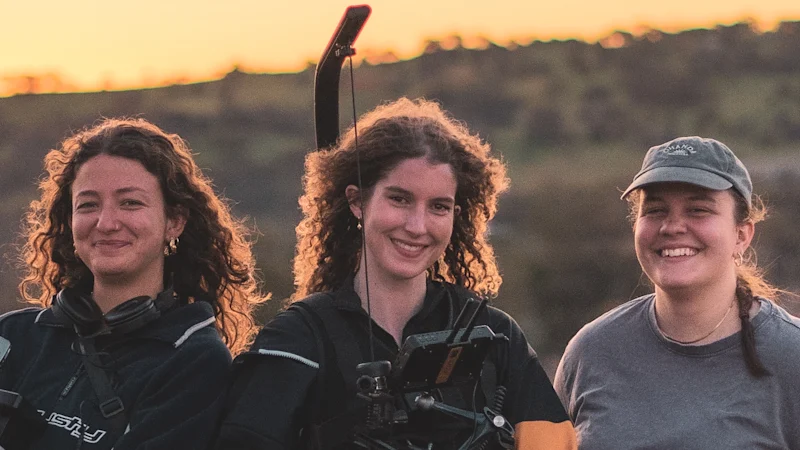
Western Australian residents have rallied behind filmmaker Emilie Lowe’s independently funded horror-western, donating everything from handmade cowboy hats and ageing cars to a collection of animal bones for her film, Dead Centre.
Lowe, a 26-year-old self-taught director and cinematographer, set out to make a contemporary neo-western in regional Western Australia. The film was shot in August and September by her Perth production company, Salt and Honey Productions, with support from volunteers, businesses and communities across the Wheatbelt.
Residents in Toodyay, York, Northam, Clackline, Beverley and Mundaring opened their homes and properties to the production. Local businesses also contributed locations, equipment, costumes, props and other materials.
Among those who responded was Anastasia Eastwick, who travelled for three hours with her mother, Juanica, from Nukarni, north of Merredin, to deliver a collection that included a horse, cow and kangaroo head.
Most of the bones had been sourced from the bush, roadkill or pests. Eastwick said she hoped her collection would play a part in the finished film.
“It’s just really exciting that my collection could be used. I want to be a taxidermist. I can’t wait to see the film,” she said.
Community support for Dead Centre
The Bullsbrook Hat Company and the Other Side Hat Company worked with Lowe to create hand-painted cowboy hats designed around the personalities of the film’s characters.
What began as costume design became part of the story, Lowe said. “Originally (the hats) were just going to be costume pieces, but they became so interesting they actually became plot points.”
She added: “It became something that was only going to be one or two characters, and now pretty much every character has their own unique little hat with different things on them.”
Horses were supplied by a Clackline-based trainer who also appeared in the film, while other locals provided old vehicles, clothing, jewellery and props. Most of the costumes were donated or made by hand.
Lowe said the Western Australian landscape offered the visual qualities she wanted for the project, with its distinctive light and expansive terrain providing a setting that could resemble the American west.
“It can look like you’re on a different planet almost sometimes. It looks like the wild west. The iconic lighting gave me that kind of gritty look that westerns have,” she said.
“I really like a naturalistic, raw and real aesthetic.”
The production also gave Lowe an opportunity to create roles for women in an industry she described as traditionally male-dominated. Almost 70 per cent of the crew were women, working in producing, editing and assistant director positions.
“It was really good having so many women on the set for something which is action-driven, fast-paced and had lots of stunt work,” Lowe said.
Filmmaker seeks post-production funding
Lowe began making films after deciding at 21, while studying writing at Edith Cowan University, that she would stop waiting for opportunities in the industry. She used her own money, together with donations from family and friends, to raise $10,000 for The Canary, a Western Australian film about female empowerment.
That production was made by four people, reached audiences overseas and was recently screened in France. Lowe’s work was also recognised earlier this year when she became the first Western Australian to receive the Australian Cinematographers Society’s John Leake OAM Emerging Cinematographer Award.
The award brought support from Sony and C.R. Kennedy, which loaned cameras and other filming equipment for Dead Centre.
With filming complete, Lowe is crowdfunding for post-production work, including visual effects, and hopes to release the film early next year.
“Everything is human-made, not AI,” she said. “All the creatures are real puppets that were created, and prosthetic effects were all made. That does cost money.”
