


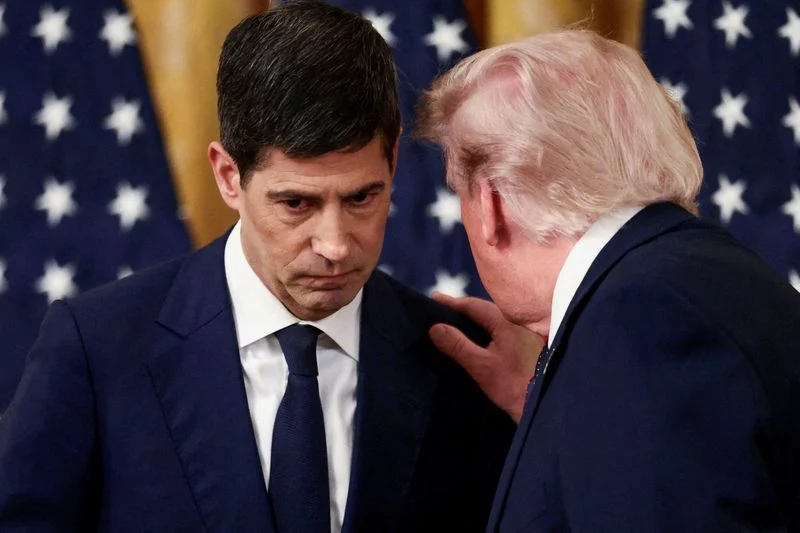
Kevin Warsh’s warning that the US Federal Reserve may need to raise interest rates has put President Donald Trump’s record on inflation under renewed scrutiny, with the central bank chief now facing pressure to match his tough words with action.
Warsh signalled at the Federal Reserve Bank of Kansas City’s Jackson Hole conference in Wyoming last Friday that borrowing costs could rise if inflation is not moving clearly and quickly towards the Fed’s 2% target.
A rate increase at the Fed’s September 15-16 meeting would be a powerful indication that price pressures remain too strong under the Trump administration. It would also risk intensifying the president’s long-running criticism of the central bank, which he has repeatedly urged to cut rates.
Investors are currently pricing in roughly a two-to-one chance of a quarter-point increase, after the prospect of tighter policy rose sharply following Warsh’s speech. The federal funds rate has remained in a range of 3.50% to 3.75% since December.
Federal Reserve faces test of independence
The decision will be closely watched as a test of Warsh’s credibility and the Federal Reserve’s independence from the White House. The chairman was appointed by Trump, who has argued that Warsh favours lower rates but is being obstructed by officials he describes as hostile and political.
Trump said on Monday that the US should have “the lowest interest rates anywhere in the world”, while adding that Warsh would “do what he has to” and retain his respect. The president has also linked lower borrowing costs to the burden of servicing America’s huge government debt.
Warsh’s own assessment of the economy was more cautious. In his Jackson Hole address, he said the Fed’s preferred personal consumption expenditures measure of inflation had risen 3.7% over the previous year and 4.1% over six months. The latest official figures from the Bureau of Economic Analysis showed core PCE inflation, excluding food and energy, at 3.3% in July.
The Fed chairman also said broad financial conditions did not appear restrictive, while describing the labour market as broadly consistent with full employment. The unemployment rate stood at 4.1% in July, according to the Bureau of Labor Statistics.
Policymakers will receive fresh employment figures on Friday, September 4, followed by the August consumer price index on September 11, before their next meeting. Those releases could determine whether Warsh can justify holding rates steady after warning that the central bank would have “work to do” if it lacked confidence that inflation was returning to target.
Some economists believe the Fed can afford to wait. Dana Peterson, chief economist at the Conference Board, said consumer demand was beginning to weaken, arguing that “the Fed can hold”. A later update to the PCE calculations is also expected to revise some inflation estimates lower.
But delaying a rate rise could create a different problem for Warsh. Analysts have warned that failing to follow through on his Jackson Hole message could make the chairman appear inconsistent, particularly after he criticised the use of forward guidance that binds policymakers to promises about future decisions.
Any increase in September or October would come just weeks before the November 3 congressional elections. Republicans are concerned that higher mortgage and borrowing costs would provide Democrats with another line of attack over the cost of living, while a decision to keep rates unchanged could fuel questions about whether political pressure had influenced the Fed.
The central bank insists that election dates do not determine monetary policy. For Trump, however, the approaching decision may offer a fresh and unwelcome measure of whether his administration has succeeded in bringing inflation under control.
