


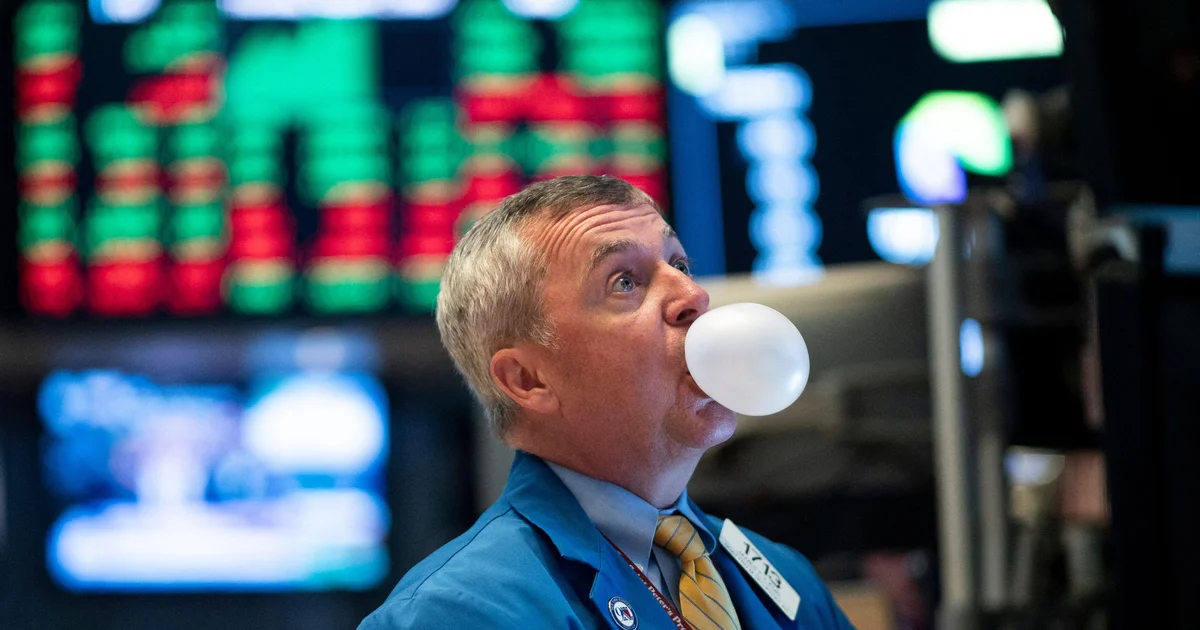
US economy growth accelerated to an annualised 4.3% in the third quarter, yet investors remain on edge as rising inflation, possible Federal Reserve rate rises and doubts over the artificial intelligence boom weigh on stock markets.
Leading indexes fell by more than 1,000 points during Wednesday morning trading before recovering much of the decline later in the day. The S&P 500 is now about 8% below its most recent high on 6 October, bringing it close to a correction of 10% or more.
The latest figures showed that the economy expanded faster than previously estimated. The upgrade from 3.4% reflected steady consumer spending and a surge in business investment, particularly by large technology companies building data centres and other infrastructure for AI.
Strong growth can support hiring, household spending and corporate earnings. But economists have warned that demand may now be outpacing supply, adding to price pressures in an economy where inflation is already elevated.
“In the simplest possible words, the economy is overheated, with demand exceeding supply. The consequence is a blowout of the trade deficit and inflation,” said Carl B Weinberg, chief economist at HFE.
Why inflation and interest rates are unsettling markets
Inflation, which earlier in the year was driven largely by higher energy costs, is now also being linked to heavy investment in AI. Austan Goolsbee, president of the Federal Reserve Bank of Chicago, said last week that spending running into trillions of dollars on data centres was contributing to “borderline disturbingly high” inflation.
Separate figures showed consumer prices rose 3.8% in October compared with a year earlier, up from 3.6% in September. The combination of firm economic growth and persistent inflation has strengthened expectations of a Federal Reserve interest-rate increase in December, with further rises possible in early 2027.
Higher rates would raise borrowing costs for technology companies seeking to expand their computing capacity. They would also increase the cost of credit cards, mortgages and other borrowing for households, potentially weakening consumer spending.
“Households face renewed inflation pressures, diminished saving capacity and higher borrowing costs, while elevated interest rates are raising the cost of investment and financing across the economy,” said Gregory Daco, chief economist at EY-Parthenon.
Investors are also questioning whether the vast sums being spent on AI will generate enough profit to justify the sector’s valuations. Anthropic, which recorded the largest initial stock offering in history last week, lost $104 billion in the first nine months of 2026 and plans to spend nearly $1 trillion on chips and AI infrastructure through 2045.
“But the critical thing AI may never be able to do is make profits high enough to justify its declining, but still stratospheric valuations,” said Laurence Kotlikoff, an economist at Boston University.
Some economists and investors expect further weakness in the near term. Anthony Saglimbene, chief market strategist at Ameriprise, said pessimism could quickly take control of market momentum, with falling share prices encouraging further selling.
Investors have been advised not to make abrupt decisions during a downturn, since selling can crystallise losses and mean missing any sharp recovery that follows. Despite the market turmoil, the strength of the wider economy is supporting expectations for corporate growth.
Doug Beath, global equity strategist at the Wells Fargo Investment Institute, said: “We expect solid economic and earnings growth in 2027 to support our year-end S&P 500 target of 8,700.”
