


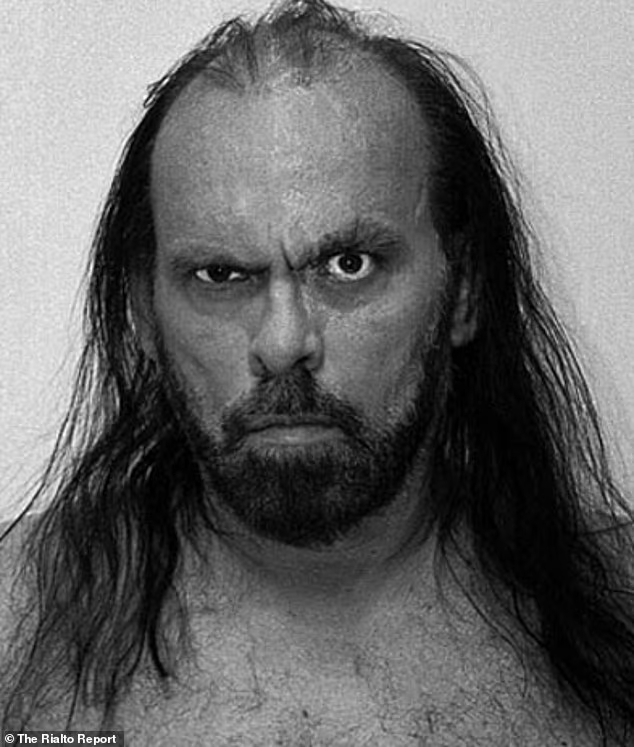
A Philadelphia woman has described how she escaped an attempted abduction by Raymond “RC” Horsch when she was nine, after learning that the man who approached her in 2009 was later linked to several missing women.
Ashley Rivera, now 26, said Horsch targeted her outside a 7-Eleven near her home in Kensington on a Friday night. She had been wearing pyjamas and was within sight of her stepfather, who was sitting on the front porch with crutches beside him.
As Rivera left the shop, she noticed an older man with long, greasy hair slowly circling the block in a green Jeep. She initially tried to ignore him but became aware that he was watching her.
Horsch then pulled over, lowered his window and told her to get into the vehicle, calling her “sexy”. When she moved away, he got out and seized her arm, dragging her towards the Jeep as she screamed for help.
Rivera said she still remembers his eyes. “He looked very evil,” she recalled.
Her stepfather heard the commotion and hobbled from the porch, striking the back window of the Jeep with one of his crutches. Horsch released Rivera and drove away.
Rivera ran home crying, while her mother, Sasha, called 911. She later said she chased Horsch’s vehicle with a baseball bat as it passed their block.
“I thought he was going to kill her. If he had taken her, I may never have found my daughter,” she said.
Police arrested Horsch and found binoculars, a digital camera, a telephoto lens, an eye patch and a condom inside the Jeep. When officers asked Rivera whether he was the man who had tried to lure her into the car, she replied that she “couldn’t forget that face”.
Raymond Horsch’s conviction was later overturned
Horsch was charged with luring a child into a motor vehicle and corrupting the morals of a minor. Rivera testified against him in January 2010, but became so distressed in court that her evidence had to be cut short.
“I was so scared, and he just kept staring at me. I just broke down crying,” she said. “I felt like I was looking at a killer.”
A judge convicted Horsch on both charges and sentenced him to between two and a half and five years in prison. The conviction would have required him to register as a sex offender under Megan’s Law.
Horsch requested a new trial, which would have meant Rivera giving evidence again. She begged her mother not to make her return to court, and the case was subsequently dropped when prosecutors did not have her testimony. The conviction was vacated and Horsch later had the case erased.
Prosecutor Jill Fertel described Rivera’s experience as “horrible”, saying the legal system at the time was not designed for children. The offence of luring a child under 13 was upgraded to a felony in 2013, while courts now more often allow children to give evidence on camera.
Investigations into Horsch’s Philadelphia home
Horsch’s home in Olney has been the subject of investigations since June, after police uncovered more than a million digital images and videos depicting women in various poses.
Investigators have said video evidence found on a hard drive led them to believe that Gabrielle Amarando, who disappeared in 2021 aged 22, and Maribel Fresses, who vanished in 2018 aged 27, are dead. Other footage reportedly showed Horsch strangling Nicole Fusaro, who disappeared in 2018 at the age of 27.
Horsch, who died in 2025 aged 82, has been linked to at least seven cases involving missing women. Rivera’s account is believed to be the first known instance of him being accused of targeting a child.
“I really do feel like I escaped something big,” Rivera said. “He could have kidnapped me. He could have done the same thing to me that he did to those women. He could have raped me, killed me.
“I was a nine-year-old girl. I was just a kid.”
Rivera said the incident has continued to affect her. She is frightened when men stare at her and worries about allowing her young son, now the same age she was at the time of the attack, to go out alone.
“I tried to get that memory out of my head,” she said. “But I can’t. It stays with me.”
