


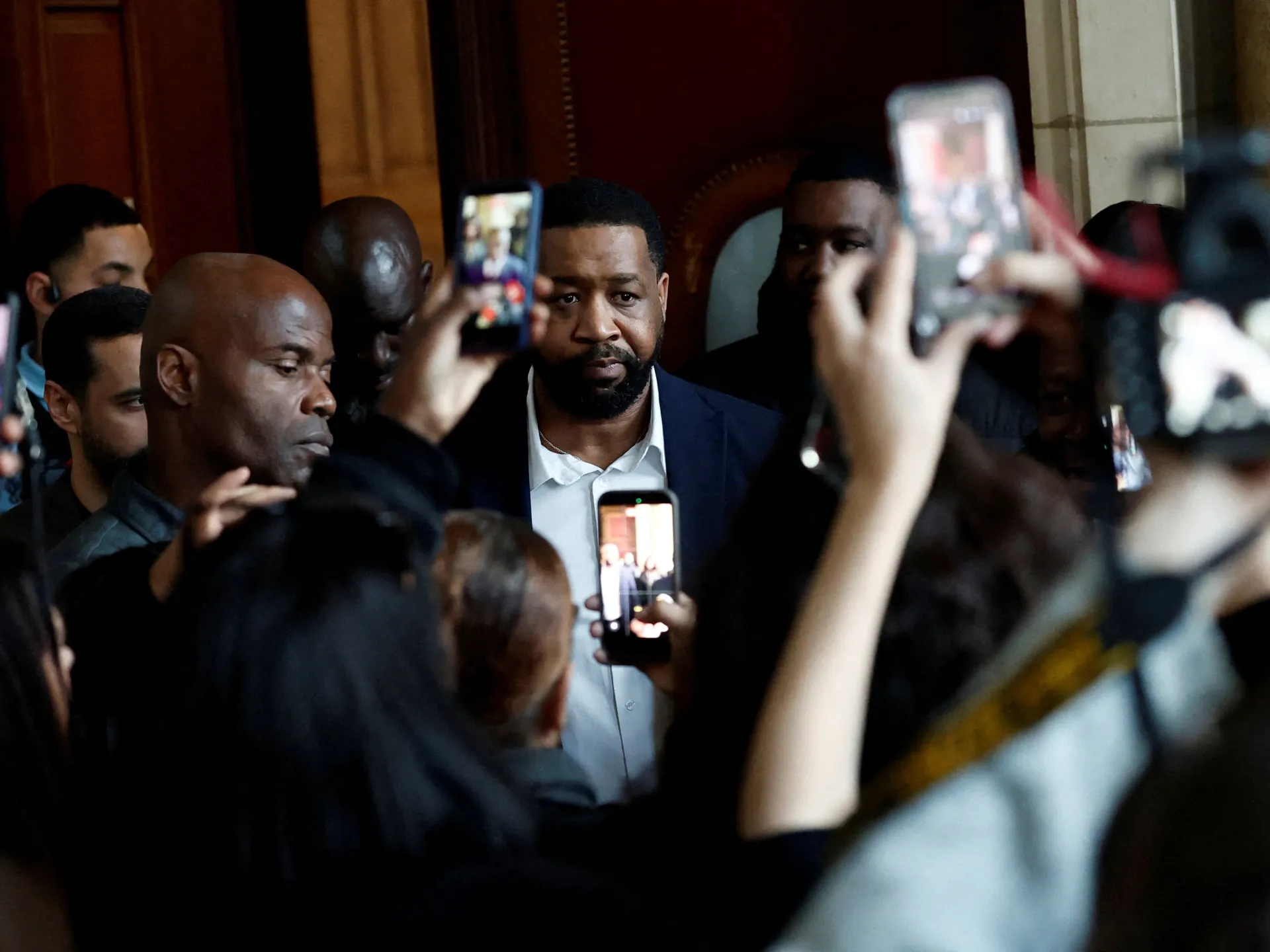
Three French police officers have been found guilty of racially motivated violence against Black music producer Michel Zecler during an assault in Paris in 2020.
The Paris criminal court sentenced each officer to five years in prison, with varying portions suspended, and barred all three from serving in the police force again. They were also convicted of falsifying an official report about the incident.
What happened to Michel Zecler?
Zecler, now 47, was stopped outside his music studio on November 21 2020 after officers accused him of failing to wear a compulsory face mask during France’s Covid-19 restrictions.
Security cameras showed the officers pushing him into the building and attacking him for about five minutes. Prosecutors said he was punched, kicked and struck with batons around 30 times.
Zecler suffered head trauma and a complete rupture of his biceps tendon. He also told the court that the officers repeatedly used a racist slur during the assault.
The footage contradicted the officers’ original account, which claimed that Zecler had attacked them. Their report did not mention that they had struck him.
Aurelien Lapersonne, who submitted the report, initially said Zecler had “struck out with his arms and legs”. When asked by the presiding judge whether he had invented that account, Lapersonne replied: “Absolutely.”
He later told the court: “I deliberately omitted them. I think out of fear. It was stupid of me.”
Sentences for the French police officers
Lapersonne, 29, received a five-year sentence with three years suspended. Philippe Tondeux, 50, received the same custodial term with three and a half years suspended.
Pierre Plantier, 37, had four years of his sentence suspended and will serve the remaining year under electronic monitoring rather than in prison.
All three officers admitted using excessive force and apologised to Zecler, but denied that the assault was racist. Tondeux said he regretted “the image I have given of the police”.
The judges said Zecler’s account of hearing one officer use the slur “sale negre” had remained consistent from the outset. They said the falsified police report had damaged the officers’ credibility.
Zecler’s lawyer described the sentences as falling short, while saying the case established an important precedent. “This precedent shows that even if a police officer lies, someone who comes forward to say the police did the worst to them can be believed,” the lawyer said.
Zecler said he was unlikely to have been recognised as a victim without the security footage recording the attack.
The wider debate over police brutality in France
The verdict has renewed scrutiny of police brutality and racial discrimination in France, where activists say such cases are rarely prosecuted despite alleging that the problem is systemic.
A 2025 report by France’s Defender of Rights found that young men perceived as Arab, Black or North African were four times more likely to be stopped under police stop-and-search powers than the overall population, and 12 times more likely to face measures such as being frisked.
The European Court of Human Rights also condemned France over identity checks it deemed discriminatory, following a case brought by six French citizens of African or North African origin.
French officials have acknowledged isolated cases of misconduct but have rejected claims of systemic racism in law enforcement. In 2023, Laurent Nunez, then prefect of the Paris police, said: “There is no racism in the police force.”
Critics say proposed legislation now being considered by the French Senate, which would provide additional protections for officers using firearms in the line of duty, could make accountability more difficult.
Legal scholar Rim-Sarah Alouane said the measure would create “a sense of impunity amongst police officers”, while activist Assa Traore has argued that acknowledging racism is necessary to save lives.
