


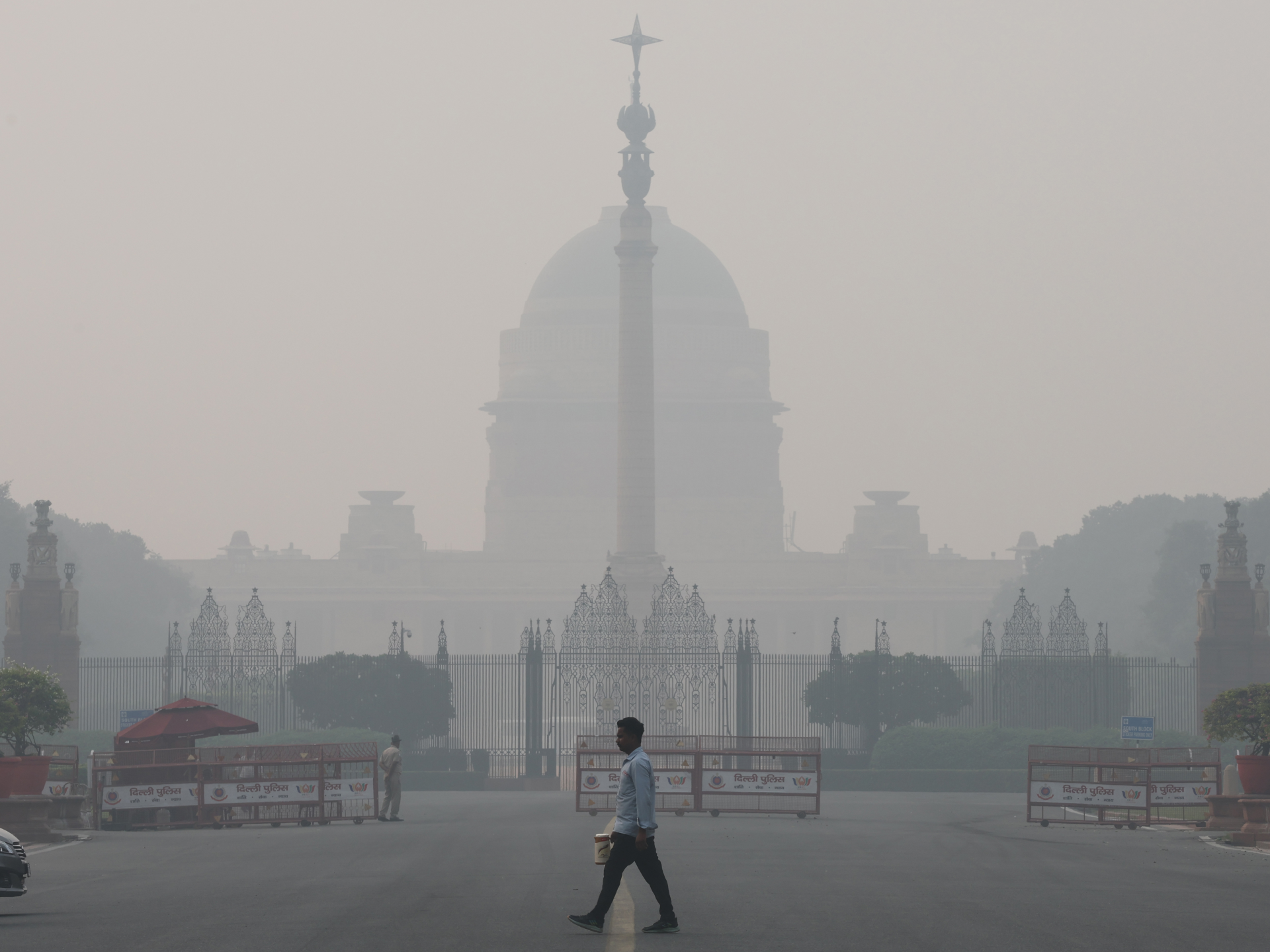
Winter smog in South Asia is returning as cities including New Delhi and Dhaka are covered by thick grey haze, with India’s capital recording Air Quality Index readings above 350 in several areas last week – a level classified as hazardous.
The seasonal pollution is driven by emissions from vehicles, industry and crop burning, which become trapped close to the ground when warmer air sits above cooler air. Weak winds further prevent the pollution from dispersing.
The problem is particularly severe across the Indo-Gangetic Plain, which stretches through parts of Pakistan, northern India, Nepal and Bangladesh. The Himalayas to the north, combined with a shallow layer of air during winter, can leave pollutants concentrated over the region.
What makes winter smog dangerous
Air quality monitoring stations measure six main pollutants, including ozone, nitrogen dioxide and particulate matter. The most harmful particles are known as PM2.5, which are 2.5 micrometres or less in diameter – about 30 times thinner than a human hair.
These particles can travel deep into the lungs and enter the bloodstream, potentially reaching organs including the heart and brain. Air pollution is linked to about seven million premature deaths worldwide each year, according to the World Health Organisation.
Exposure is most strongly associated with stroke, heart disease, chronic obstructive pulmonary disease, lung cancer and pneumonia. It can also worsen asthma, reduce lung function and has been linked to dementia and a higher risk of diabetes.
Children, older people, pregnant women and those with heart or lung conditions face the greatest risks. Exposure during pregnancy has been linked to premature birth and low birth weight.
Air pollution is also produced indoors. Smoke from cooking with fossil fuels has been linked to cataracts, while pollutants entering the body through the lungs can cause inflammation, damage cells and weaken the immune system.
How polluted is the air?
The US Air Quality Index runs from zero to 500. Readings from zero to 50 are classed as good, while 51 to 100 is considered moderate.
Levels between 101 and 150 are deemed unhealthy for sensitive groups, including children, older adults and people with heart or lung conditions. A reading of 151 to 200 is unhealthy for the general public, 201 to 300 is very unhealthy, and anything above 300 is hazardous.
All 50 of the world’s most polluted cities in 2025 were in Asia, according to IQAir, with 42 located in India and Pakistan. Loni, on the outskirts of Delhi in Uttar Pradesh, recorded average PM2.5 levels of 112.5 micrograms per cubic metre – more than 22 times the World Health Organisation’s recommended limit.
It was followed by Hotan in China, and Byrnihat and New Delhi in India. In Delhi, vehicles account for 23 per cent of winter pollution, while biomass burning, including farm stubble fires, contributes 20 per cent, according to India’s Ministry of Environment, Forest and Climate Change.
How to reduce exposure during smog season
People can reduce the amount of pollution they breathe by checking the AQI before going outside and limiting strenuous outdoor activity when levels are high.
On heavily polluted days, windows should be kept closed and indoor air can be filtered with a purifier fitted with a HEPA filter. A well-fitting N95 or similar mask offers protection outdoors, while cloth masks provide little defence against fine particles.
Extra care should be taken with children, older people and those with asthma or other heart and lung conditions.
Measures to cut air pollution
Governments have used a range of measures to reduce pollution, including car-free days, low-emission zones and restrictions on household fuel burning.
Paris recorded nitrogen dioxide reductions of up to 40 per cent in some areas during its first car-free day in September 2015. London’s Ultra Low Emission Zone was followed by a 19.6 per cent fall in nitrogen dioxide concentrations at roadside monitoring sites in central London within three months of its launch in 2019, according to a University of Birmingham study.
In Krakow, Poland, more than 25,000 coal and wood-burning heating devices were replaced before solid fuels were banned for home heating in September 2019. Average annual PM2.5 levels in the city fell by 40 per cent between 2010 and 2021, according to a 2025 study.
