


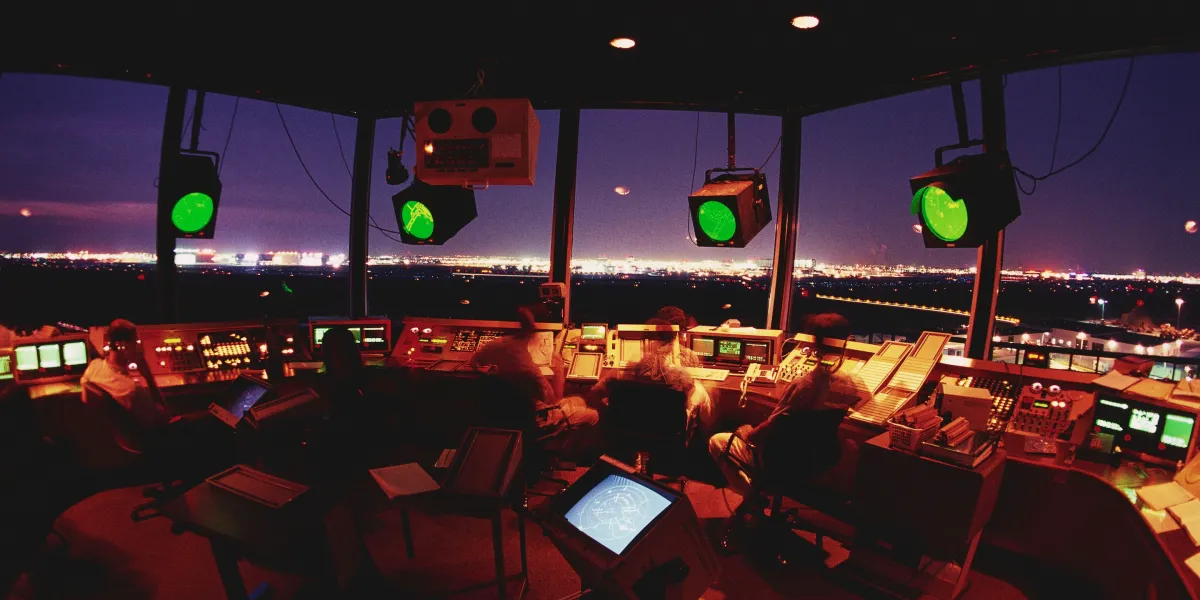
A global air traffic controller shortage is intensifying as countries compete for a limited pool of qualified staff, while the United States is prevented from recruiting overseas by rules requiring every Federal Aviation Administration controller to be an American citizen.
The number of air traffic controllers in the US is about 6% lower than it was a decade ago, despite a 10% rise in flights using the country’s air traffic control system, according to a January analysis by the Government Accountability Office.
Across the world, aviation training company CAE estimates that 71,000 new controllers will be needed by 2034 – an average of about 7,000 a year. Countries including Australia and Qatar are offering work visas and salaries linked to experience as they compete for trained personnel.
Why the US is struggling to rebuild its workforce
The FAA’s domestic recruitment pipeline has been disrupted by repeated interruptions to training. Government shutdowns in 2013 and 2018-19 halted hiring and instruction, while the Covid-19 pandemic stopped training for four months and then reduced capacity for almost two years.
High attrition between 2019 and 2024 further slowed efforts to rebuild staffing levels. By November 2025, the FAA said nearly half of major air traffic control facilities were short-staffed, with controllers working without pay during that year’s shutdown.
The role is among the most demanding in aviation. Tiffany Bisbey, an assistant professor of industrial and organisational psychology at George Washington University, said it was “one of the highest stress occupations out there”.
The Bureau of Labor Statistics says controllers must maintain maximum concentration at all times, with night, weekend and rotating shifts common.
Pay does not appear to be the main obstacle. The median US air traffic controller earned $148,080 a year, or $71.19 an hour, in May 2025, while the highest-paid 10% earned more than $215,610.
The FAA requires applicants to be US citizens under 31 and to pass pre-employment tests, a medical examination and a security investigation. Applicants must also have either a bachelor’s degree, one year of progressively responsible work experience, or a combination of the two.
The agency says fewer than 10% of applicants meet the requirements and enter training. The Government Accountability Office found that only about 2% of applicants ultimately qualify for and complete the full process.
A global contest for qualified controllers
Countries facing shortages are increasingly looking abroad. Airservices Australia appealed for experienced international controllers in September, offering a work visa with eligibility to transition to permanent residency and promising “the perfect balance between work and leisure”.
Australia’s need was highlighted that month when unplanned absences left eight of Sydney Airport’s 49 controllers unavailable. Roughly a third of inbound flights were delayed one morning.
Qatar has also recruited controllers from Airservices Australia, while Canada’s NAV CANADA used an outside firm to recruit eight foreign controllers. South Africa lost 28 controllers over eight months.
The country that trains a controller usually pays the full cost of that training, even if the employee later moves overseas, according to a spokesperson for industry group CANSO.
The shortage has prompted calls for technology to ease pressure on the system. Ed Bastian, Delta’s chief executive, said the biggest opportunity for artificial intelligence in aviation was in air traffic control rather than inside aircraft, because it could help deliver “quicker travel, more efficient travel”.
Training cannot easily be shortened
The FAA hired 2,235 controller trainees in the 2026 financial year, its highest number on record. Its 2026-28 workforce plan put the certified workforce at about 11,000 in April, against a target of 12,563.
That target was lowered by about 2,000 controllers in May, with the FAA citing forecast demand and changes to scheduling and training. The National Air Traffic Controllers Association said it had not been involved in drawing up the plan.
Ms Bisbey said fast-tracking applicants or compressing training would not provide a safe solution. “It’s such a high-risk organization, and the training is so arduous for a reason,” she said.
The FAA has tested limited alternatives, including a 2024 pilot scheme allowing graduates of two Oklahoma schools to bypass further academy training and move directly to facility training. However, certifying a controller still takes years, leaving airlines and passengers exposed to continued delays while the workforce catches up.
