


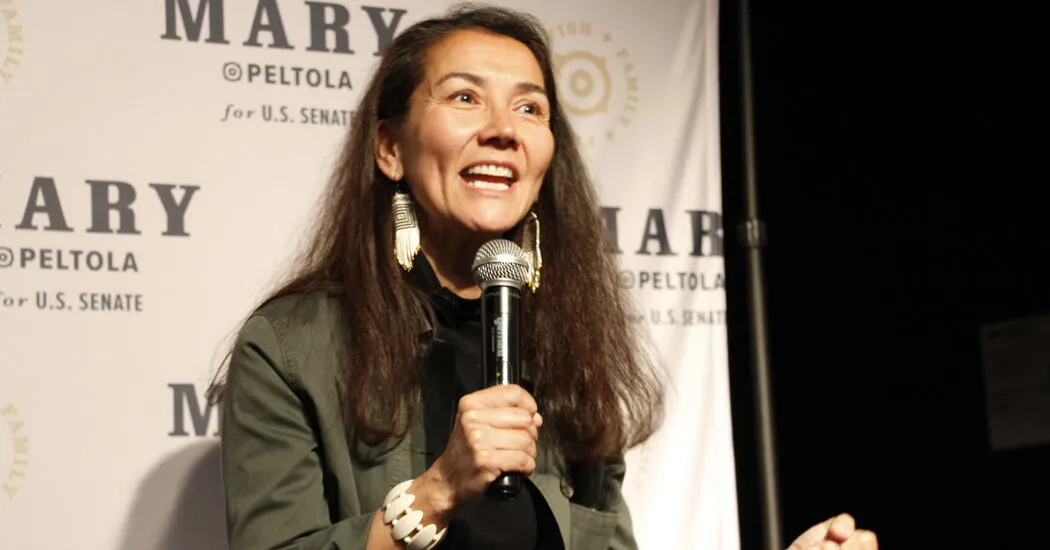
Revelations about former congresswoman Mary Peltola’s treatment of staff, including angry outbursts and the use of slurs, have drawn Republican criticism as she seeks a Senate seat in Alaska.
Republicans have argued that the reported conduct demonstrates her unfitness for office. It remains unclear, however, whether Alaskan voters will regard it as disqualifying in a state with a long tradition of electing politicians known for abrasive, confrontational or sometimes violent behaviour.
Alaska’s representatives in Washington have often cultivated a combative style while fighting for federal money and support for the remote state. Their approach has been linked to a frontier political culture in which independence and toughness can be valued as signs of authenticity.
“In Alaska, abrasiveness can sometimes read as political charisma, or sometimes even as authenticity, given that Alaska has a political culture that rewards independence,” said Alexander Hirsch, a political science professor at the University of Alaska Fairbanks.
“What sometimes reads like irreverence in Washington, D.C., can simultaneously signal to Alaskan voters something that’s really politically attractive,” he added.
Alaska’s combative political tradition
Ted Stevens, who represented Alaska in the Senate for 40 years, was a fierce advocate for the state and used his senior position on the Appropriations Committee to direct billions of dollars towards it, including funding for the Trans-Alaska Pipeline.
His temper was voted the hottest on Capitol Hill in a 2006 poll of congressional staff. During a difficult Senate debate, he wore an Incredible Hulk tie and in 1977 described himself as “a mean, miserable S.O.B.”
Stevens also grabbed a reporter by the lapels during a Capitol confrontation over environmental opposition to energy development. He became a strong supporter of gender equality in sport after his daughters were prevented from playing Little League baseball.
Don Young, who served in the House for 49 years, likewise built a reputation as a gruff defender of Alaska’s oil, mineral and logging industries. He used influential committee positions to secure funding for roads, bridges, pipelines and other projects.
Young’s public behaviour included waving an 18-inch walrus penile bone at a wildlife official during a House debate. He later used an ethnic slur for Latino migrant workers, forcefully grabbed a congressional staffer’s arm and shoved and swore at a reporter.
Former House speaker John Boehner also said Young had once pinned him against a Capitol wall and held a 10-inch knife to his throat. Young acknowledged at the time that the account was “mostly true”.
Despite those incidents and occasional allegations of questionable ethics, Young was elected to 25 consecutive terms. He won more than 70 per cent of the vote five times.
Frank Murkowski was less confrontational than Stevens or Young, but was still regarded as gruff and impatient while pursuing federal aid for Alaska. After leaving the Senate to become governor, he appointed his daughter, Lisa, to his former seat, prompting accusations of nepotism.
Lisa Murkowski went on to establish herself as an independent-minded senator, including by voting to convict Donald Trump at his 2021 impeachment trial. During a 2017 meeting in the Oval Office, she told him: “With all due respect, Mr. President, I didn’t come here to represent the Republican Party. I am representing my constituents and the state of Alaska.”
Against that background, the criticism of Peltola has raised questions about how Alaska’s political culture will shape the Senate contest, and whether voters will view allegations about her conduct differently from voters elsewhere.
