


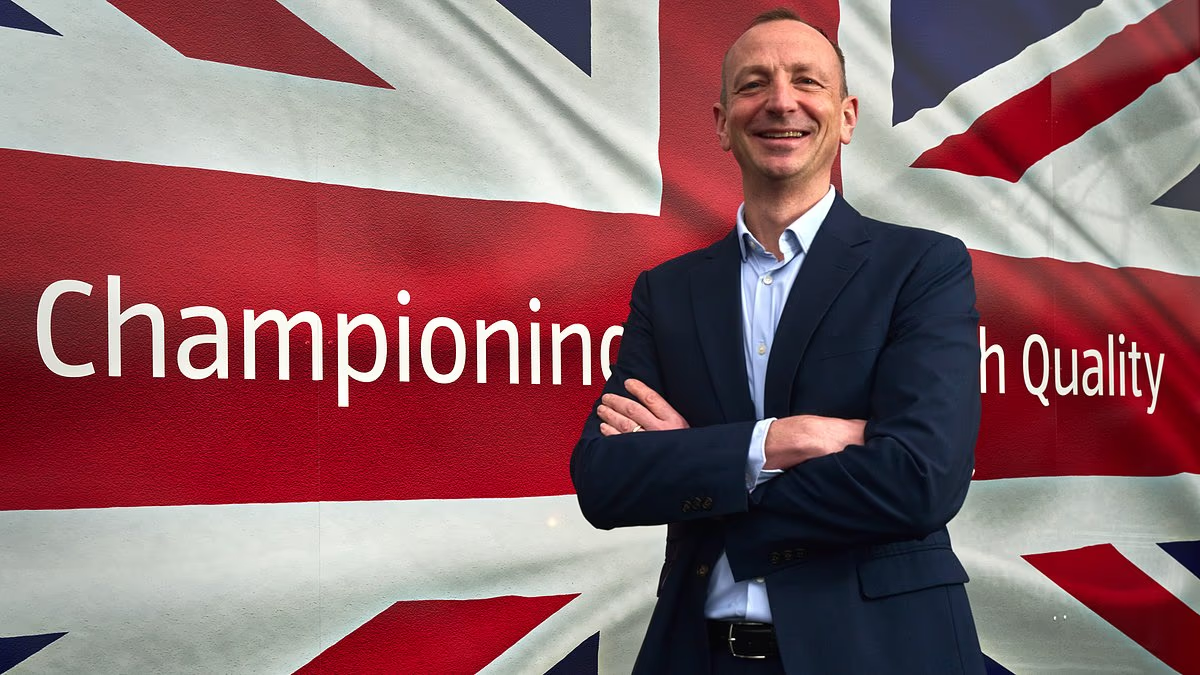
The UK boss of Aldi has taken a swipe at his rivals as he backed Andy Burnham to tackle ‘phoney bargains’ in supermarkets.
Giles Hurley threw his support behind the Prime Minister’s plan to crack down on what he called ‘invented reductions’ saying enforcement must be ‘rigorous and targeted’.
The grocery boss also took aim at supermarket loyalty schemes and apps, saying consumers should not be forced to pay more ‘simply because they do not have a smartphone.’
His remarks served as a thinly-veiled critique of some of Aldi’s biggest competitors, as grocers crank up an intense battle for shoppers during the cost of living crisis.
As part of an attack on what he called ‘rip-off Britain’, Burnham said last week that the Government would draw up plans to ban misleading prices that make discounts seem better than they are.
He said this would include fake prices that effectively have made-up discounts, as well as misleading ‘recommended’ retail prices.
Speaking out: Giles Hurley threw his support behind the Prime Minister’s plan to crack down on what he called ‘invented reductions’
Join the discussion
Should supermarkets make all discounts available to everyone, not just loyalty scheme members?
Writing for The Financial Mail on Sunday’s sister publication This is Money, Hurley backed Burnham’s efforts and said supermarkets should be doing all they can to make prices affordable for shoppers, arguing grocers should ‘start low, stay competitive and make the price available to everyone.’
He added: ‘Genuine promotions can help customers, and retailers that follow the rules should not be treated as wrongdoers. But reference prices must be meaningful, savings claims must be clear and action on deceptive practices must be swift.’
As Britain’s fourth-largest supermarket, Aldi is one of the only major grocers to not offer a loyalty membership scheme. These often involve shoppers having to download an app on their phone to access discounts.
By contrast, Tesco and Sainsbury’s have been growing their membership schemes over the past years. On many goods, they offer customers a lower price than those who aren’t members.
Aldi’s rival discounter Lidl also does this and lets members earn points for ‘rewards’.
‘A discount can be genuine, yet the final price can still be expensive.
A loyalty badge is not proof that shoppers are getting the best value,’ Hurley said, highlighting data from consumer website Which? that showed an average basket of household staples totalled £158.05 at Aldi while the same basket cost £187.86 at Sainsbury’s and £188.45 at Tesco even when loyalty discounts were included.
He asked: ‘After every card has been scanned and every promotion applied, is a customer actually getting a low price?’
He also argued that consumers should not be denied discounts for refusing to sign up to apps and loyalty programmes.
‘Nobody should pay more for an essential simply because they do not have a smartphone, cannot join a scheme or choose not to hand over their data,’ the Aldi boss said.
The criticism follows allegations grocers are using loyalty apps to harvest customer data, which can then be used to encourage them to spend more.
Some supermarkets are also accused of increasing standard prices for items, with the ‘loyalty price’ simply reducing their cost back down to market rates.
Other grocers pointed to a finding by the Competition and Markets Authority in 2024 that 92 per cent of loyalty-priced products offered a real reduction compared with their usual price.

Price issues: Some supermarkets are also accused of increasing standard prices for items
But Hurley called this only ‘part of the story’ as it compared supermarket discounts with their own prices and not the prices more widely.
Hurley’s broadside is the latest in an ongoing battle between the German discounters and their British rivals, with Aldi and Lidl rapidly expanding as they lure cost-conscious customers.
But their ascent was dealt a blow this month when the UK’s competition watchdog said it could include them in a ban on supermarkets blocking rivals opening nearby by buying up suitable land in those areas.
This threatens a loophole that has let Aldi and Lidl rapidly gain market share. Tesco and Sainsbury’s declined to comment.
DIY INVESTING PLATFORMS
AJ Bell
AJ Bell
Easy investing and ready-made portfolios

Hargreaves Lansdown
Hargreaves Lansdown
Free fund dealing and investment ideas

interactive investor
interactive investor
Flat-fee investing from £4.99 per month

Freetrade
Freetrade
Investing Isa now free on basic plan

Trading 212
Trading 212
Free share dealing and no account fee
Affiliate links: If you take out a product This is Money may earn a commission. These deals are chosen by our editorial team, as we think they are worth highlighting. This does not affect our editorial independence.
Compare the best investing account for you
