


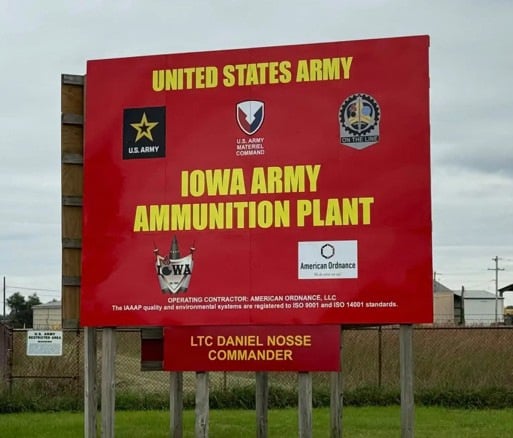
The US Army has cancelled a contract awarded to a Georgia company to neutralise unstable explosives at the Iowa Army Ammunition Plant, opting instead for a controlled detonation.
Dr Valentine Nzengung, a University of Georgia professor and founder of MuniRem Environmental, said his firm had secured the contract in March after briefing a multi-agency federal expert panel. Contracting officers withdrew the agreement in May, citing “an abundance of caution” and unspecified safety concerns.
“I’m not disputing that,” Dr Nzengung said. “We do what we do. The government does what it does.”
Army plans Iowa explosives detonation
The Army is preparing to destroy unstable lead azide held in two 80-year-old concrete storage magazines. Officials said the operation had been scheduled for Wednesday, following several delays as agencies reviewed safety measures and weather conditions.
Colonel Aaron Teller, who is leading the mitigation work, said crews had spent eight months preparing the site. Earthen barriers and temporary wooden doors have been installed to direct the blast towards three miles of uninhabited land and reduce the risk of lead particles entering the air.
Two walls of 16,000-gallon water tanks have also been positioned around the magazines. A cofferdam, tarpaulins, lead-containment screens and at least two feet of blast-suppressing foam developed by Sandia National Laboratories have been used around the bunkers.
“Our goal is to get to zero — zero release of lead particulate into the atmosphere,” Colonel Teller said.
Major General Gavin Shirley, commander of the Army Sustainment Command, said updated modelling indicated a substantial reduction in the expected dispersion compared with an unmitigated open-air release.
Colonel Teller said a 1977 disposal of 7,000lb of lead azide in Colorado had left 75% of the lead at the site. Officials expect the current barriers to capture most of the remainder.
Firm seeks safety data behind cancelled contract
Dr Nzengung said federal officials had declined to provide the scientific data behind the decision to reject his company’s method. His company’s lawyer has filed a Freedom of Information Act request for the government’s risk assessments, but it has not yet received a response.
“We want to see data details,” Dr Nzengung said. “We want to see data in order to understand.”
MuniRem was developed at the University of Georgia and patented by the University of Georgia Research Foundation. Its solid chemical reagent powder is dissolved in water and applied to explosives inside containment drums, where it is intended to neutralise and destroy the material without an explosion.
The process leaves wastewater and sludge, which are tested at laboratories accredited by the Environmental Protection Agency. Dr Nzengung said the technology had been used to neutralise unstable military-grade explosives in the US, Europe and the Middle East.
He said he did not have enough information to judge whether the Army’s planned detonation was the right course of action.
“I’m assuming that the U.S. Army and the U.S. government has enough data to be able to move forward in a way that is protective of human beings, is protective for the environment, and is the best possible option forward,” he said.
Monitoring planned after blast
EPA official Tom Croci said the agency would publish real-time field data and laboratory samples from the operation. Air monitoring will continue “for as long as it takes” to confirm that lead levels are safe.
Army Surgeon General Lieutenant General Mary Izaguirre said lead toxicity typically results from prolonged exposure over months or years. Her team is working with the EPA and the Iowa Poison Control Center to track air quality after the detonation.
The acting secretary of the Army has also ordered inspections of every weapons storage facility in the Army’s inventory. Officials said the Iowa plant became the military’s sole consolidation site for lead azide stockpiles after a 2009 base realignment.
The acting secretary said the delays, which moved the operation from Friday to Monday and then Wednesday, reflected the need to reach agreement between agencies and verify weather forecasts.
“We understand your concern, and we understand your frustration,” he said. “We have clarity now, and what matters now is the next 24 hours and getting this operation right.”
