


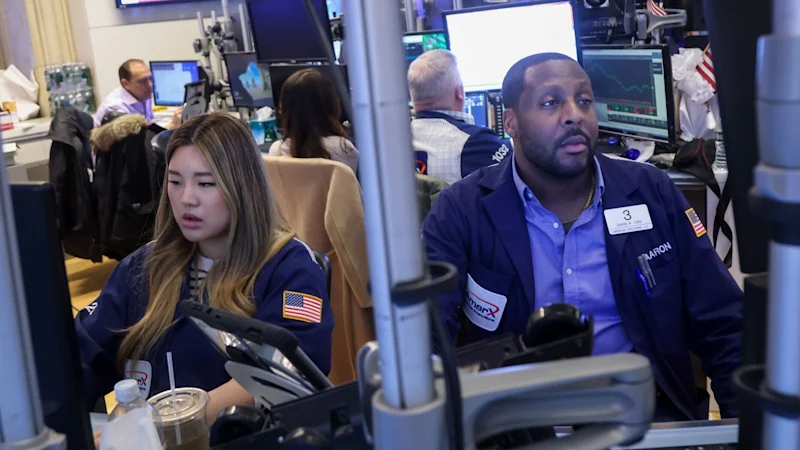
AI stocks dragged Wall Street lower on Wednesday as the sector’s sharp rebound quickly unravelled, despite gains across much of the wider market. Nvidia fell heavily, while shares linked to artificial-intelligence infrastructure and services also declined.
The S&P 500 was down 0.3% in early afternoon trading and was on course for its eighth fall in nine sessions. The technology-heavy Nasdaq Composite dropped 1.3%, while the Dow Jones Industrial Average rose 441 points, or 0.9%.
Australia’s ASX was expected to open slightly lower, with futures pointing to a fall of six points, or 0.1%. The index had gained 1.8% on Tuesday, while the Australian dollar was trading at US66.44 cents.
Nvidia shares dropped 7.1%, reversing much of the previous session’s surge of 31.5% — their biggest one-day gain in more than two decades. CoreWeave, which buys Nvidia chips and rents access to them through the cloud, fell 11.6%, while GE Vernova, which helps supply power to data centres, lost 4.6%.
Anthropic, the company behind the Claude chatbot, fell 7.4% to below US$83. That was the price at which its shares were first sold in last week’s initial public offering, after briefly reaching US$115 on their first day of trading.
Investors question the scale of AI investment
The declines have revived concerns that valuations across the artificial-intelligence industry may have risen too far and could weigh on the broader market. AI companies have become some of Wall Street’s most influential stocks, increasing the potential impact on investors and retirement accounts.
Investors are also questioning whether the profits and productivity generated by AI will be sufficient to justify the vast sums being committed to data centres. Higher interest rates are making it more expensive to fund the sector’s expansion, while recent Democratic victories in US midterm elections have prompted concerns about tighter regulation, including possible restrictions on further data-centre construction.
The pressure on technology shares came despite signs of improving economic confidence. Consumer confidence in the US increased by more than economists had expected, with the Conference Board reporting a particularly sharp rise among Democrats and independents after the midterm elections.
Several retailers also reported stronger-than-expected results. Dollar Tree climbed 12.5% after beating earnings forecasts, while Kohl’s rose 18.9% after recording a quarterly profit when analysts had expected little or none.
Companies in the S&P 500 are on course to report earnings-per-share growth of more than 25% for a third consecutive quarter, according to FactSet. However, the latest market moves show how quickly investor sentiment can overwhelm otherwise positive corporate and economic news.
The yield on the 10-year US Treasury note slipped to 4.91% from 4.92%, as investors moved towards assets viewed as safer. Brent crude rose 1.7% to US$88.14 a barrel.
Share markets were mixed elsewhere. South Korea’s Kospi rose 6.3% and Japan’s Nikkei 225 gained 3.9%, recovering the previous day’s Wall Street-driven move after their markets had been closed.
