


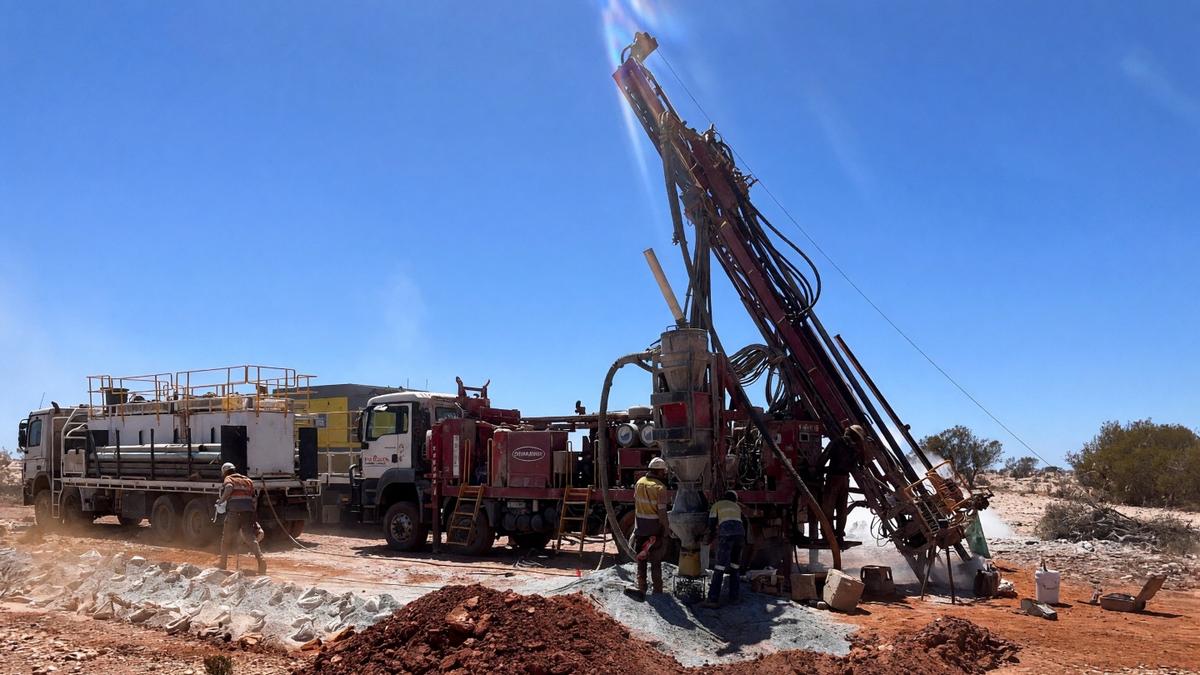
Augustus Minerals has identified two higher-grade gold shoots at its Music Well project near Leonora in Western Australia, with both zones remaining open to the north-north-east and along strike.
The interpretation at the Clifton East prospect combines recent diamond and reverse circulation drilling with assay results and surface soil sampling. Augustus said the western shoot is supported by soil geochemistry extending across more than 400 metres, while the eastern zone is traced by pathfinder elements over about 300 metres.
Earlier reverse circulation drilling produced several significant intersections within the broader system, including 11 metres at 2.41 grams per tonne of gold from 32 metres, 8 metres at 3.27 grams per tonne from 72 metres and 34 metres at 0.83 grams per tonne from 38 metres.
Soil readings for tellurium, bismuth, molybdenum and tungsten have helped the company establish the direction of the mineralised structures and connect the separate drilling results.
A recent diamond hole returned lower-grade gold anomalism, including 6 metres at 0.31 grams per tonne from 79 metres, 5 metres at 0.43 grams per tonne from 106 metres and 12 metres at 0.22 grams per tonne from 117 metres.
However, Augustus said the core showed alteration changing from hematite to silica-sericite-pyrite-carbonate, becoming stronger near the gold-bearing part of the system. The company believes the hole may have passed along the edge of a larger mineralised zone.
Structural measurements from the core indicate that the higher-grade quartz-pyrite veins dip steeply to the south-east. Augustus has used that information to design a series of north-west-oriented reverse circulation holes aimed at testing for denser veining between the original drill holes.
Assays from that programme are expected in the middle to latter part of October. Further drilling is planned once wet ground conditions improve.
Third gold target identified at Clifton East
Alongside the two defined shoots, Augustus is assessing a separate 200-metre zone marked by anomalous rock-chip and soil pathfinder results. Rock chips from the area graded up to 1.8 grams per tonne of gold, with the anomaly coinciding with a major fault in the eastern part of Clifton East.
The third target has not yet been tested by drilling. The company’s Music Well project covers 1,242 square kilometres of exploration tenure about 35 kilometres north of Leonora, within the Leonora-Laverton gold district.
Augustus’ ground adjoins tenements held by Northern Star Resources and Genesis Minerals, near the Darlot, King of the Hills and Thunderbox gold projects. The district has a total reported endowment of more than 28 million ounces.
The latest exploration results come as gold companies consolidate positions across the Leonora-Laverton region. Genesis merged with Vault in a deal valued at $12.6 billion in July, while Brightstar Resources acquired five exploration licences from Panther Metals in September next to its developing Laverton processing hub.
Genesis has also expanded its regional pipeline through the acquisition of Focus Minerals’ Laverton project, a $639 million purchase of Magnetic Resources for exposure to the 2.24-million-ounce Lady Julie deposit, and its $600 million acquisition of St Barbara’s Leonora assets, including the Gwalia mine and mill, in 2023.
For Augustus, the next results from its targeted drilling programme will determine whether the newly interpreted structures contain the denser, higher-grade veining suggested by the geological model.
