


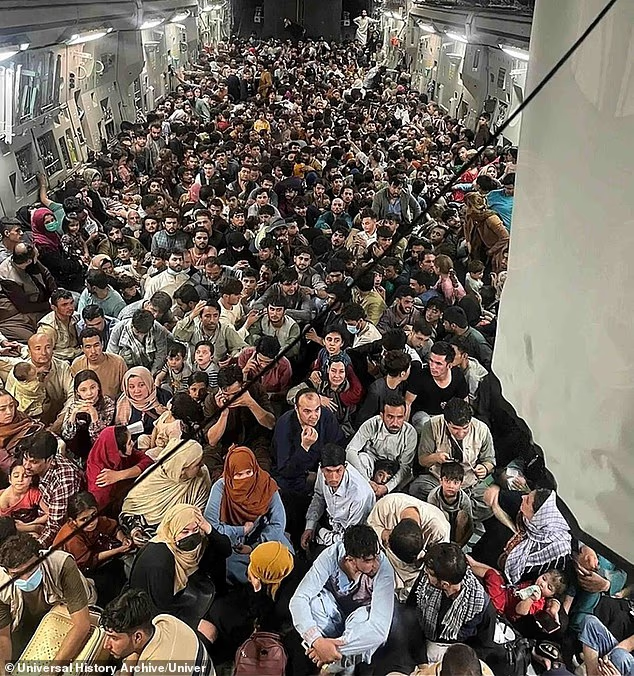
A US watchdog has identified serious failures in the vetting of Afghan refugees who sought asylum after the chaotic American withdrawal from Afghanistan in 2021, including two cases involving potential terrorism-related concerns.
A review of 678 randomly selected asylum files found errors in 40 per cent of them, according to a report by the Inspector General for the Department of Homeland Security.
The audit found that asylum officers had failed to record aliases in a quarter of the files examined. In total, 303 aliases were missed, while 23 files lacked security checks, 45 contained unresolved records and 115 had other documentation problems.
The report said most errors involved missed aliases or incomplete paperwork, but added that two cases related to potential inadmissibility on terrorism-related grounds had also been identified.
Some mistakes involved officers failing to recognise spelling variations in names or failing to reprint and add documents to an asylum file. The watchdog said such errors created “missed opportunities” to connect applicants with potentially adverse information.
It warned that some of the failures could undermine the integrity of asylum records used by US Citizenship and Immigration Services for future immigration administration and enforcement.
Review covered Afghan asylum files
The investigation followed complaints about a 2023 class-action settlement that accelerated asylum decisions for about 20,000 Afghan evacuees. The agreement required 90 per cent of cases to be decided within 150 days, prompting concerns among USCIS employees that supervisory checks could be weakened.
However, the Inspector General found no evidence that the settlement had made the problems worse.
The 678 files were selected from 13,682 applications submitted by Afghans resettled under Operation Allies Welcome, a programme launched by the Biden administration after the US military withdrawal. The wider evacuation effort involved about 97,000 people.
The report also noted the difficulty of conducting checks involving common names. A search for a name such as Mohammad can produce more than 1,000 potential matches, while one file examined contained 124 aliases.
USCIS had flagged at least eight files in which social media information was described as “derogatory” or “of interest”, but did not pursue the matter further. The agency told investigators that ambiguous guidance had contributed to the problem.
USCIS officers “may be unable to entirely avoid missed aliases”, the report said, citing tight deadlines and the complexity of the cases.
Senator Charles Grassley, the Republican chairman of the Senate Judiciary Committee, criticised what he described as the Biden administration’s “failure to properly vet Afghan refugees”. He also pointed to the “improper classification of security risk data with respect to evacuees”.
Republicans have cited the 2024 arrest of 27-year-old Afghan refugee Nasir Ahmad Tawhedi in Oklahoma, who was accused of plotting an Election Day terrorist attack, as well as the 2025 shooting of two National Guard troops near the White House, one of whom died. Rahmanullah Lakanwal, an Afghan national who had worked for the CIA, was identified as the suspect in that case.
In 2021, then-DHS secretary Alejandro Mayorkas defended Operation Allies Welcome, saying the government had “established a robust screening and vetting architecture”. A separate Inspector General report issued in 2024 criticised what it called a fragmented process for identifying and resolving adverse information about people admitted under the programme.
The latest report made five recommendations, all of which USCIS agreed to accept. They include establishing a benchmark error rate, improving the identification and recording of aliases, ensuring security checks are completed before cases are closed, and documenting how officers respond to information found on social media.
