


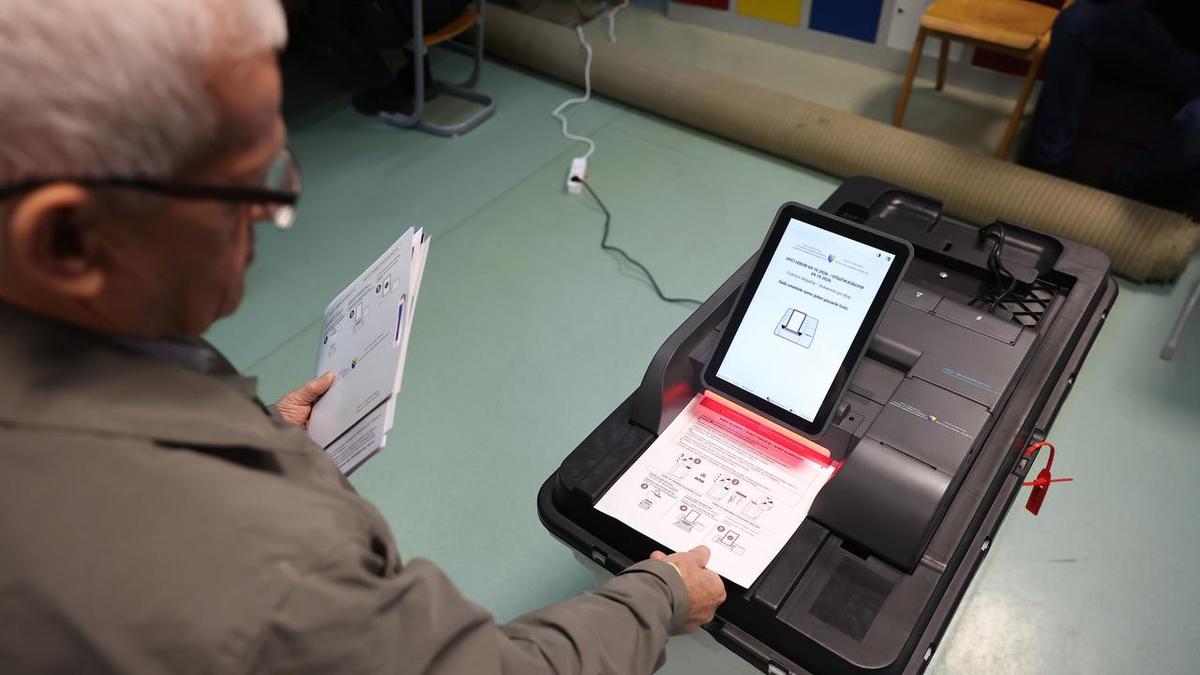
Voting has opened in Bosnia for a general election dominated by the influence of pro-Russian politician Milorad Dodik, whose separatist views have heightened concern over divisions in the multi-ethnic Balkan state.
About 3.4 million voters are choosing the three members of Bosnia’s collective presidency, national parliament lawmakers and leaders of the country’s two entities: the Federation of Bosnia and Herzegovina and Republika Srpska.
The complicated political system was established under the US-brokered peace agreement that brought the 1992-95 war to an end.
Dodik looms over Bosnia’s general election
Dodik, the former president of the Serb-majority Republika Srpska, is not standing after being barred from public office following his conviction for defying decisions by the international envoy overseeing the peace agreement.
He remains central to the campaign, however. His Alliance of Independent Social Democrats is expected to retain power in Republika Srpska, after Dodik returned from Moscow, where he met Russian President Vladimir Putin.
At the party’s final rally in Banja Luka, the entity’s administrative capital, Dodik told supporters that Bosnia “is dead”.
“It is an impossible country. It doesn’t make any sense,” he said. The rally was also attended by Russia’s ambassador to Bosnia and Herzegovina, Igor Khalabukov.
Bosnia has remained peaceful in recent years, but political leaders have continued to draw on divisions between Bosniaks, who are mainly Muslim, and Serbs and Croats.
Bosnian Serb leaders including Dodik have advocated separation from the rest of the country, prompting concern in western countries that tensions could again become unstable.
The country is among the poorest in Europe and continues to struggle with the legacy of the war, which followed Bosnia’s declaration of independence from the Serb-led former Yugoslavia. More than 100,000 people were killed and millions displaced during the conflict.
Many voters say nationalist rhetoric is distracting politicians from problems including low living standards and the departure of young people.
Durak Miler, a resident of Sarajevo, said governing politicians “just poison people when they talk”.
“We should change the old faces,” he said. “They have been governing for 35 years … I think whoever comes next will work better for retired people and the poor.”
For the first time, authorities are using electronic voter identification and ballot scanning, in an effort to prevent irregularities and organised manipulation that have raised doubts about previous elections.
Ivan Silic, from Mostar in the south, said he had seen no improvement since he began voting. “We all know who lives well,” he said. “It is better for (politicians), and for the rest of us everything is the same.”
